BLIMA CHAYA SIDE · SHAPIRO FAMILY

Shapiro-Teller Family

Browse family history
Shapiro family / Questions
Temporary, separate from the family history

Saved questions

Questions are saved here with the sources they refer to. Answer when convenient. Answers are saved separately and do not change the family history automatically. This temporary section can be removed once the questions are settled.

Q-1827-NAME

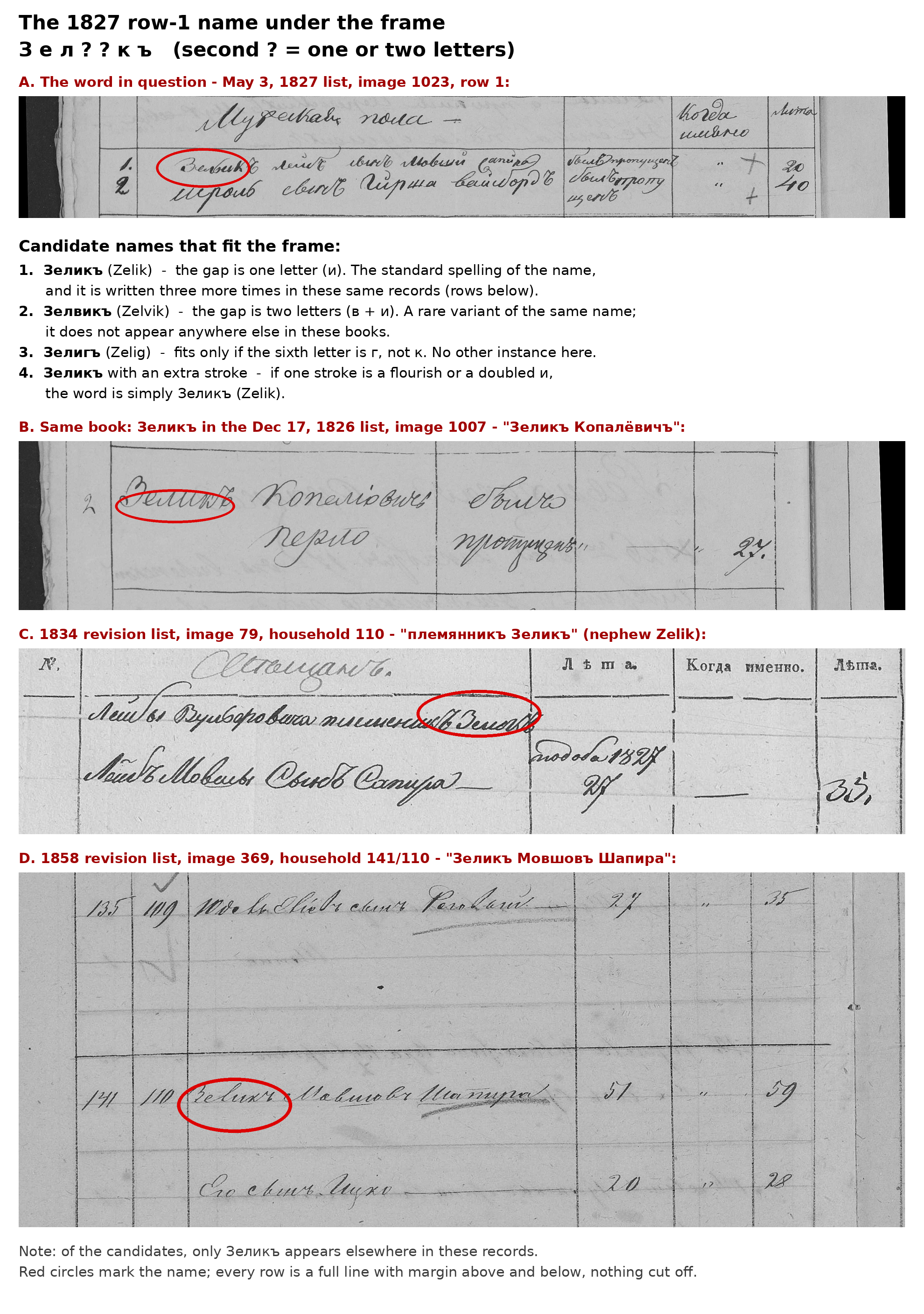
The first name in the 1827 row

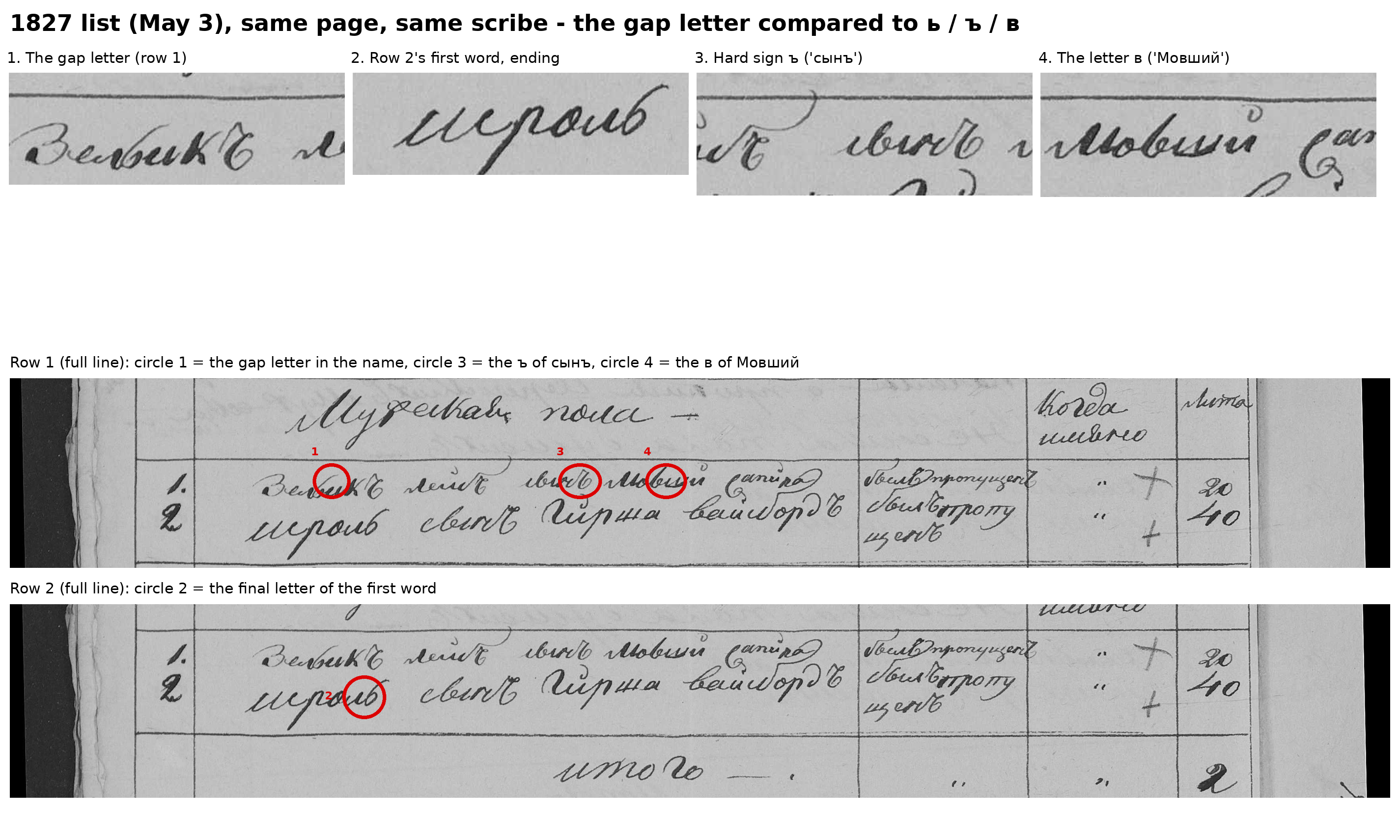
What is the exact spelling of the first name in the 1827 row, particularly the b-shaped letter between л and и?

Зельикъ (Zelʹik) (reading by BBB)

  1. A. Зельикъ (Zelʹik), with a soft sign ь before и - the reading above
  2. B. Зелвикъ (Zelvik), if the loop is в
  3. C. Зеликъ (Zelik), with the extra stroke unexplained
  4. D. Another reading or undecidable

Also listed for a native Russian speaker to look at.

Evidence

The b-shaped gap letter is read as the soft sign ь, matching the final ь of Сроль directly below. This gives Зельикъ, a spelling of Zelik with a softened л. The same hand also makes в as a tall unticked loop. Other records spell the name Зеликъ.

Same-scribe comparison: gap letter, Сроль soft sign, сынъ hard sign, and в
Same-scribe letter comparison · Open full size
Marked 1827 row and three comparison entries
Marked 1827 row and three comparison entries · Open full size
Write your reading
Q-1816-WIFE

The wife's name in household 13

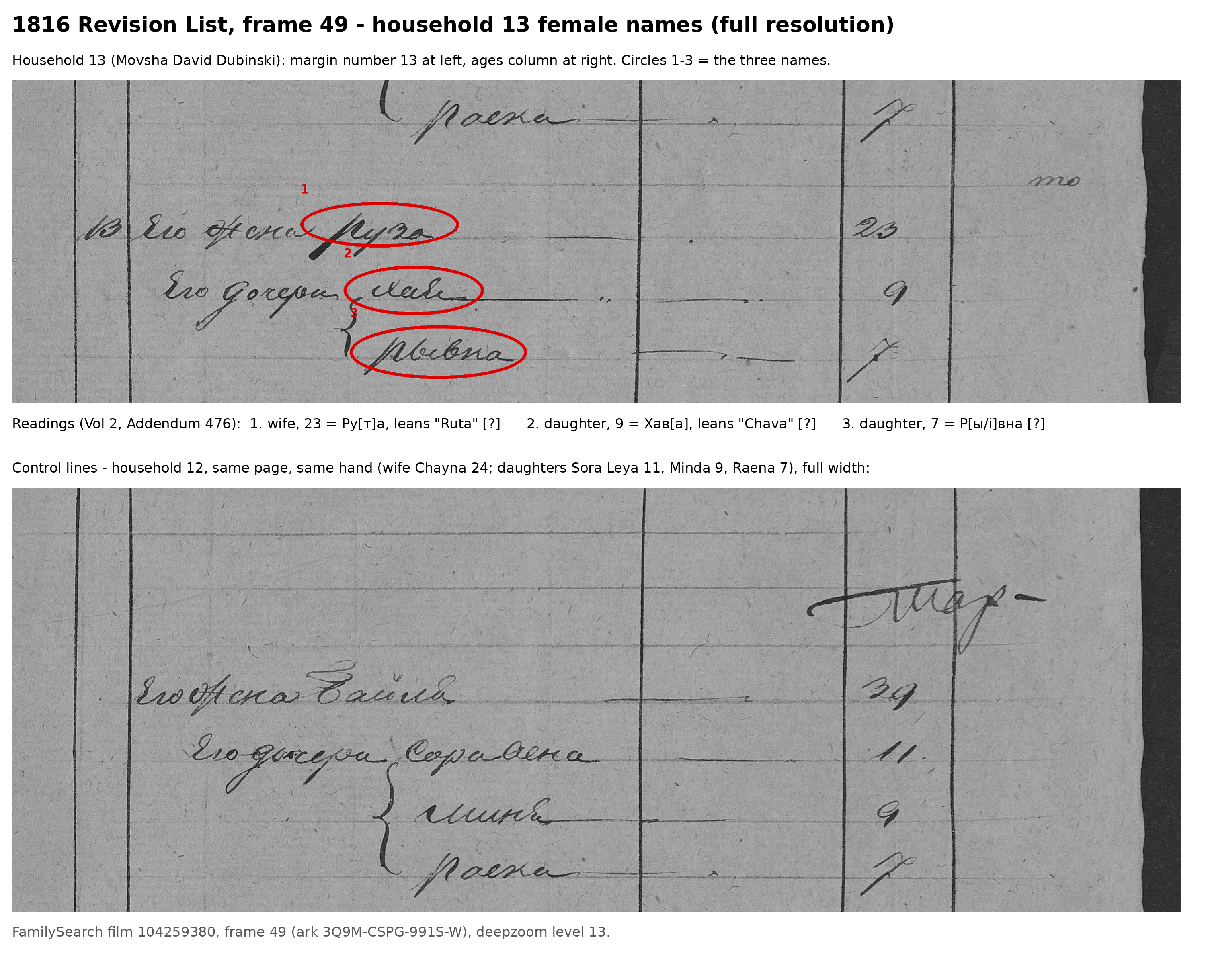
How should the wife's name, age 23, be read in the 1816 Volozhin household 13?

  1. A. Рута (Ruta), the leading reading
  2. B. Руха (Rukha)
  3. C. Another reading or undecidable

Evidence

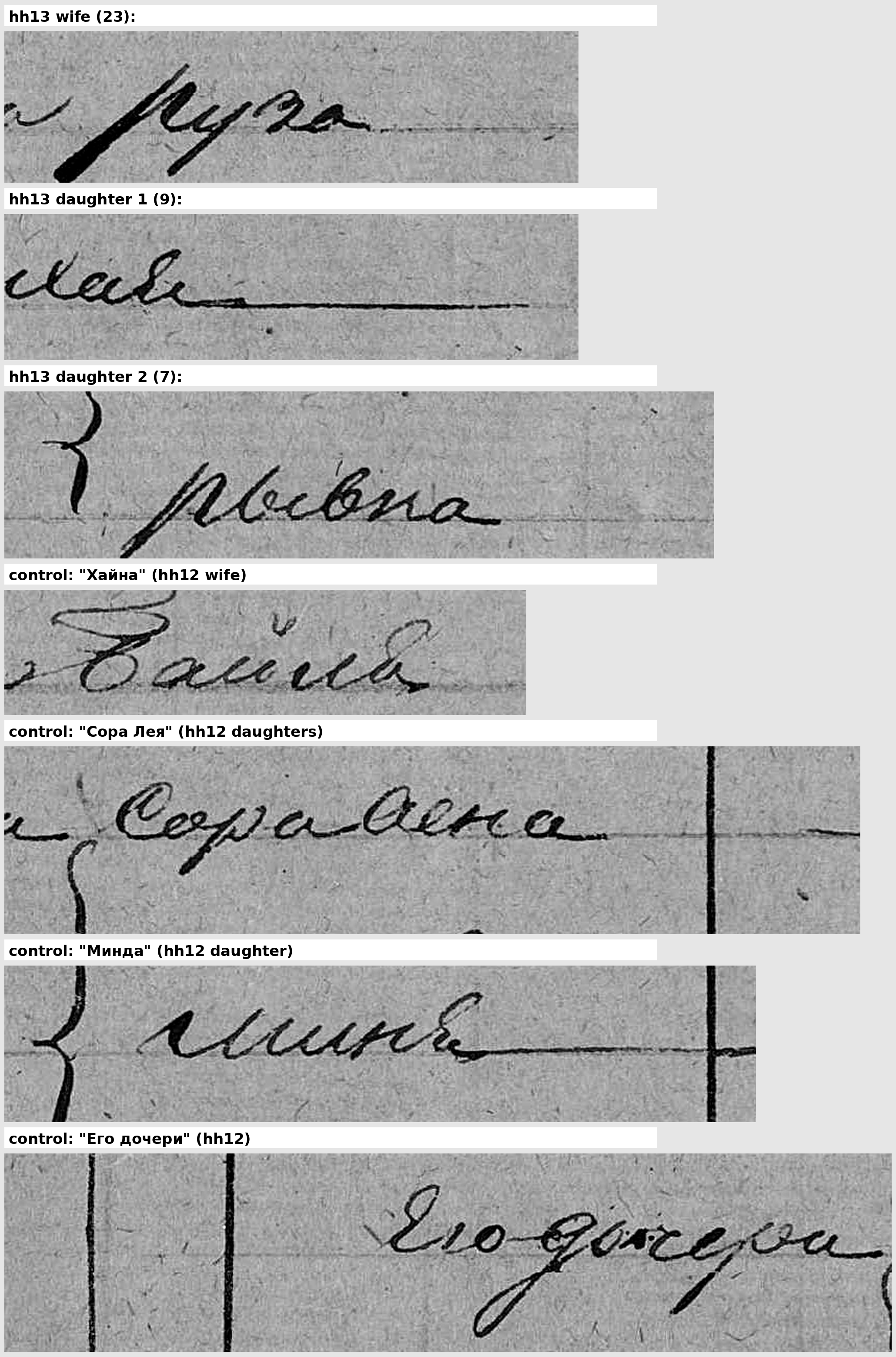
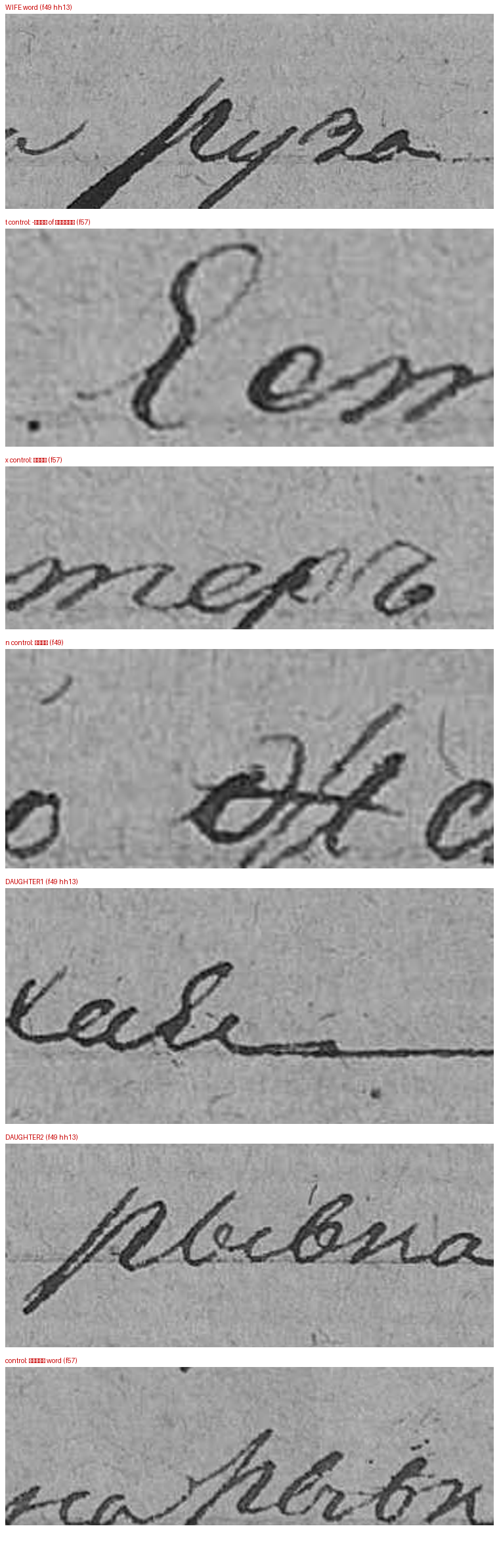
FamilySearch film 104259380, frame 49, household 13. The marked full-width panel shows the three lines and ages, with household 12 on the same page and in the same hand as a control. The close-ups compare individual letter forms. All three readings remain open.

Full-width frame 49: household 13 and nearby household 12 controls
Full-width frame 49: household 13 and nearby household 12 controls · Open full size
Tight names and comparison words
Tight names and comparison words · Open full size
Closer letter forms
Closer letter forms · Open full size
Write your reading
Q-1816-DAUGHTER-9

The older daughter's name in household 13

How should the daughter aged 9 be read in the 1816 Volozhin household 13?

  1. A. Хава (Khava/Chava), the leading reading
  2. B. Хая (Khaya)
  3. C. Лая (Laya) - discounted after a full-resolution re-check of the handwriting: this hand uses a different large oval for Л in nearby Лея.
  4. D. Another reading or undecidable

Evidence

FamilySearch film 104259380, frame 49, household 13. The full-width panel shows the line and age beside household 12 controls in the same hand. The first letter has the crossed Х form, not the large oval Л of Лея, and the third letter has the tall loop of в. Хава is the leading but still open reading; Лая is kept as an earlier candidate discounted after a full-resolution re-check of the handwriting.

Full-width frame 49: household 13 and nearby household 12 controls
Full-width frame 49: household 13 and nearby household 12 controls · Open full size
Tight names and comparison words
Tight names and comparison words · Open full size
Closer letter forms
Closer letter forms · Open full size
Write your reading
Q-1816-DAUGHTER-7

The younger daughter's name in household 13

How should the daughter aged 7 be read in the 1816 Volozhin household 13, especially the vowel after Р?

  1. A. Рывна (Ryvna)
  2. B. Рівна (Rivna)
  3. C. Рывка (Ryvka) - discounted after a full-resolution re-check of the handwriting: the looped letter is в, not к.
  4. D. Another reading or undecidable

Evidence

FamilySearch film 104259380, frame 49, household 13. The full-width panel shows the line and age beside household 12 controls in the same hand. The current open reading is Р[ы/і]вна: a dotted і may be present after the vowel; the fourth letter has the scribe’s tall looped в, not к. Рывка is kept as an earlier candidate discounted after a full-resolution re-check of the handwriting.

Full-width frame 49: household 13 and nearby household 12 controls
Full-width frame 49: household 13 and nearby household 12 controls · Open full size
Tight names and comparison words
Tight names and comparison words · Open full size
Closer letter forms
Closer letter forms · Open full size
Write your reading
Q-RAV-YITZCHOK-SONS

Rav Yitzchok of Volozhin's sons

Should Rav Yosef of Parich be included among Rav Yitzchok's sons?

  1. A. Five sons, including Rav Yosef of Parich
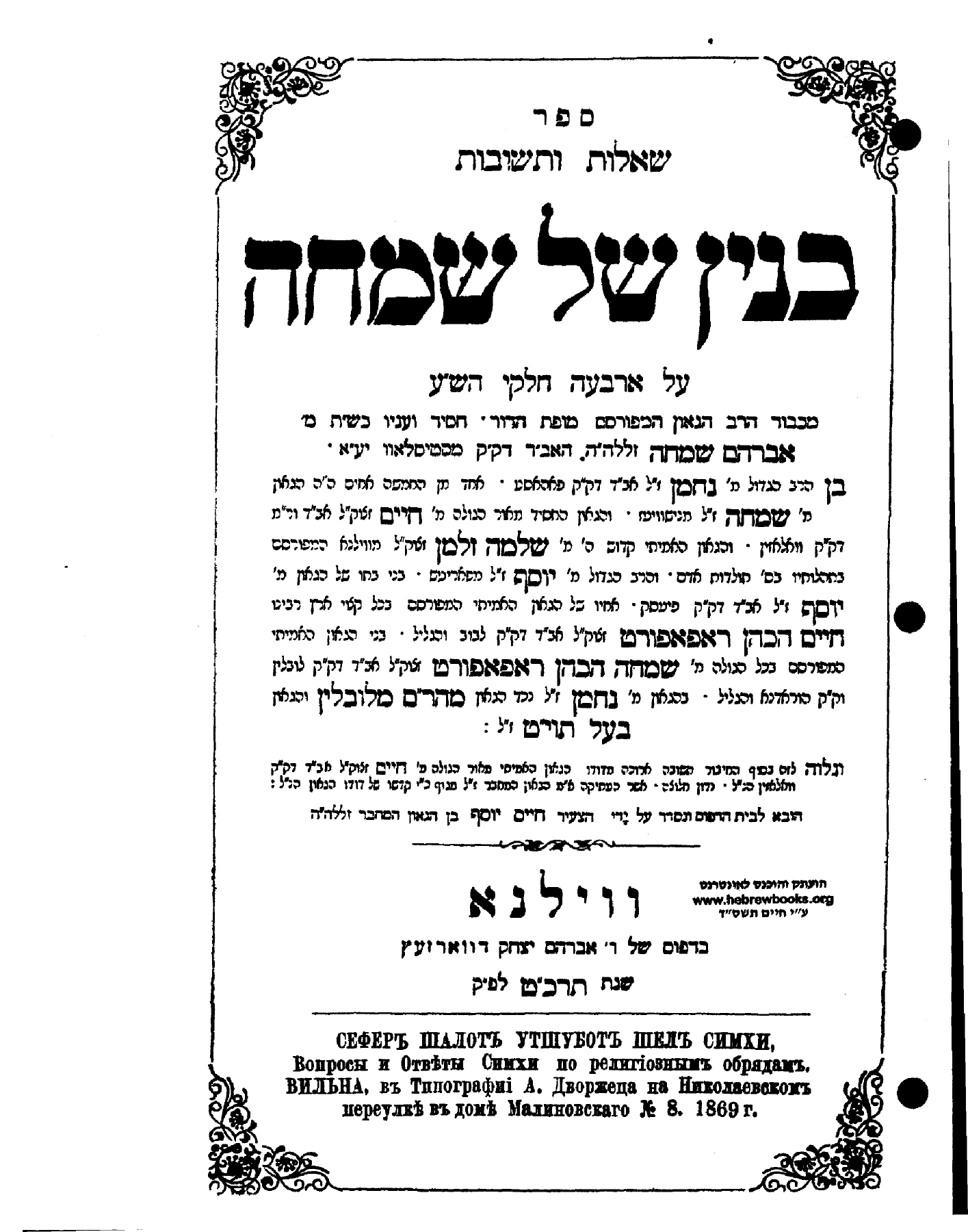
  2. B. Four sons named on the 1869 title page; Rav Yosef's relationship still needs proof
  3. C. Another interpretation or unresolved

Evidence

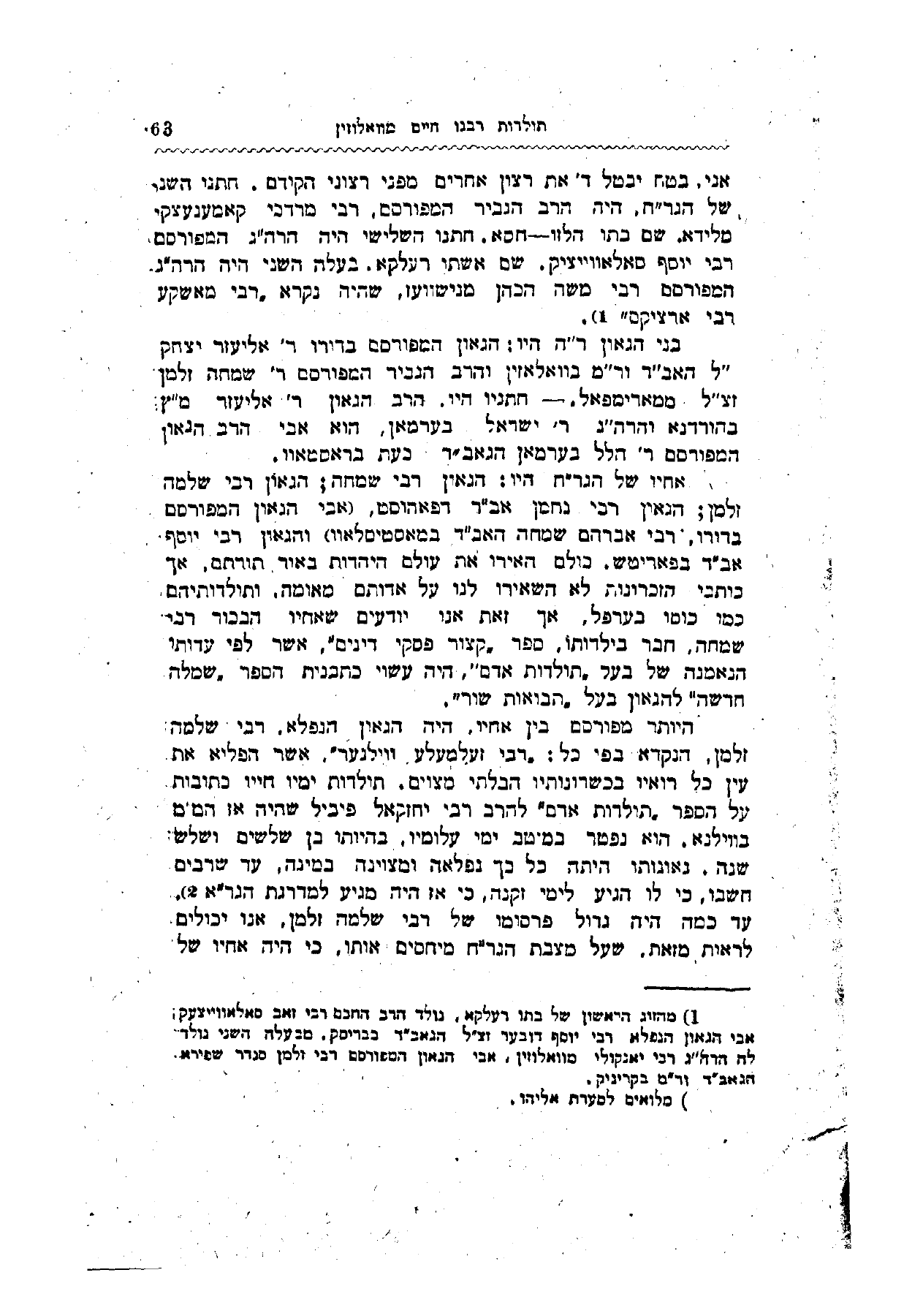
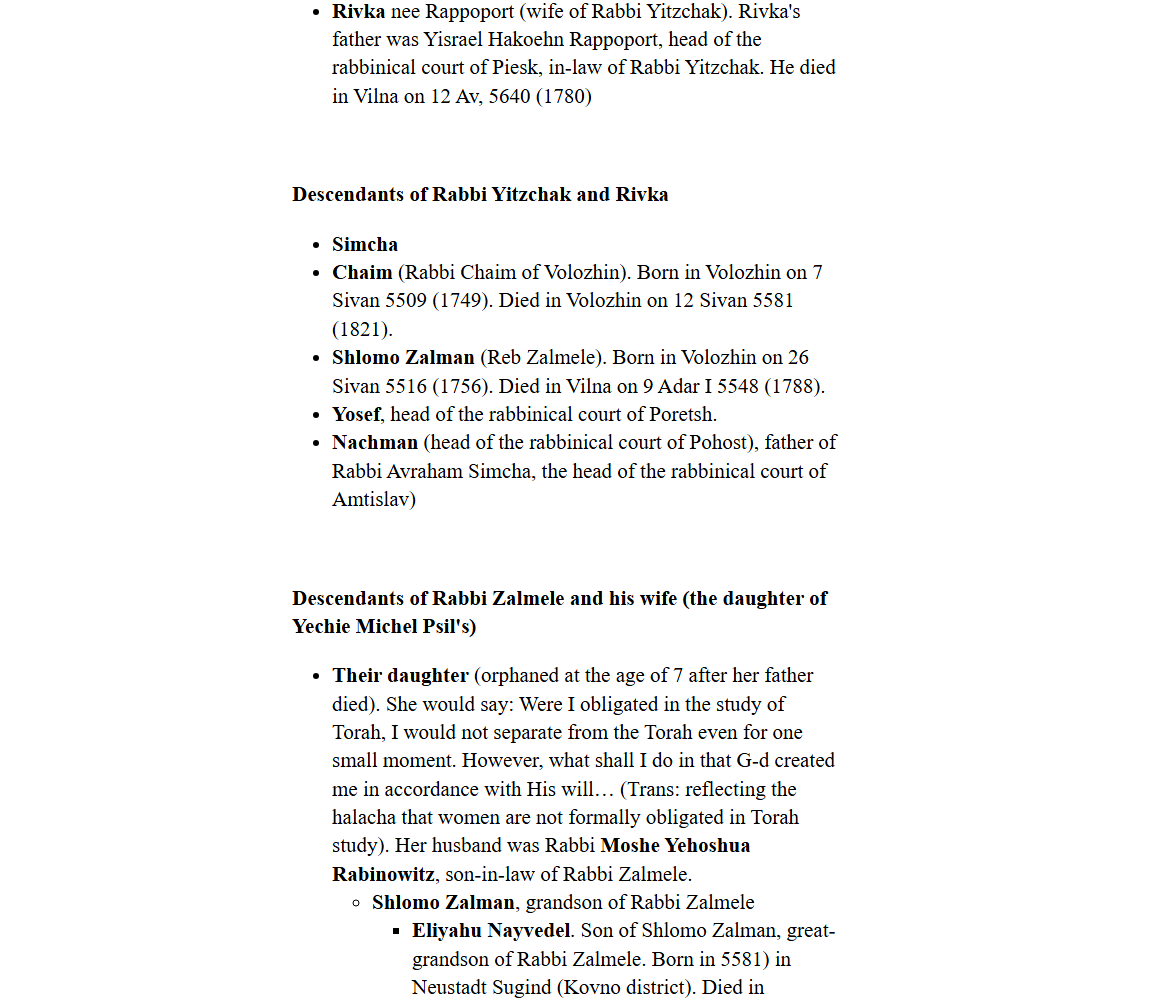
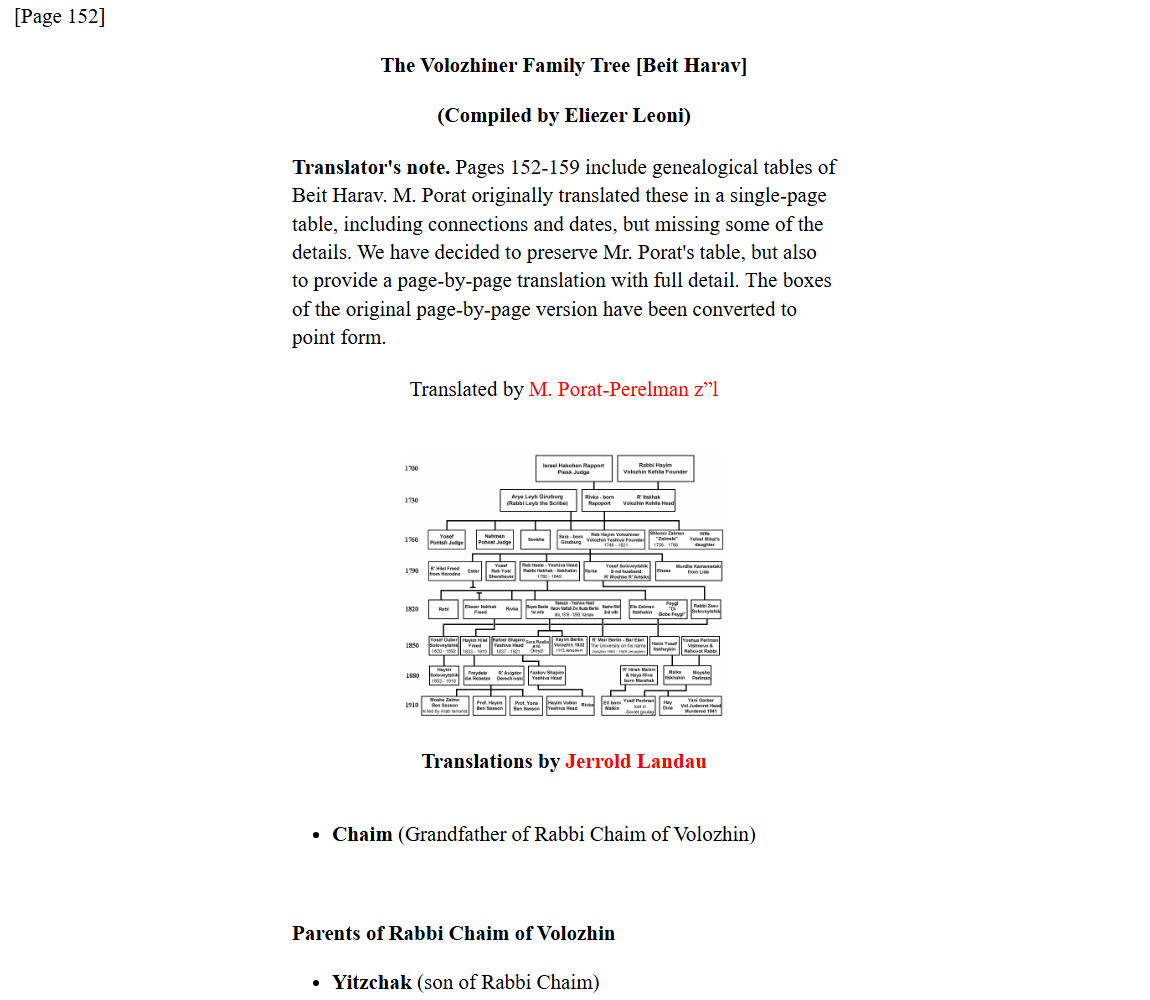
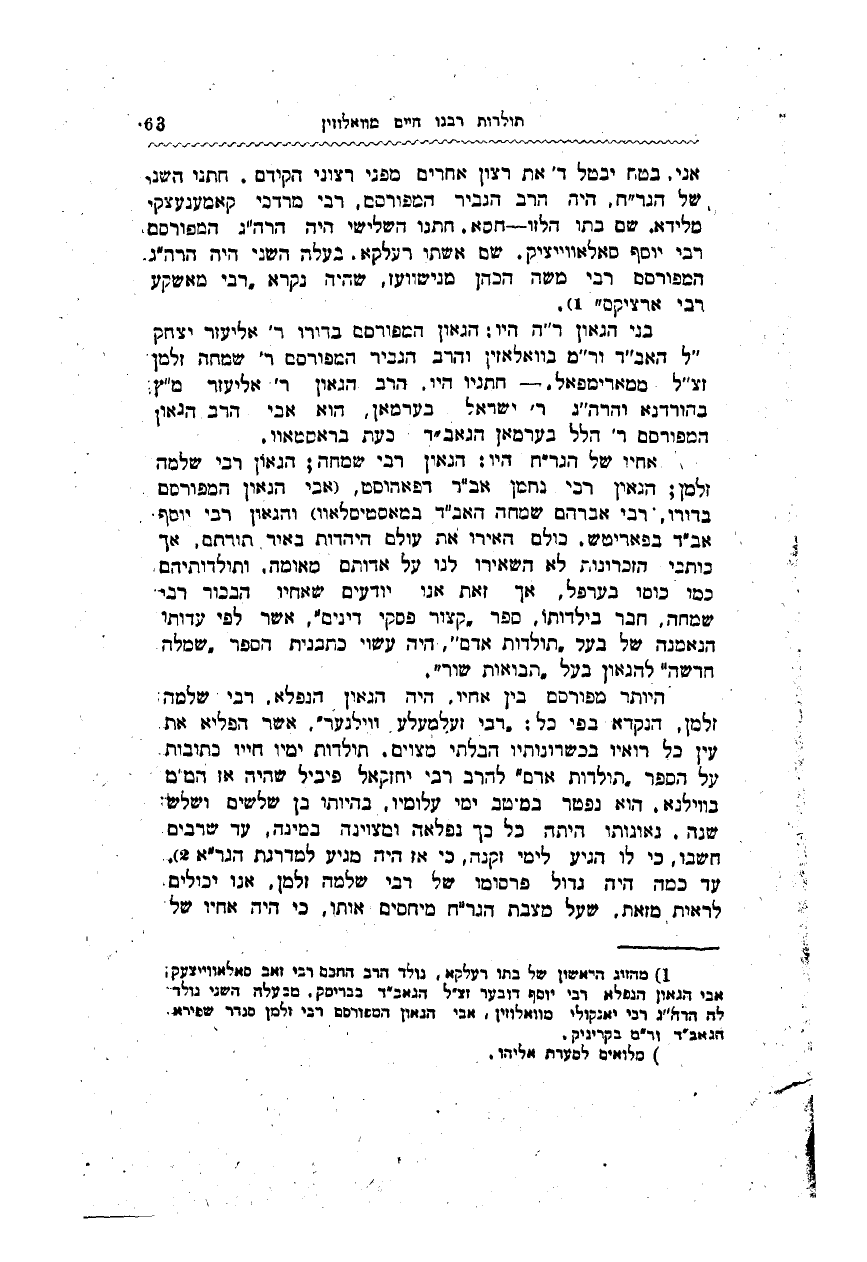
Toldos (p. 63) and Beis Harav (p. 152) list five: Rav Chaim, Rav Simcha, Rav Shlomo Zalman, Rav Nachman of Pohost, and Rav Yosef of Parich. The 1869 Binyan shel Simcha title page names Rav Nachman and three brothers (Simcha, Chaim, Shlomo Zalman), but does not name Yosef. Omission alone is not proof that there were only four.

Toldos Rabbeinu Chaim, printed page 63: paragraph naming Rav Chaim and four brothers
Binyan Shel Simcha, Vilna 1869, original title page
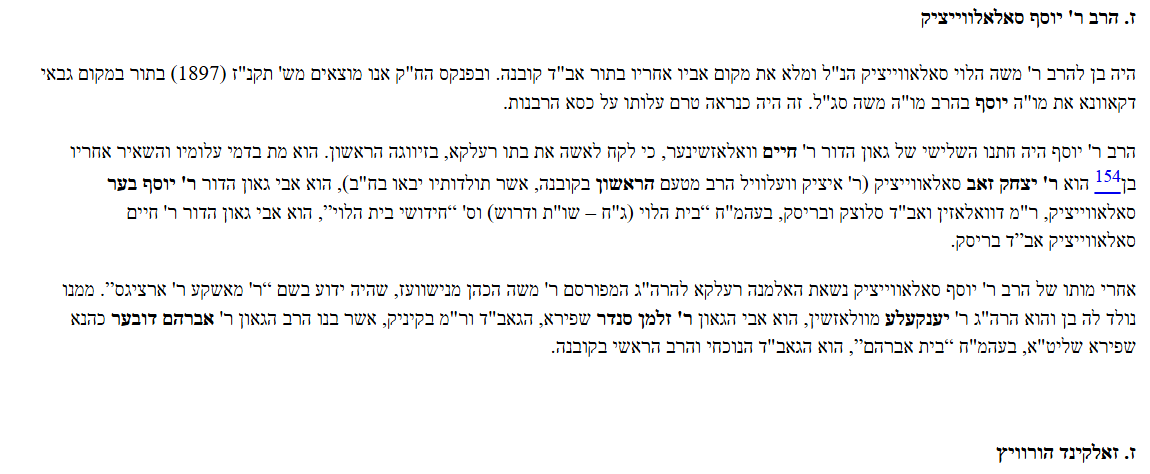
Beis Harav, page 152, JewishGen English translation: five sons listed
Write your reading
Q-RIVKA-RAPOPORT-FATHER

Rivka Rapoport's father

Who was Rivka Rapoport's father?

  1. A. Rav Yisrael Rapoport, as Beis Harav states
  2. B. Rav Yosef Rapoport, as a secondary researcher reports from a Minsk pinkas
  3. C. Evidence insufficient or another reading

Evidence

Beis Harav gives Yisrael. Pantilat reports Yosef, citing a Minsk pinkas; that cited pinkas has not yet been checked here. The Rav Yosef of Piesk on the Binyan shel Simcha title page is the author's maternal grandfather and does not settle Rivka's father.

Beis Harav, page 152, JewishGen English translation: Rivka and her father Yisrael
Write your reading
SAVED-Q-21

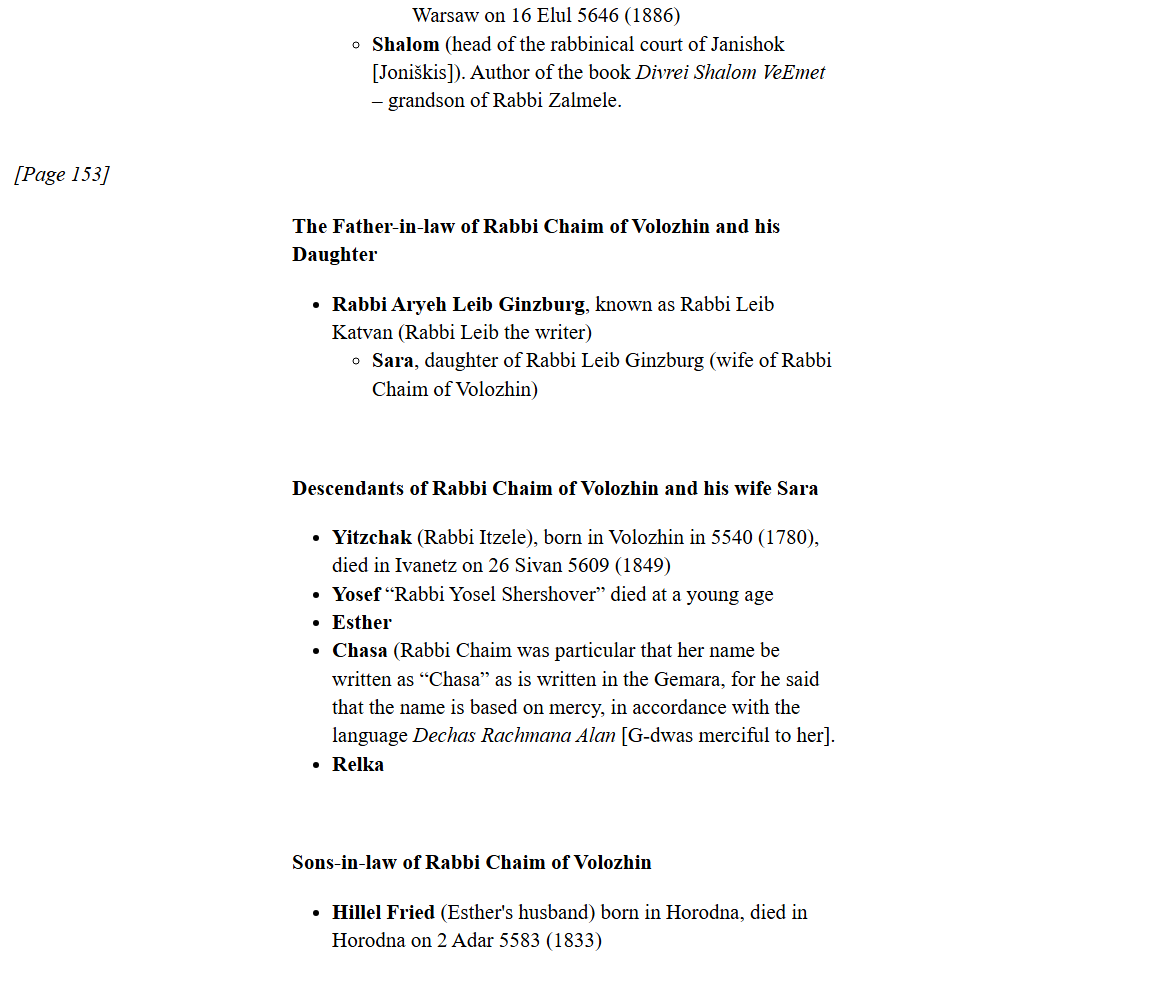
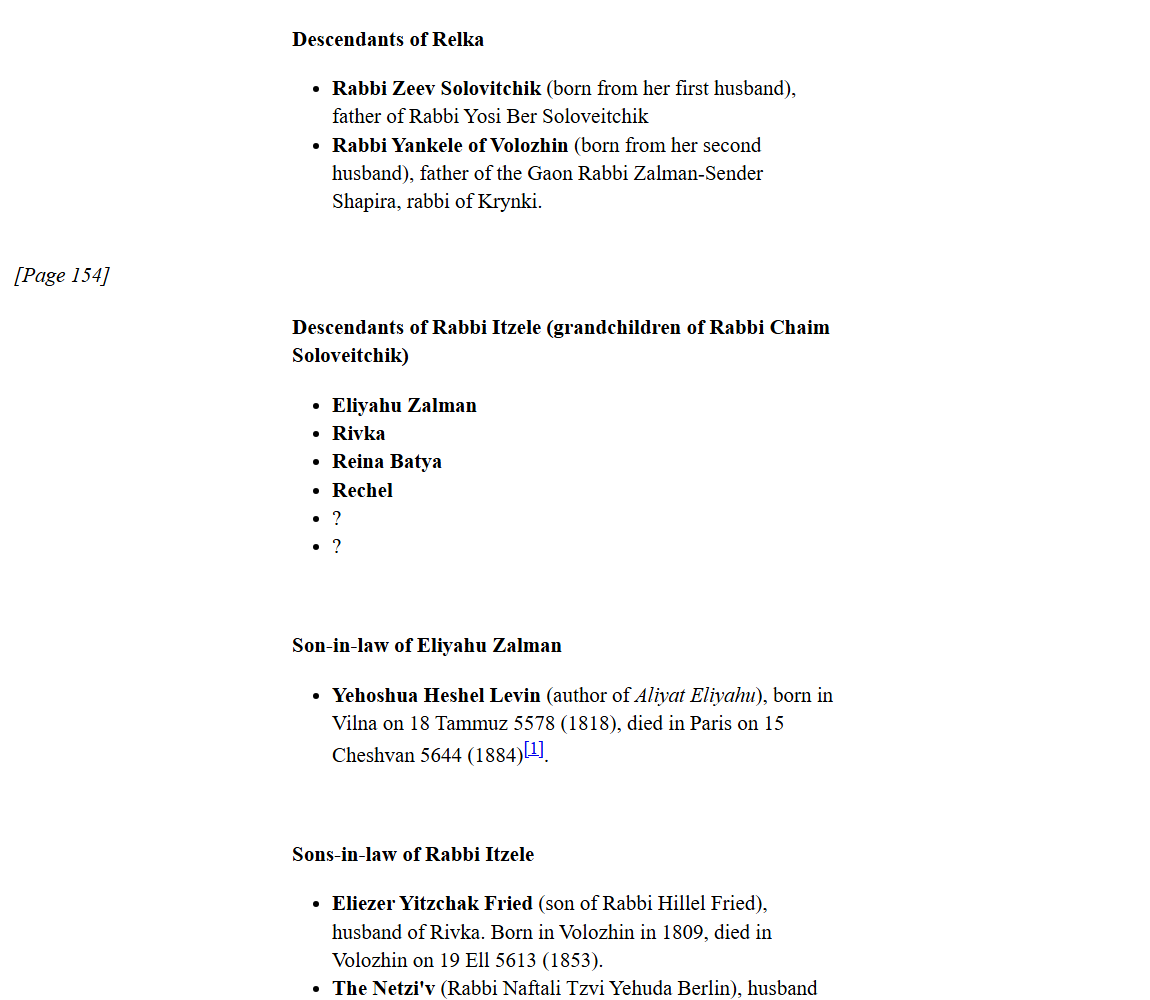
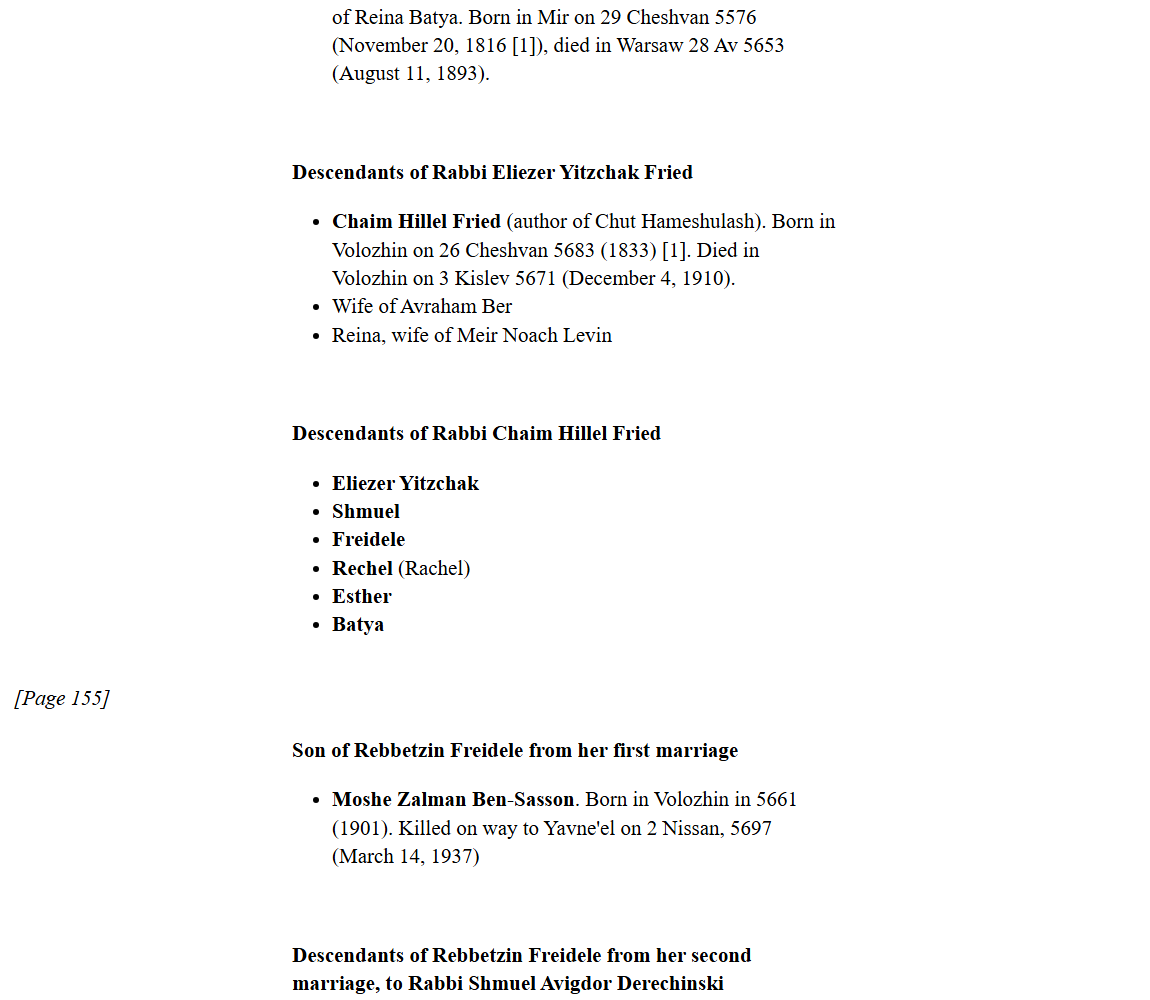
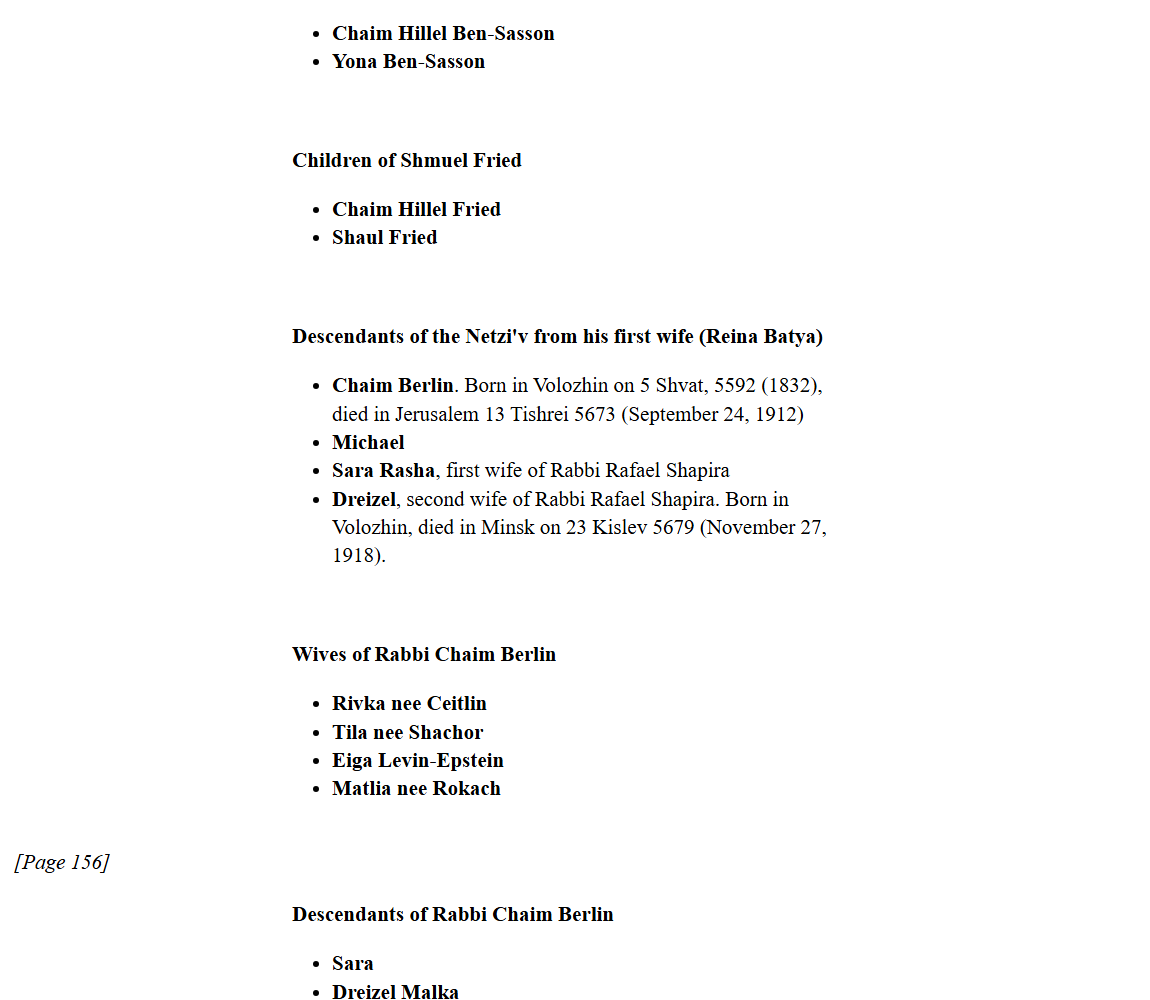
Q-21 - The Leoni chart is a generation off on Relka

How should this source conflict or interpretation be stated in the family history?

Wording and source conflict

Current wording:
title: The Leoni chart is a generation off on Relka

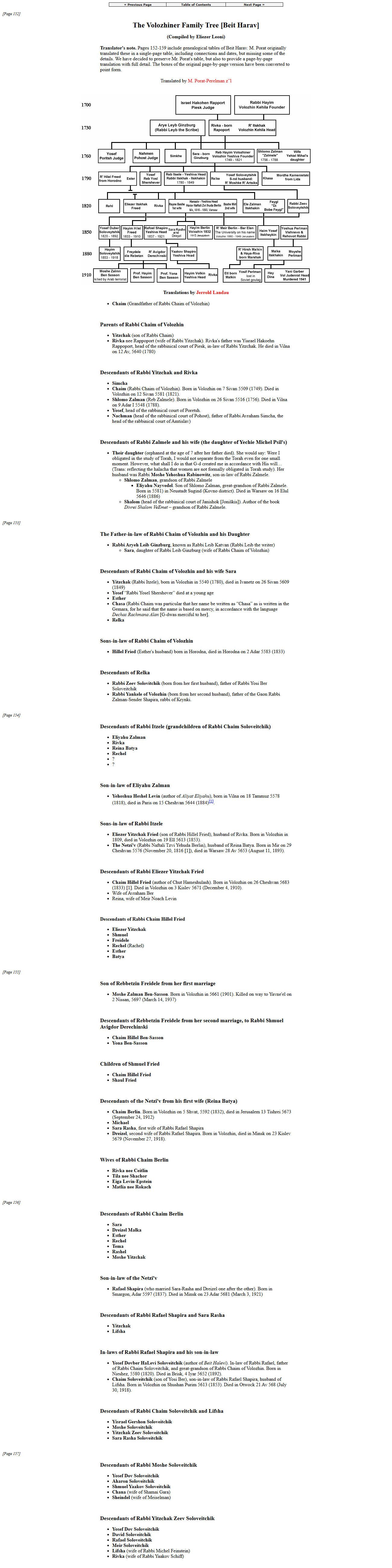
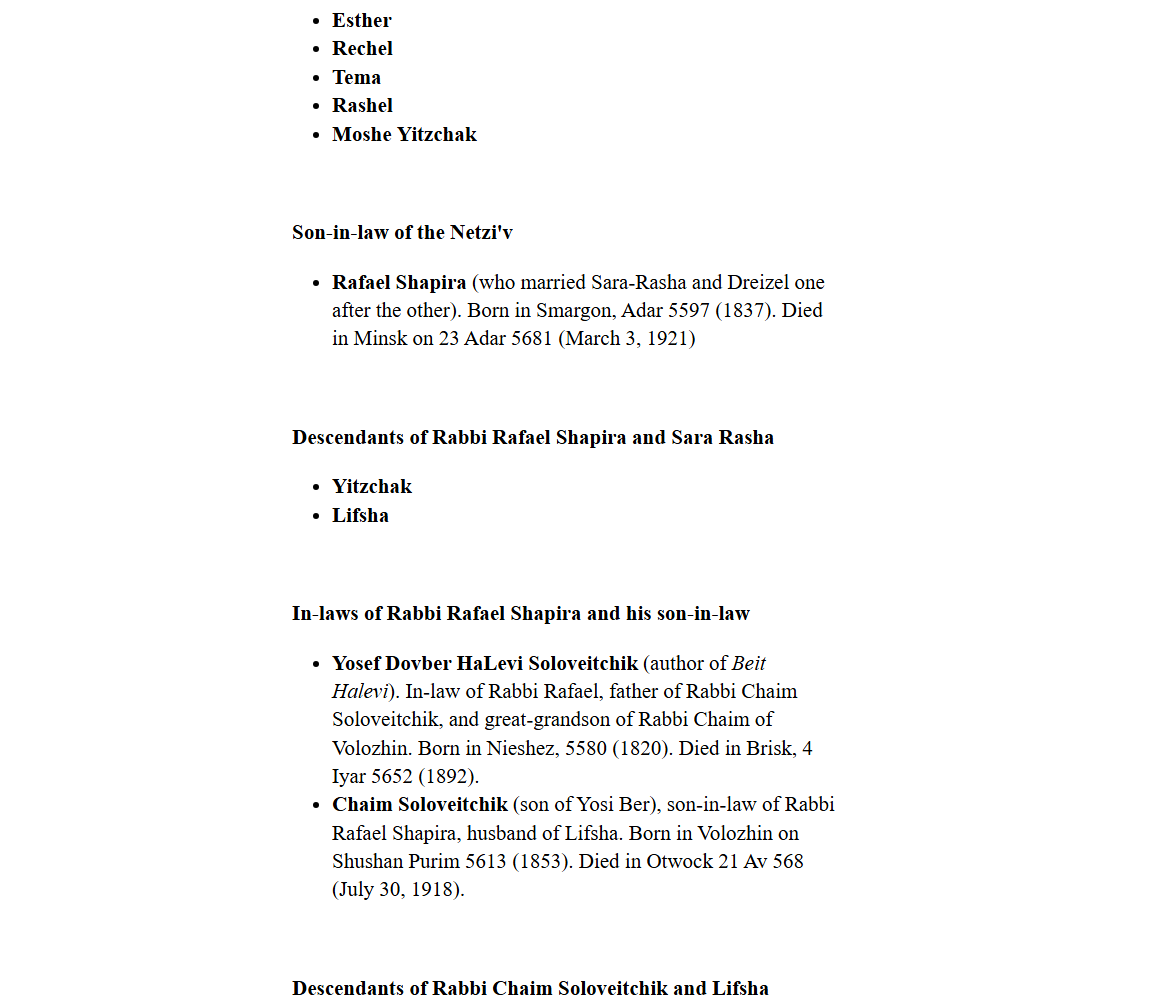
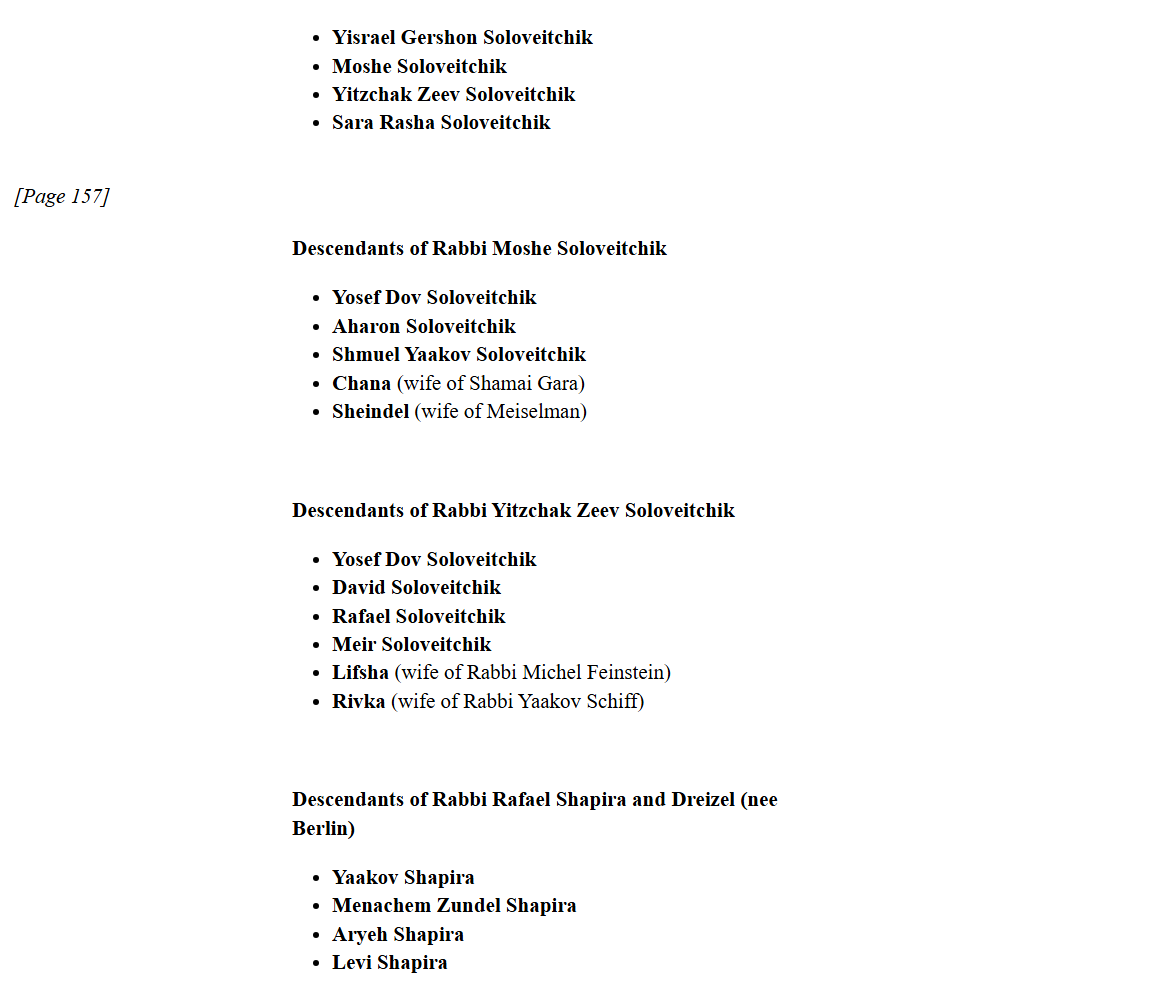
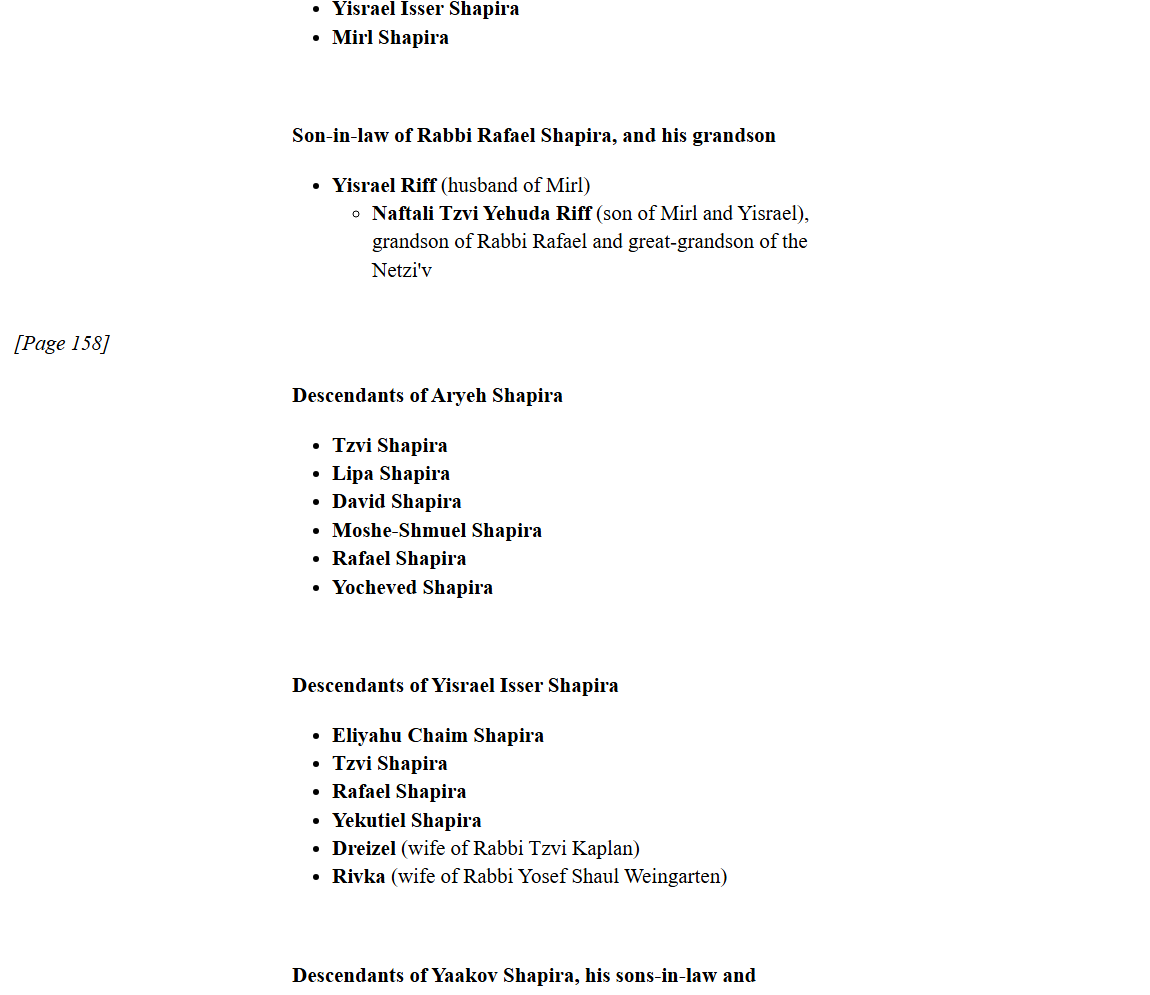
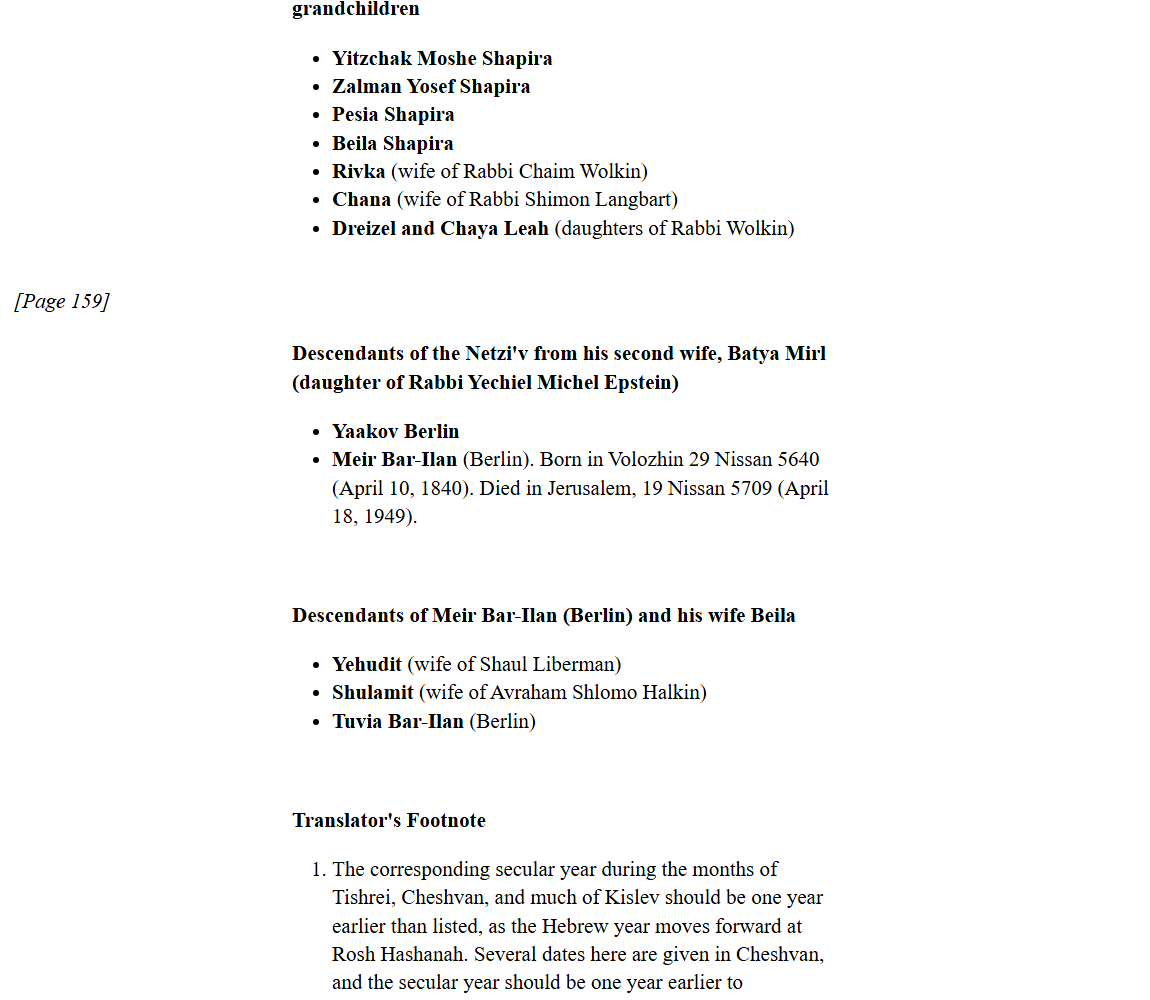
claim: Leoni makes Rav Zeev Soloveitchik and Yankele into Relka's sons without naming her husbands. Lipman has the husbands as R. Yosef Soloveitchik and R. Moshe HaKohen of Nesvizh, with Yitzchak Zev and Yankele as the sons.

settle: Nothing further is needed on the facts. What is needed is a judgement on how far the rest of the Leoni chart can be trusted. A chart wrong by one generation where it can be checked may be wrong by one where it cannot , and that possibility is exactly the size of the gap in Q-03.

Proposed wording or replacement phrase:
title: Relka's husbands in Lipman and the Leoni chart
Why this needs a decision: Leoni p153 and Lipman both place these men as Relka's sons; difference is omitted husband names, not generation.

claim: Leoni lists Rav Zeev Soloveitchik and Yankele as Relka's sons , born from her first and second husbands, without naming those husbands. Lipman names the husbands as R. Yosef Soloveitchik and R. Moshe HaKohen of Nesvizh, and the sons as Yitzchak Zev and Yankele.
Why this needs a decision: Keep the actual comparison; remove unsupported suggestion that Leoni placed the sons in wrong generation.

settle: These passages agree on the sons' generation. Lipman adds the husbands' names and calls Yosef the third son-in-law. This comparison does not establish a generation error elsewhere in the Leoni chart.
Why this needs a decision: A missing husband name does not justify treating the rest of the chart as a generation off.

Sources

Volozhin yizkor book, JewishGen translation: the page as a whole, then the Leoni family chart translation, pp.152 to 159, with the translator's footnote and site footer.
Volozhin yizkor book, JewishGen translation: the page as a whole, then the Leoni family chart translation, pp.152 to 159, with the translator's footnote and site footer. - Open full size
Volozhin yizkor book, JewishGen translation: the page as a whole, then the Leoni family chart translation, pp.152 to 159, with the translator's footnote and site footer.
Volozhin yizkor book, JewishGen translation: the page as a whole, then the Leoni family chart translation, pp.152 to 159, with the translator's footnote and site footer. - Open full size
Volozhin yizkor book, JewishGen translation: the page as a whole, then the Leoni family chart translation, pp.152 to 159, with the translator's footnote and site footer.
Volozhin yizkor book, JewishGen translation: the page as a whole, then the Leoni family chart translation, pp.152 to 159, with the translator's footnote and site footer. - Open full size
Volozhin yizkor book, JewishGen translation: the page as a whole, then the Leoni family chart translation, pp.152 to 159, with the translator's footnote and site footer.
Volozhin yizkor book, JewishGen translation: the page as a whole, then the Leoni family chart translation, pp.152 to 159, with the translator's footnote and site footer. - Open full size
Volozhin yizkor book, JewishGen translation: the page as a whole, then the Leoni family chart translation, pp.152 to 159, with the translator's footnote and site footer.
Volozhin yizkor book, JewishGen translation: the page as a whole, then the Leoni family chart translation, pp.152 to 159, with the translator's footnote and site footer. - Open full size
Volozhin yizkor book, JewishGen translation: the page as a whole, then the Leoni family chart translation, pp.152 to 159, with the translator's footnote and site footer.
Volozhin yizkor book, JewishGen translation: the page as a whole, then the Leoni family chart translation, pp.152 to 159, with the translator's footnote and site footer. - Open full size
Volozhin yizkor book, JewishGen translation: the page as a whole, then the Leoni family chart translation, pp.152 to 159, with the translator's footnote and site footer.
Volozhin yizkor book, JewishGen translation: the page as a whole, then the Leoni family chart translation, pp.152 to 159, with the translator's footnote and site footer. - Open full size
Volozhin yizkor book, JewishGen translation: the page as a whole, then the Leoni family chart translation, pp.152 to 159, with the translator's footnote and site footer.
Volozhin yizkor book, JewishGen translation: the page as a whole, then the Leoni family chart translation, pp.152 to 159, with the translator's footnote and site footer. - Open full size
Volozhin yizkor book, JewishGen translation: the page as a whole, then the Leoni family chart translation, pp.152 to 159, with the translator's footnote and site footer.
Volozhin yizkor book, JewishGen translation: the page as a whole, then the Leoni family chart translation, pp.152 to 159, with the translator's footnote and site footer. - Open full size
Volozhin yizkor book, JewishGen translation: the page as a whole, then the Leoni family chart translation, pp.152 to 159, with the translator's footnote and site footer.
Volozhin yizkor book, JewishGen translation: the page as a whole, then the Leoni family chart translation, pp.152 to 159, with the translator's footnote and site footer. - Open full size
Volozhin yizkor book, JewishGen translation: the page as a whole, then the Leoni family chart translation, pp.152 to 159, with the translator's footnote and site footer.
Volozhin yizkor book, JewishGen translation: the page as a whole, then the Leoni family chart translation, pp.152 to 159, with the translator's footnote and site footer. - Open full size
Volozhin yizkor book, JewishGen translation: the page as a whole, then the Leoni family chart translation, pp.152 to 159, with the translator's footnote and site footer.
Volozhin yizkor book, JewishGen translation: the page as a whole, then the Leoni family chart translation, pp.152 to 159, with the translator's footnote and site footer. - Open full size
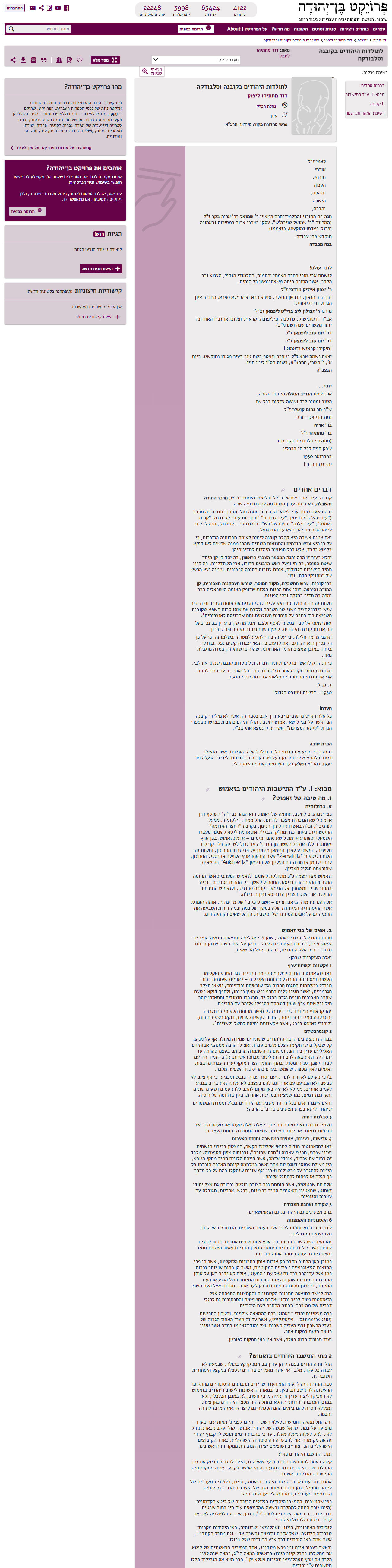
Lipman, Berlin 1930, as digitised by Project Ben-Yehuda: the opening of the text, and the passage on Rav Yosef Soloveitchik, the third son-in-law, Relka's two marriages, and the descent of Rav Zalman Sender Kahana Shapira
Lipman, Berlin 1930, as digitised by Project Ben-Yehuda: the opening of the text, and the passage on Rav Yosef Soloveitchik, the third son-in-law, Relka's two marriages, and the descent of Rav Zalman Sender Kahana Shapira - Open full size
Lipman, Berlin 1930, as digitised by Project Ben-Yehuda: the opening of the text, and the passage on Rav Yosef Soloveitchik, the third son-in-law, Relka's two marriages, and the descent of Rav Zalman Sender Kahana Shapira
Lipman, Berlin 1930, as digitised by Project Ben-Yehuda: the opening of the text, and the passage on Rav Yosef Soloveitchik, the third son-in-law, Relka's two marriages, and the descent of Rav Zalman Sender Kahana Shapira - Open full size
Save your answer
SAVED-Q-22

Q-22 - Chasa's husband, once the blank page in the chart

How should this source conflict or interpretation be stated in the family history?

Wording and source conflict

Current wording:
fore: This closes the largest blank in the standard tree from a primary source, not a secondary one. It also confirms Chasa was the second daughter married off, which independently answers Q-23.

Proposed wording or replacement phrase:
fore: It identifies Chasa's husband as the second son-in-law . The passage does not by itself establish the daughters' birth order or marriage order.
Why this needs a decision: Ordinal applies to son-in-law in quoted text; daughter chronology is unproved.

Sources

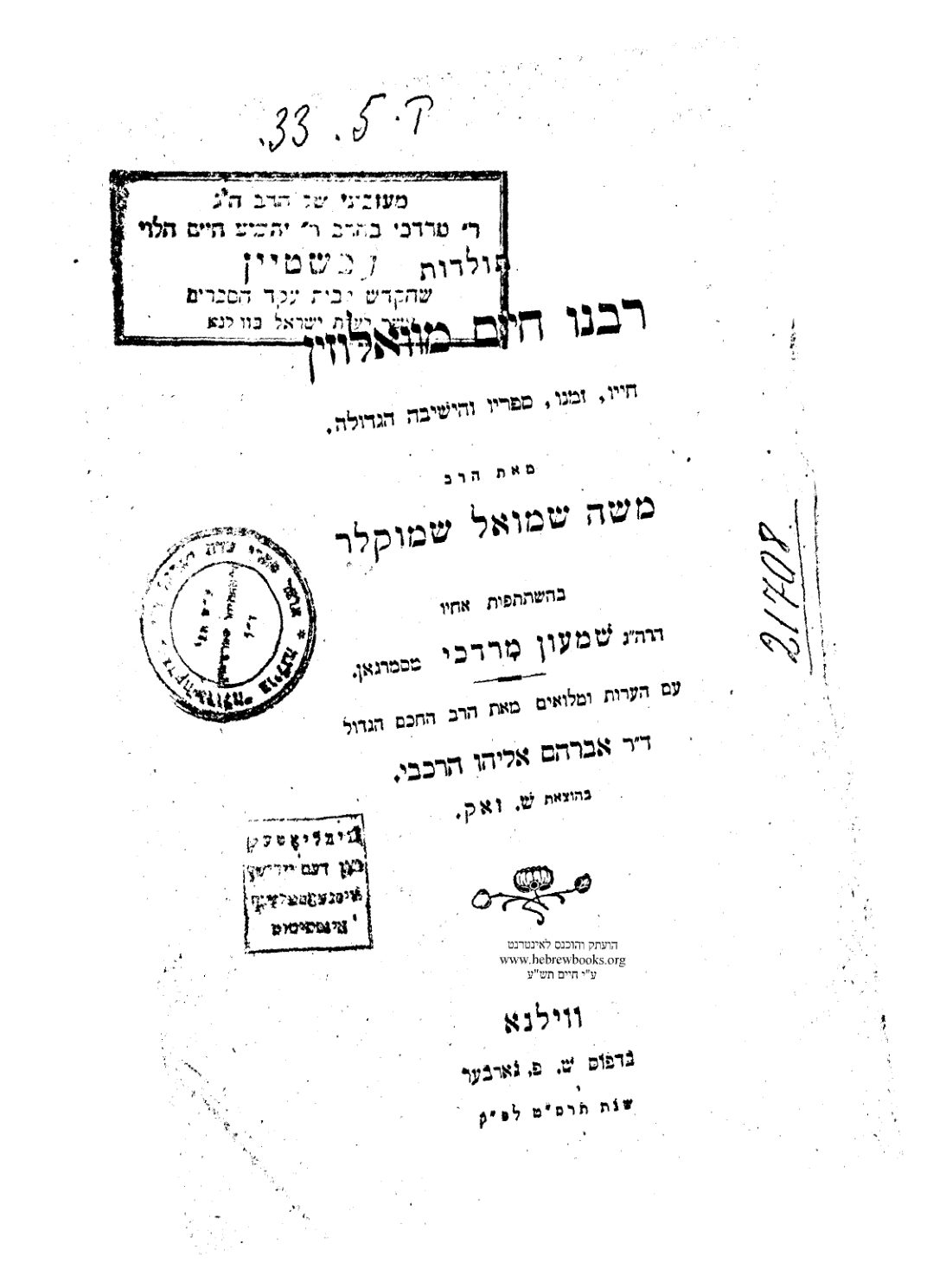
Toldos Rabbeinu Chaim MiVolozhin, 1909, title page
Toldos Rabbeinu Chaim MiVolozhin, 1909, title page - Open full size
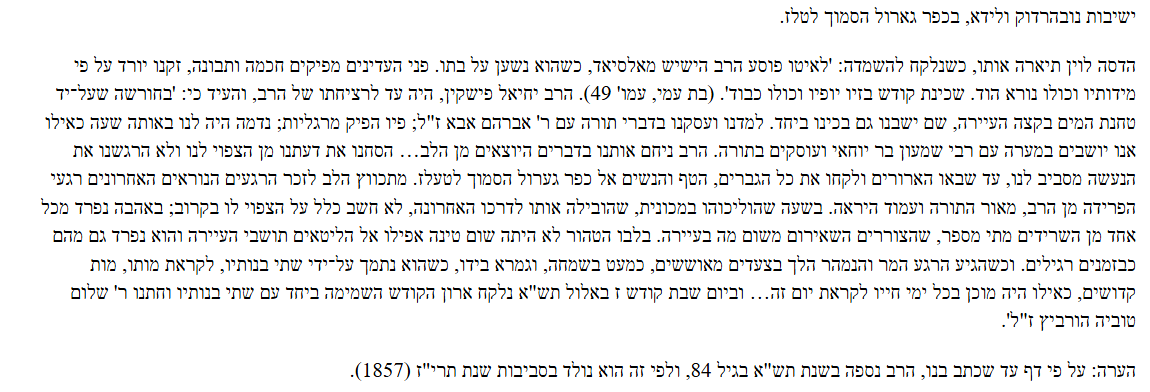
Toldos Rabbeinu Chaim MiVolozhin, 1909, printed p.63 (HebrewBooks viewer p.69): Rav Mordechai Kamenetzky of Lida, second son-in-law, and daughter Chasa
Toldos Rabbeinu Chaim MiVolozhin, 1909, printed p.63 (HebrewBooks viewer p.69): Rav Mordechai Kamenetzky of Lida, second son-in-law, and daughter Chasa - Open full size
Save your answer
SAVED-Q-27

Q-27 - Maria Semyonovna Rubina as his daughter

How should this source conflict or interpretation be stated in the family history?

Wording and source conflict

Current wording:
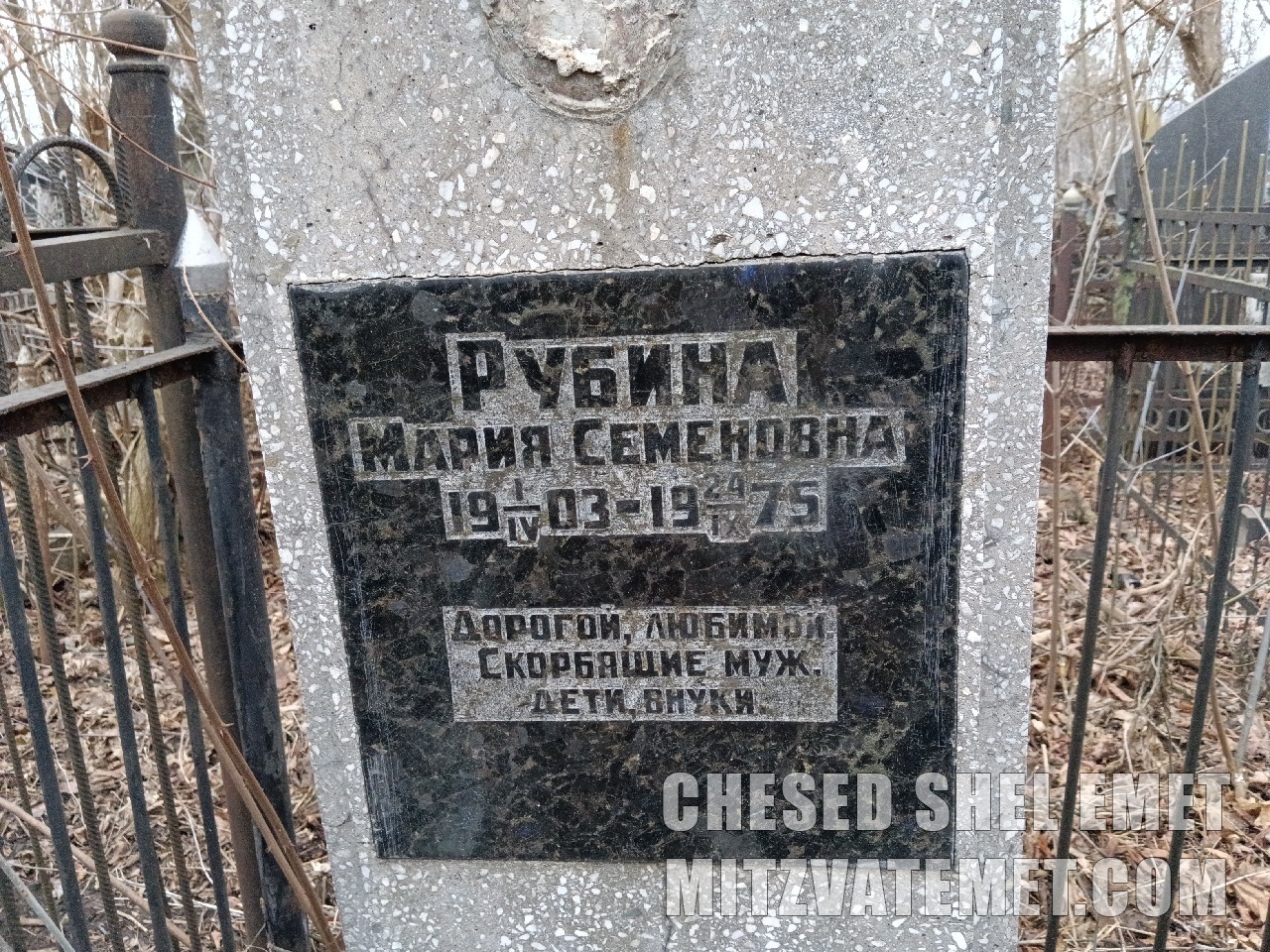
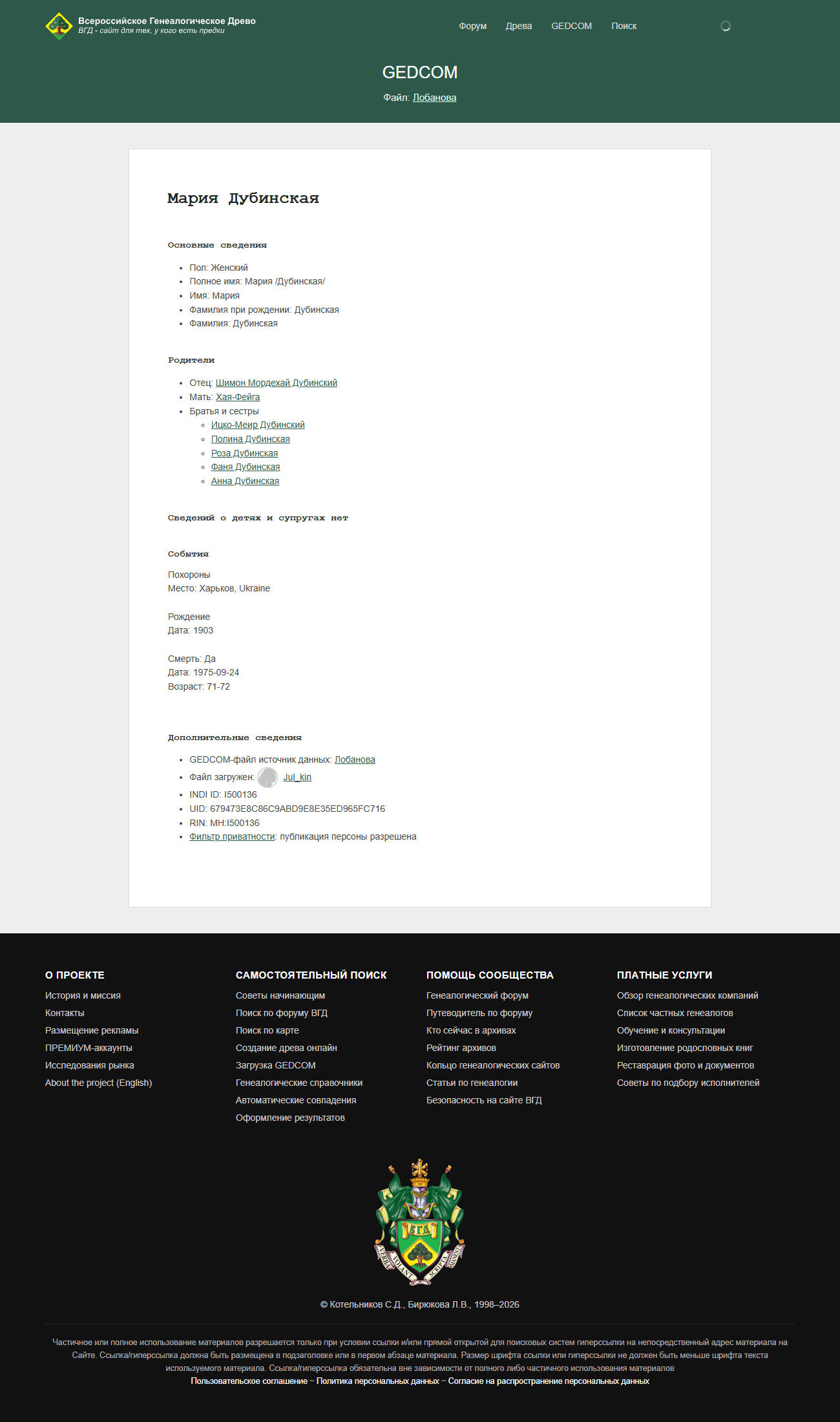
fore: This is the load-bearing inference of the whole Kharkiv section. If it holds, a family in about 1980 carved into stone the link between Maria and a Dubinsky whose name began Sh. and who died in 1946, which attests the father and daughter relationship independently of the VGD tree . The VGD tree's Maria, 1903 to 24 September 1975, matches the catalogue's Rubina Maria Semyonovna, 1903 to 1975.

Proposed wording or replacement phrase:
fore: The VGD tree identifies Maria Dubinskaya as Shimon Mordechai and Haya Feiga's daughter. The Kharkiv stone names Maria Semyonovna Rubina, 1903 to 1975. The stone's death date reads 24 September 1975, matching VGD. Her patronymic and the associated family stones are consistent with a connection, but the stone does not directly name her father or husband. The birth day remains a provisional reading.
Why this needs a decision: The VGD tree names her parents; the stone does not directly state her father's or husband's identity.

Sources

Kharkiv: Mitzvat Emet burial 353077
Kharkiv: Mitzvat Emet burial 353077 - Open full size
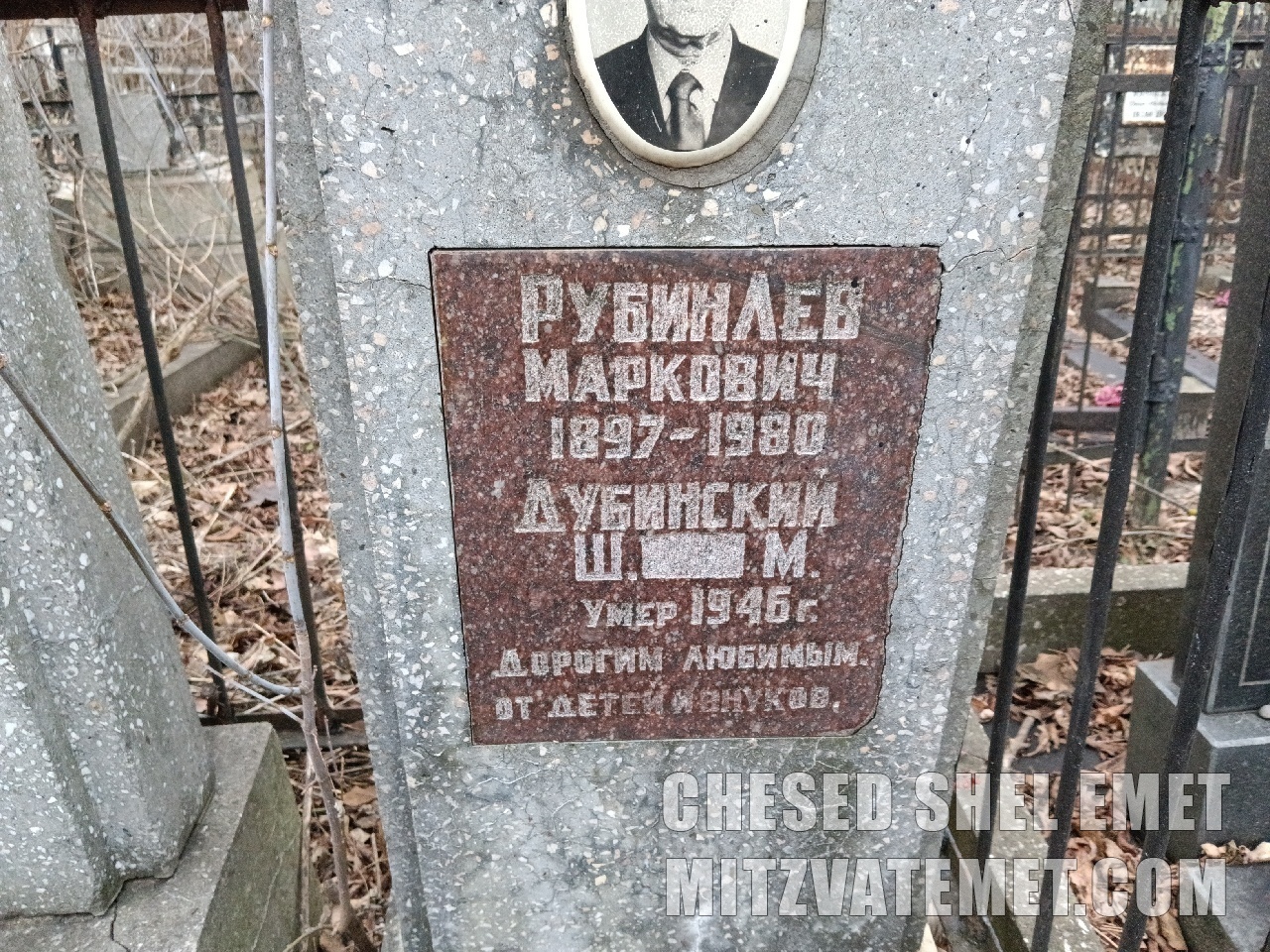
Kharkiv: the stone of Rav Shimon Mordechai Dubinsky (Mitzvat Emet burial 352860)
Kharkiv: the stone of Rav Shimon Mordechai Dubinsky (Mitzvat Emet burial 352860) - Open full size
VGD GEDCOM record I500136
VGD GEDCOM record I500136 - Open full size
Save your answer
SAVED-Q-26

Q-26 - Is Shimon Mordechai actually buried there?

How should this source conflict or interpretation be stated in the family history?

Wording and source conflict

Current wording:
against: The stone was cut after 1980, thirty-four years after he died, by children and grandchildren. Commemorating a relative on a later family monument is common, and it is what the layout suggests: Lev Rubin gets a full name, a patronymic and both dates; Dubinsky gets two initials and a memorial formula.

Proposed wording or replacement phrase:
against: The stone includes Lev Rubin's death in 1980 and a dedication from children and grandchildren. That inscription is later than Dubinsky's death in 1946; the photograph does not date when the stone itself was cut.
Why this needs a decision: Later inscription date does not prove entire monument cutting date.

Sources

Kharkiv: the stone of Rav Shimon Mordechai Dubinsky (Mitzvat Emet burial 352860)
Kharkiv: the stone of Rav Shimon Mordechai Dubinsky (Mitzvat Emet burial 352860) - Open full size
Save your answer
SAVED-F-09

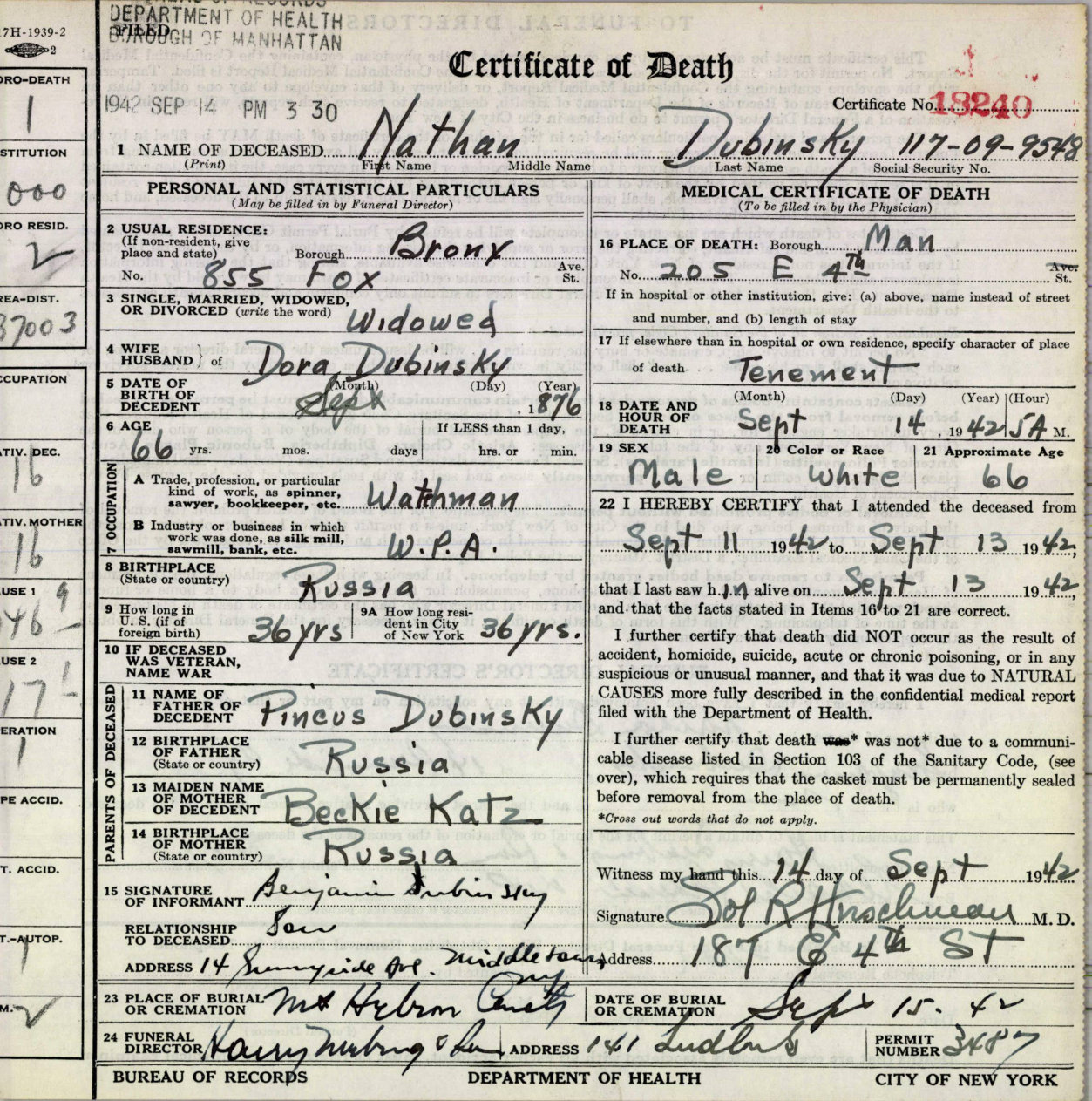
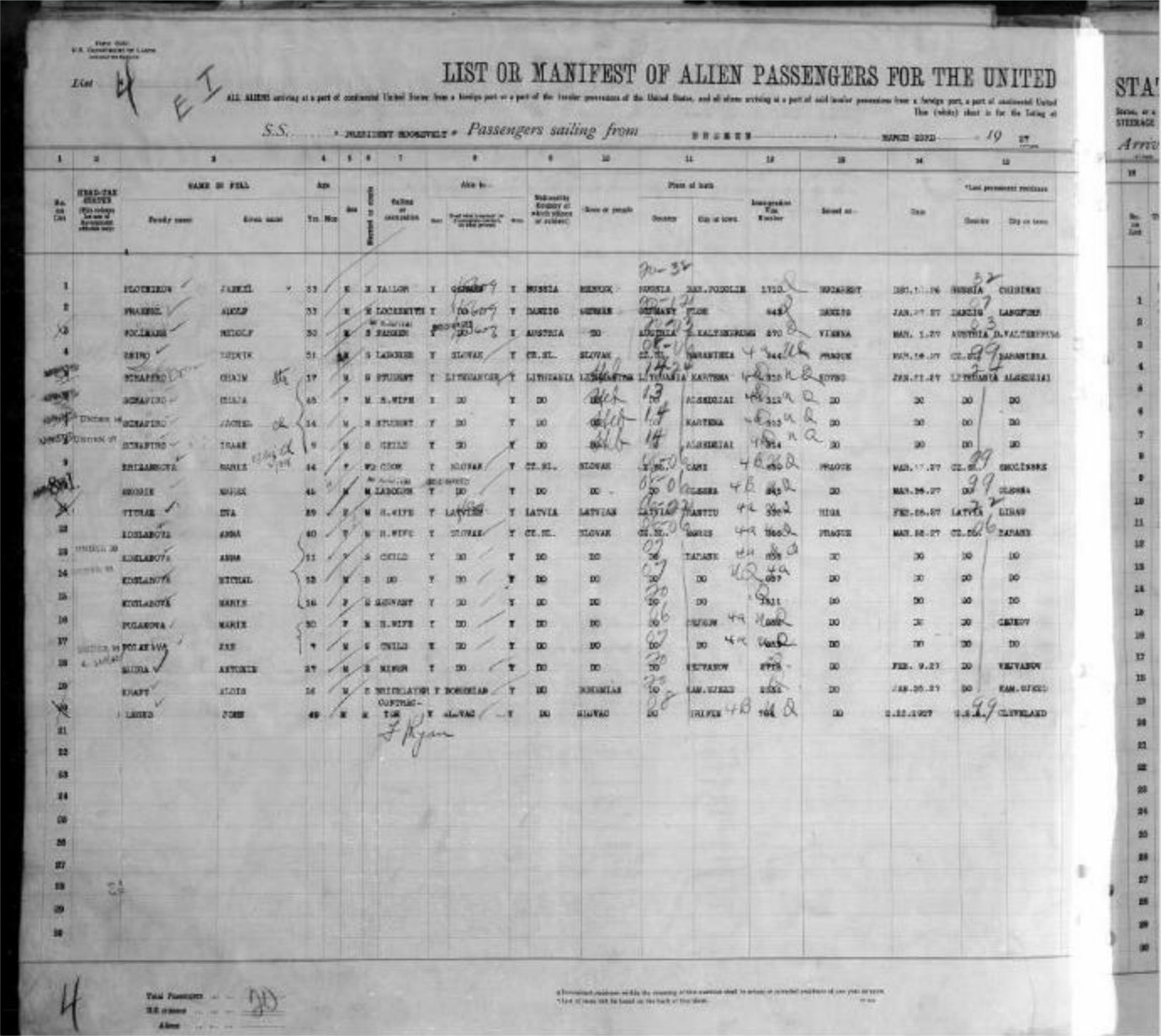
F-09 - Emigrated to New York at the end of summer 5683, 1923, now confirmed by his own immigration record.

How should this source conflict or interpretation be stated in the family history?

Wording and source conflict

Current wording:
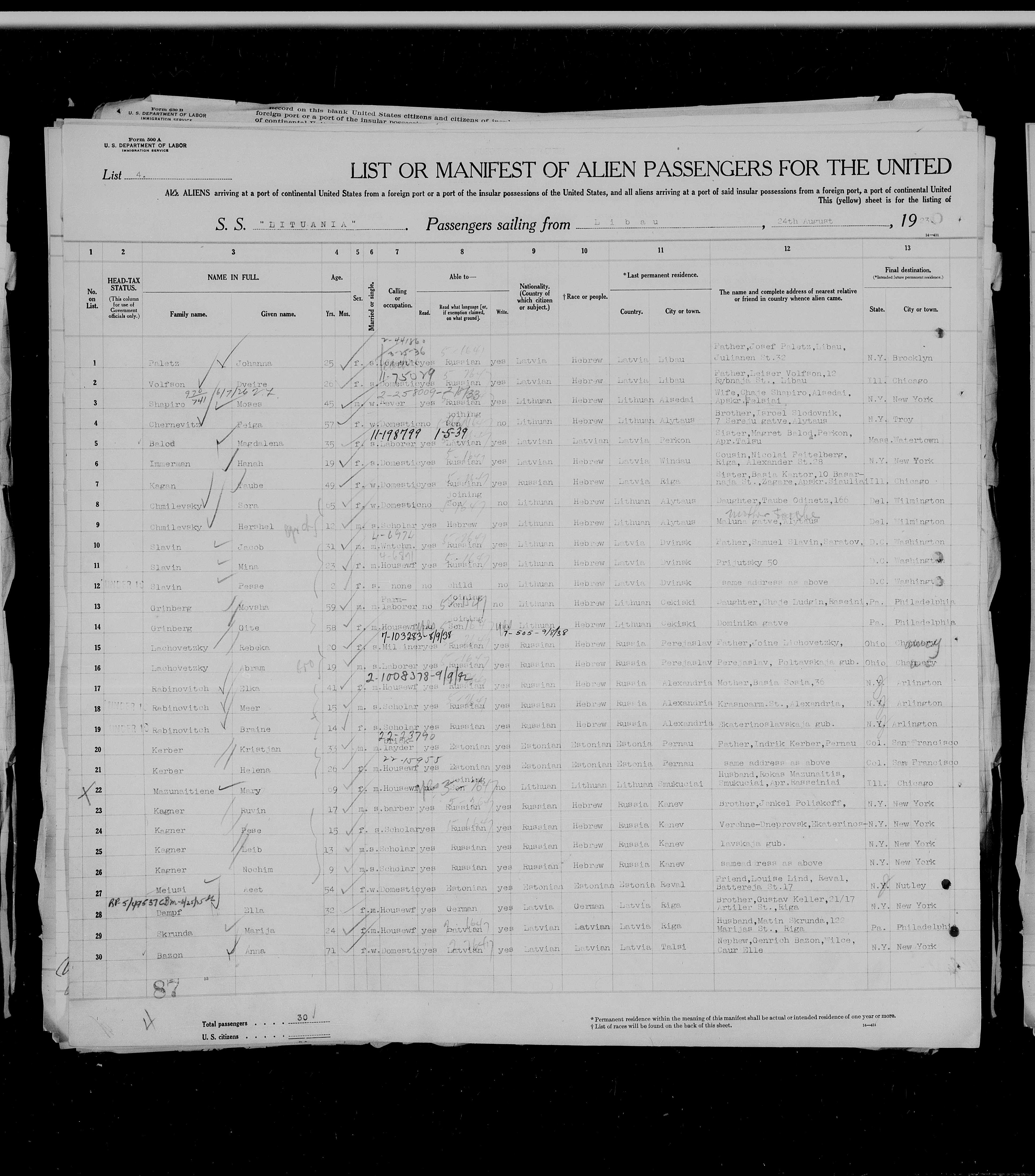
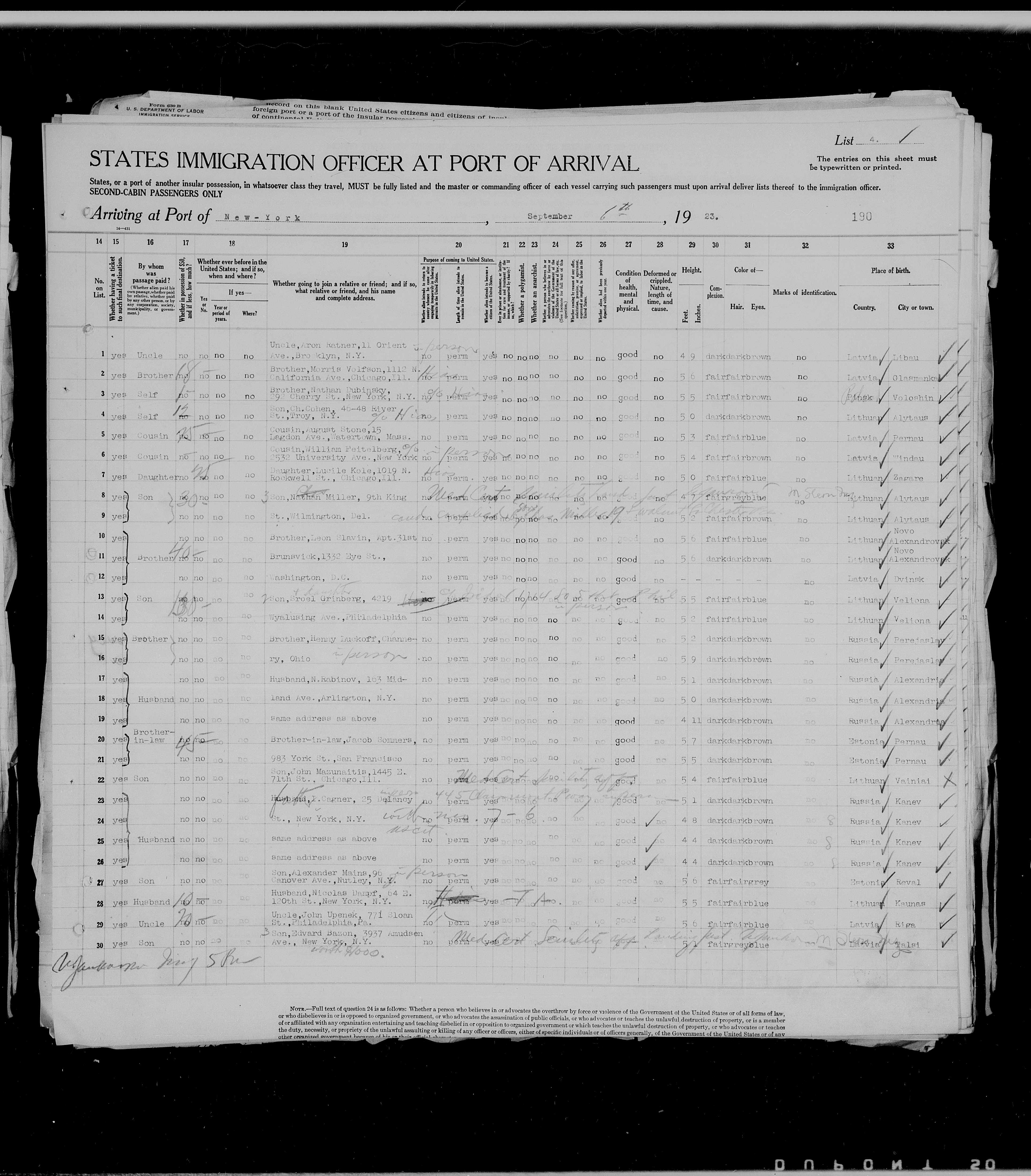
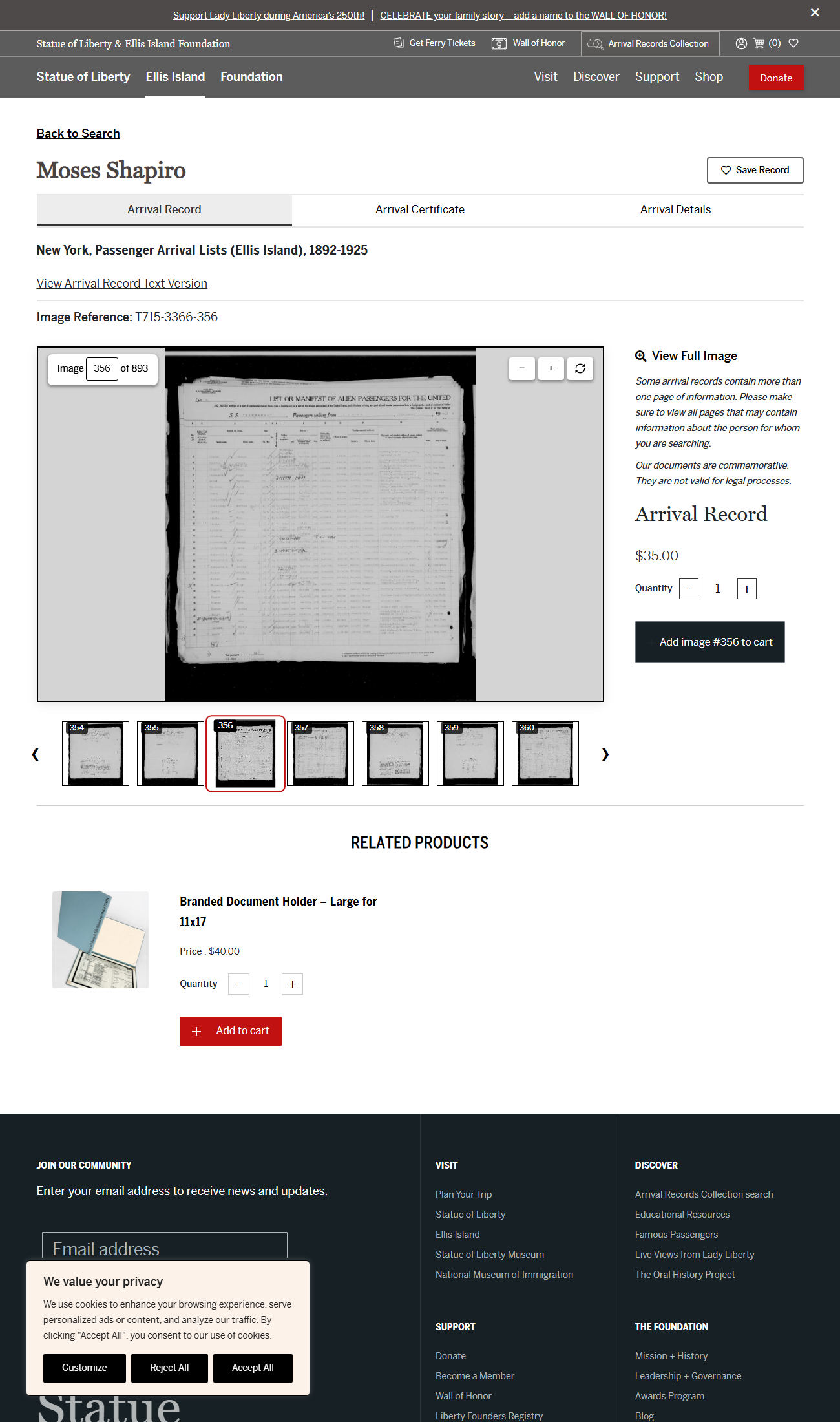
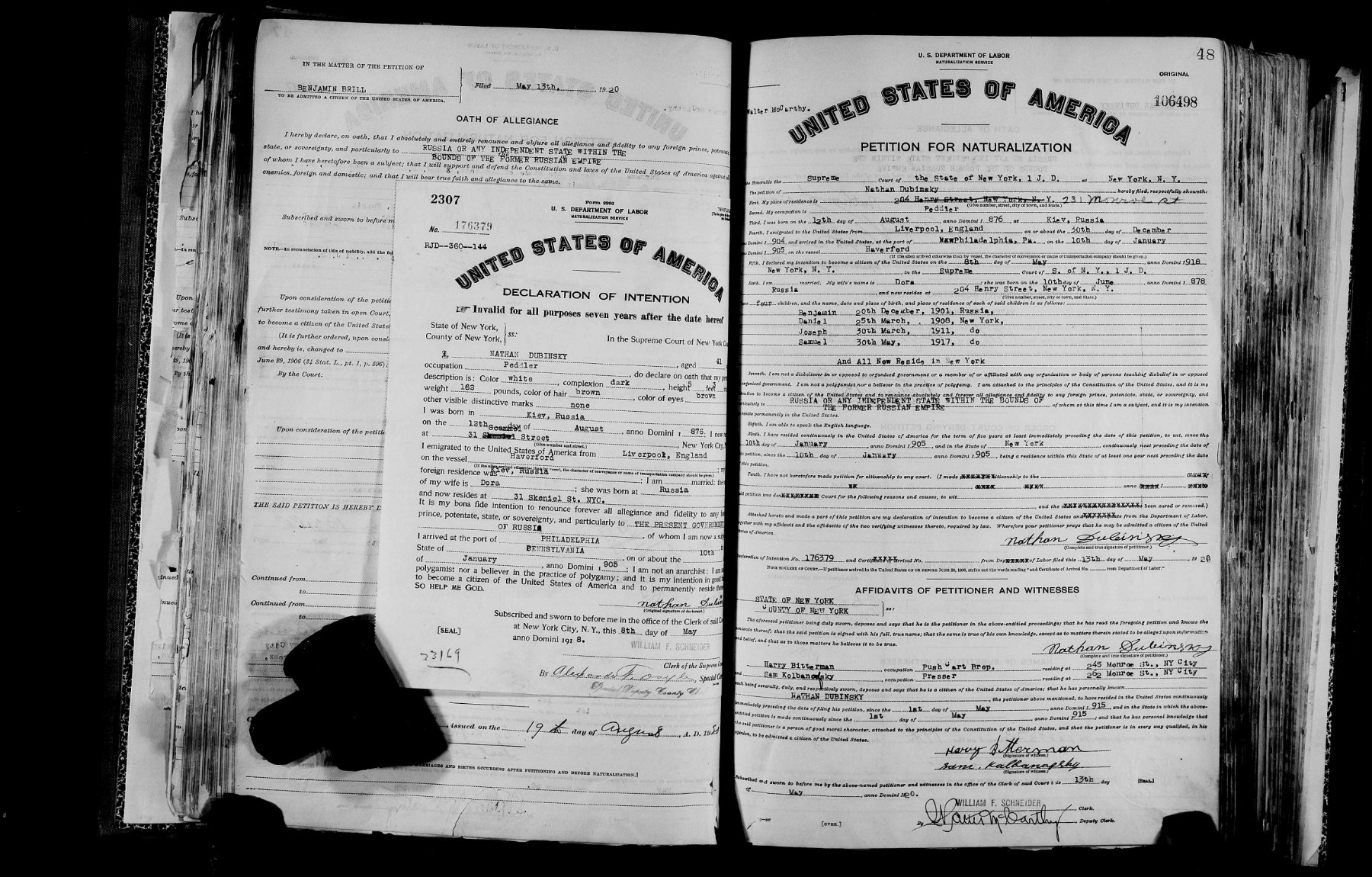
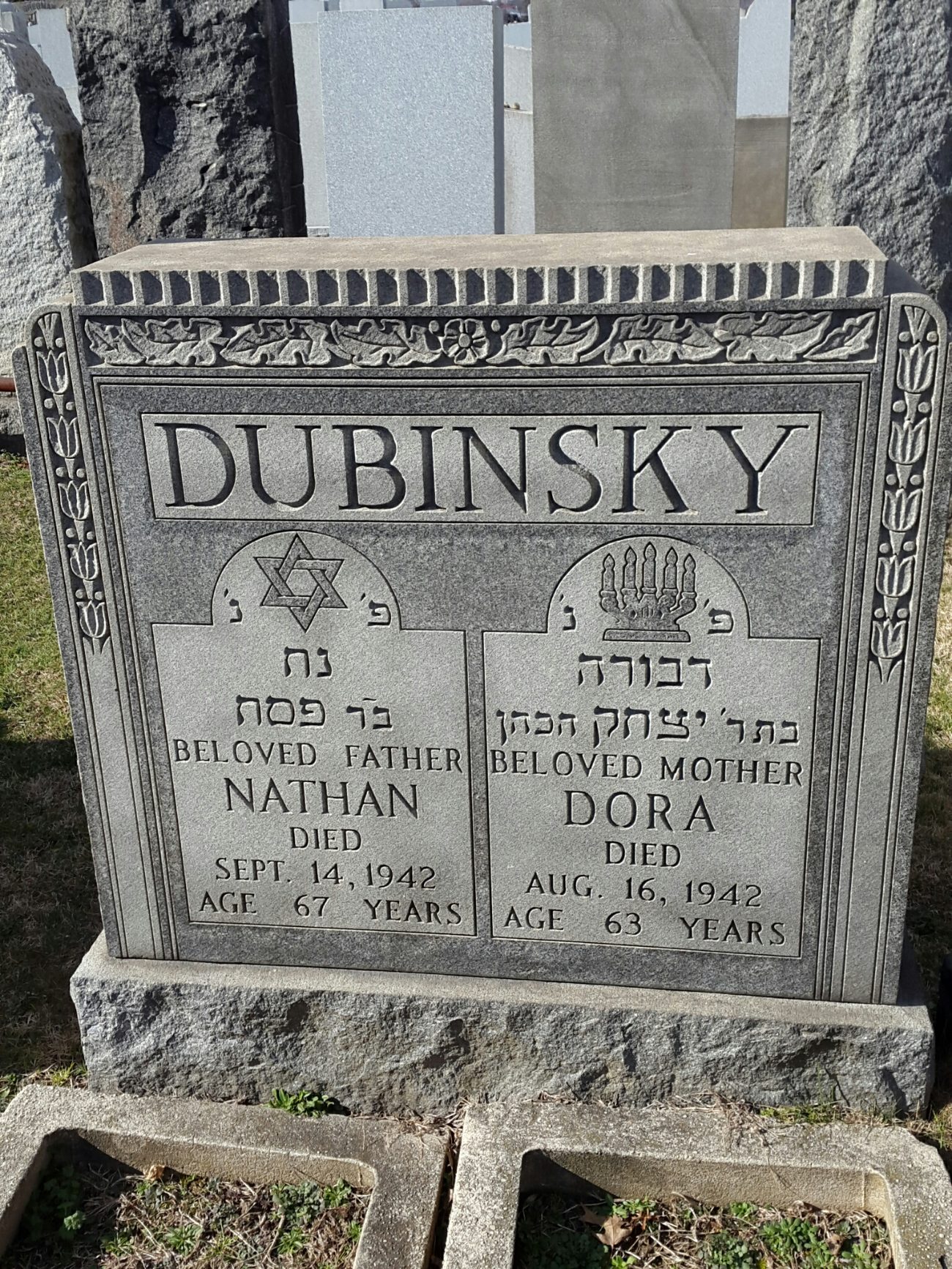
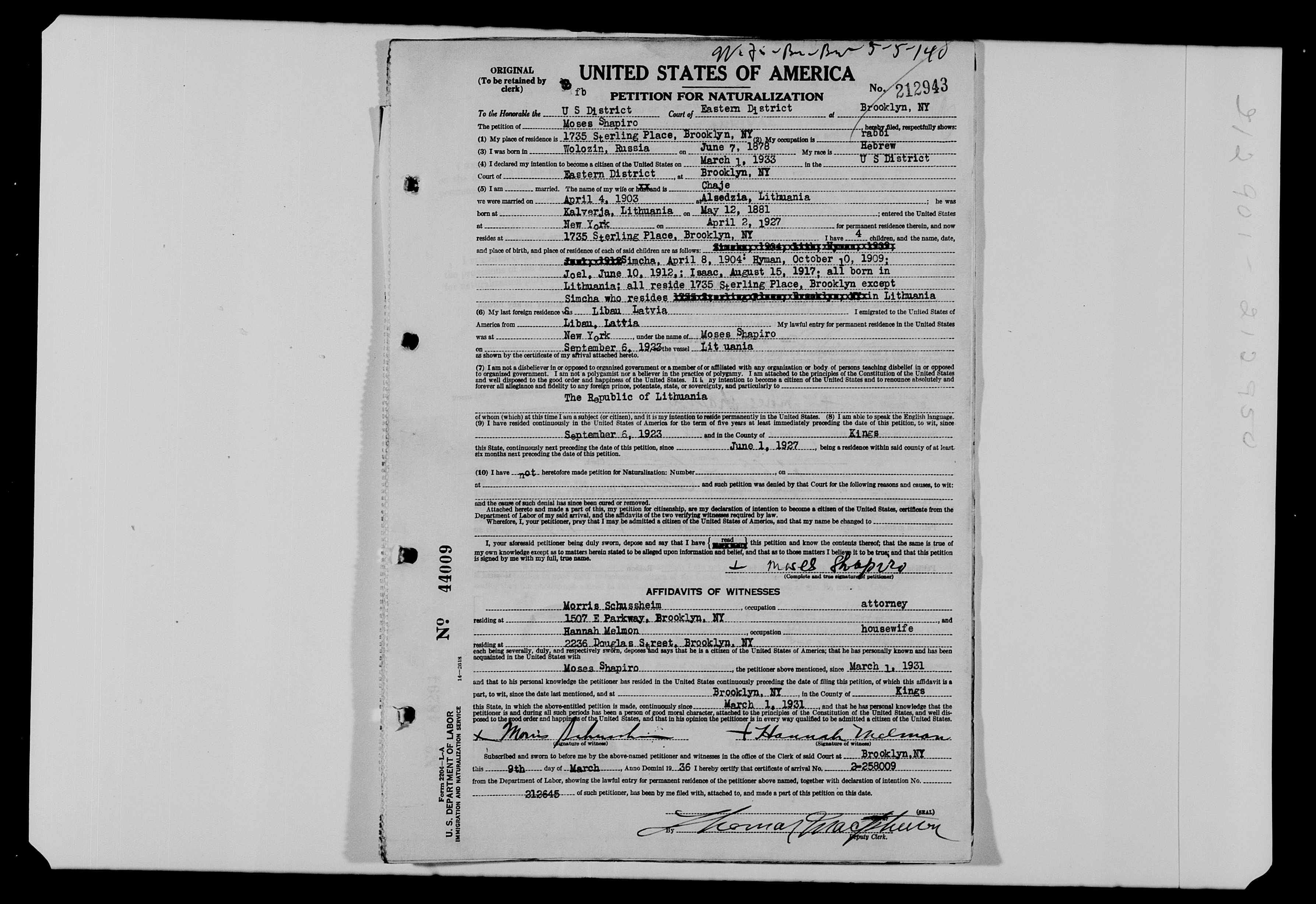
claim: Emigrated to New York at the end of summer 5683, 1923, now confirmed by his own immigration record. The Ellis Island manifest of the S.S. Lituania , sailing from Libau, records a Moses Shapiro, age 45 , arriving 6 September 1923 , last residence Alsedai, Lithuania , the same town as Alshad. This is the actual passenger list, line 3, checked directly against the scanned manifest image, not a database transcription taken on faith: image reference T715-3366-356 . One index transcription of this same manifest gives his marital status as widower ; his wife Chaya was alive until 1946 (F-41), and the 1940 census, F-55, independently lists him as married with her in the household, so the manifest transcription is a transcription error, not a real second marriage. The manifest also names a New York contact, now chased down and resolved. Column 12 gives the nearest relative in the country he came from as wife Chaje Shapiro, Alsedai , since both his own parents were long dead; column 18 gives who he was going to join in America: Brother, Nathan Dubinsky, 292 Cherry St., New York . Nathan's own American paper trail, read in full 3 September 2026, resolves him: born 12 August 1876 in Kiev , not Volozhin, son of Pincus Dubinsky and Beckie Katz , per his own 1918 declaration and 1920 naturalization petition and, independently, his 1942 New York death certificate. He is buried at Mount Hebron Cemetery, Flushing, beside his wife Dora, the stone reading נח ב״ר פסח , Noach ben Reb Pesach. He was not a blood brother. "Brother" on a 1923 immigration manifest, for a man whose real father was Pincus of Kiev, was a relative called brother loosely, most plausibly a cousin, and there the trail ends for now; nothing ties a Pincus Dubinsky to Yeshaya's line. His family followed in 1927. The years between were hard: for a time he had no position and no income, and by early 1925 he was writing from Chicago , out of work and in despair, already hoping to bring at least one son over to join him.

claim: Emigrated to New York at the end of summer 5683, 1923, now confirmed by his own immigration record. The Ellis Island manifest of the S.S. Lituania , sailing from Libau, records a Moses Shapiro, age 45 , arriving 6 September 1923 , last residence Alsedai, Lithuania , the same town as Alshad. This is the actual passenger list, line 3, checked directly against the scanned manifest image, not a database transcription taken on faith: image reference T715-3366-356 . One index transcription of this same manifest gives his marital status as widower ; his wife Chaya was alive until 1946 (F-41), and the 1940 census, F-55, independently lists him as married with her in the household, so the manifest transcription is a transcription error, not a real second marriage. The manifest also names a New York contact, now chased down and resolved. Column 12 gives the nearest relative in the country he came from as wife Chaje Shapiro, Alsedai , since both his own parents were long dead; column 18 gives who he was going to join in America: Brother, Nathan Dubinsky, 292 Cherry St., New York . Nathan's own American paper trail, read in full 3 September 2026, resolves him: born 12 August 1876 in Kiev , not Volozhin, son of Pincus Dubinsky and Beckie Katz , per his own 1918 declaration and 1920 naturalization petition and, independently, his 1942 New York death certificate. He is buried at Mount Hebron Cemetery, Flushing, beside his wife Dora, the stone reading נח ב״ר פסח , Noach ben Reb Pesach. He was not a blood brother. "Brother" on a 1923 immigration manifest, for a man whose real father was Pincus of Kiev, was a relative called brother loosely, most plausibly a cousin, and there the trail ends for now; nothing ties a Pincus Dubinsky to Yeshaya's line. His family followed in 1927. The years between were hard: for a time he had no position and no income, and by early 1925 he was writing from Chicago , out of work and in despair, already hoping to bring at least one son over to join him.

Proposed wording or replacement phrase:
claim: column 19 gives who he was going to join in America:
Why this needs a decision: Full-page header checked in earlier native-source batch; contact/address is column19, not18.

claim: The passenger-list entry has conflicting marital-status evidence: its marked status was read as widower, while the same manifest names wife Chaje Shapiro in Alsedai and Chaya lived until 1946 (F-41). The 1940 census index also lists him with his wife (F-55). The conflict cannot be explained solely as an index transcription error.
Why this needs a decision: Original marked status was visually checked earlier; later marriage evidence does not erase actual original mark. No second marriage inferred.
Sources

Original Lituania manifest, page 1
Original Lituania manifest, page 1 - Open full size
Original Lituania manifest, page 2
Original Lituania manifest, page 2 - Open full size
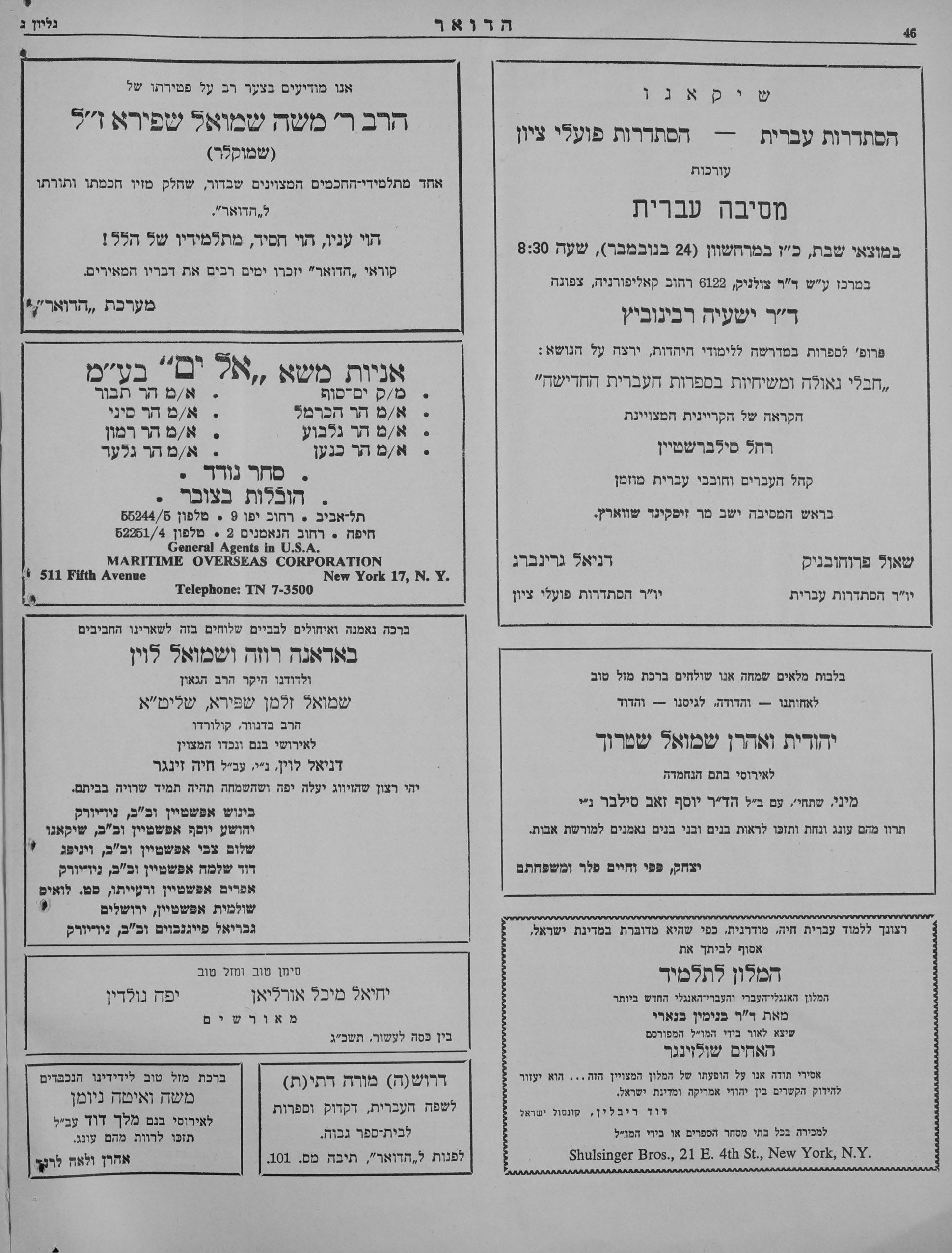
HaDoar, 16 November 1962, printed annual p.46 (issue p.14)
HaDoar, 16 November 1962, printed annual p.46 (issue p.14) - Open full size
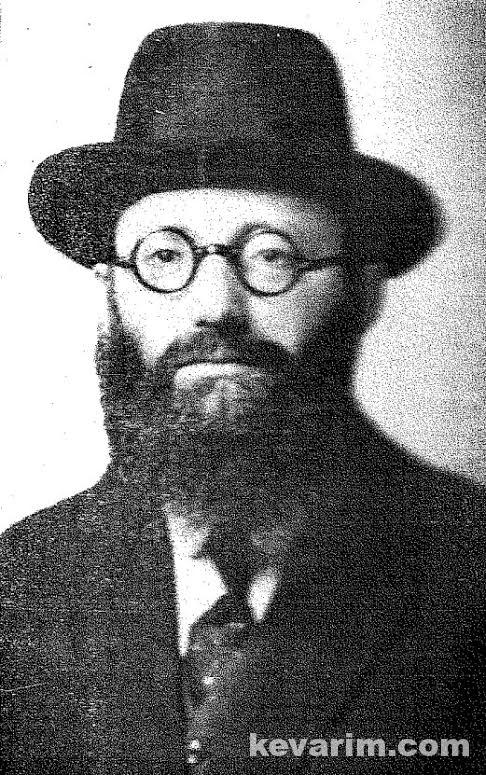
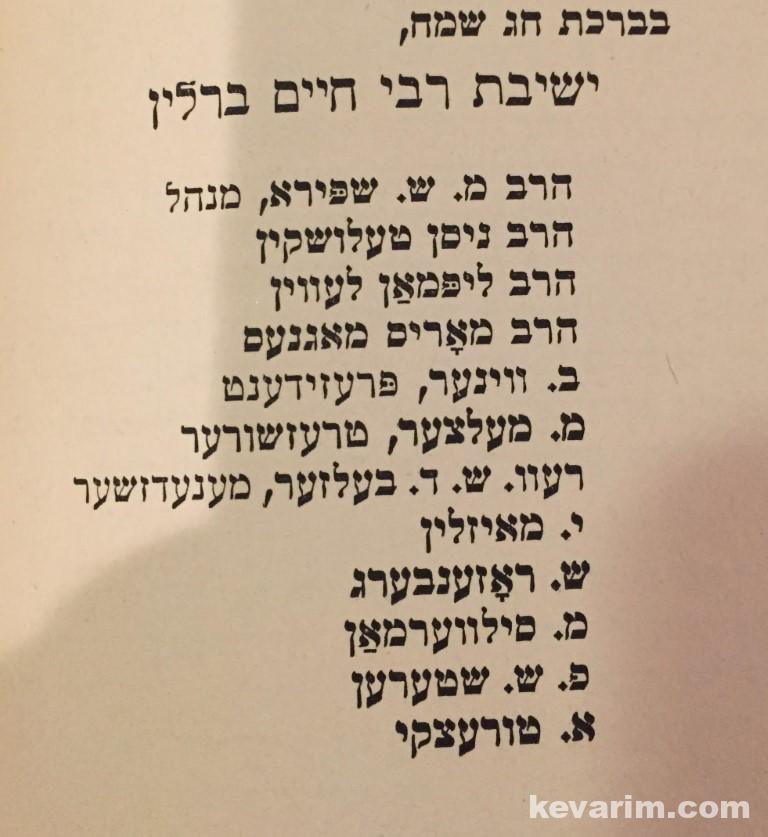
kevarim.com: his portrait and the Yeshiva Rabbeinu Chaim Berlin faculty list posted by the family
kevarim.com: his portrait and the Yeshiva Rabbeinu Chaim Berlin faculty list posted by the family - Open full size
kevarim.com: his portrait and the Yeshiva Rabbeinu Chaim Berlin faculty list posted by the family
kevarim.com: his portrait and the Yeshiva Rabbeinu Chaim Berlin faculty list posted by the family - Open full size
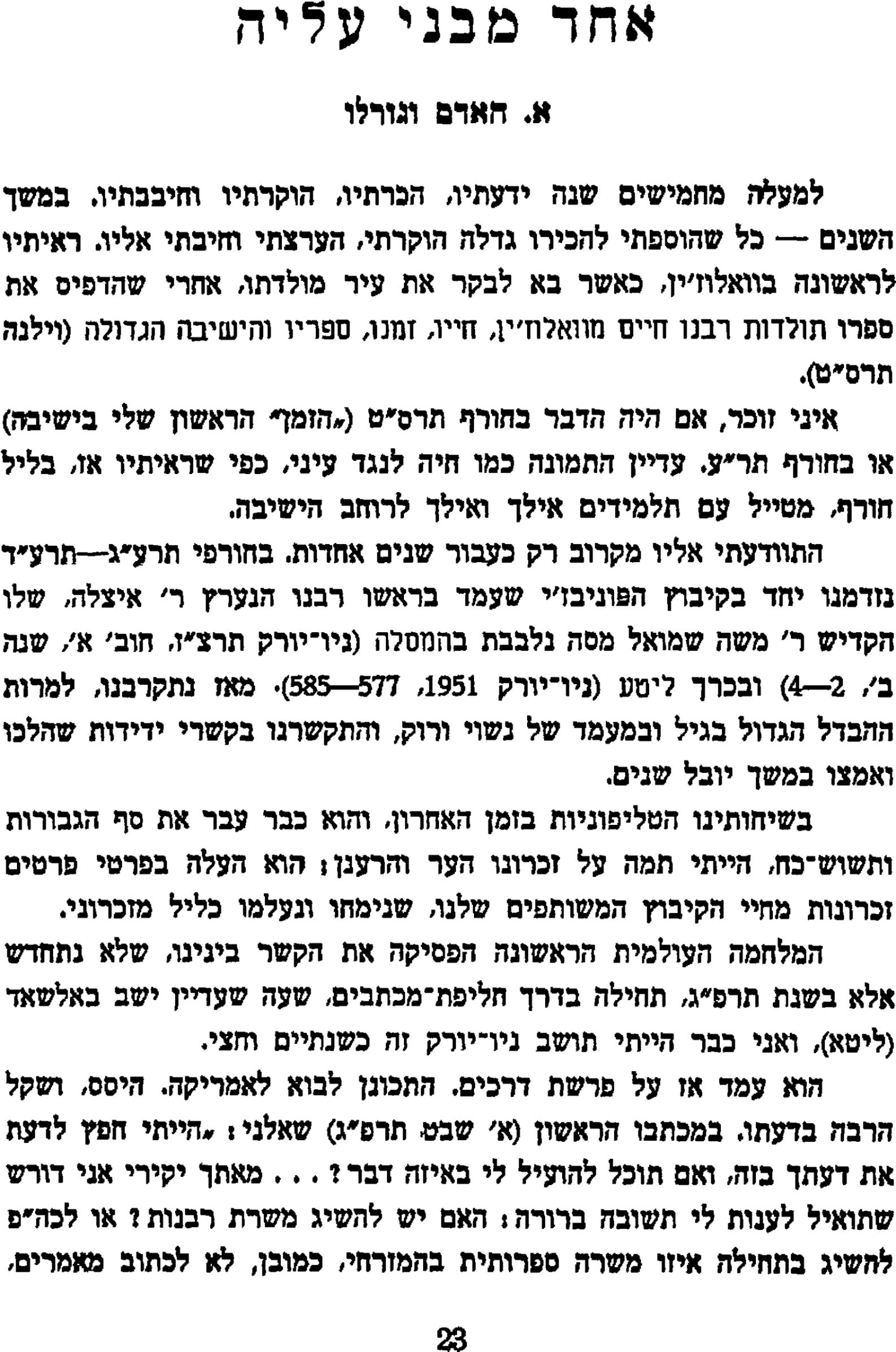
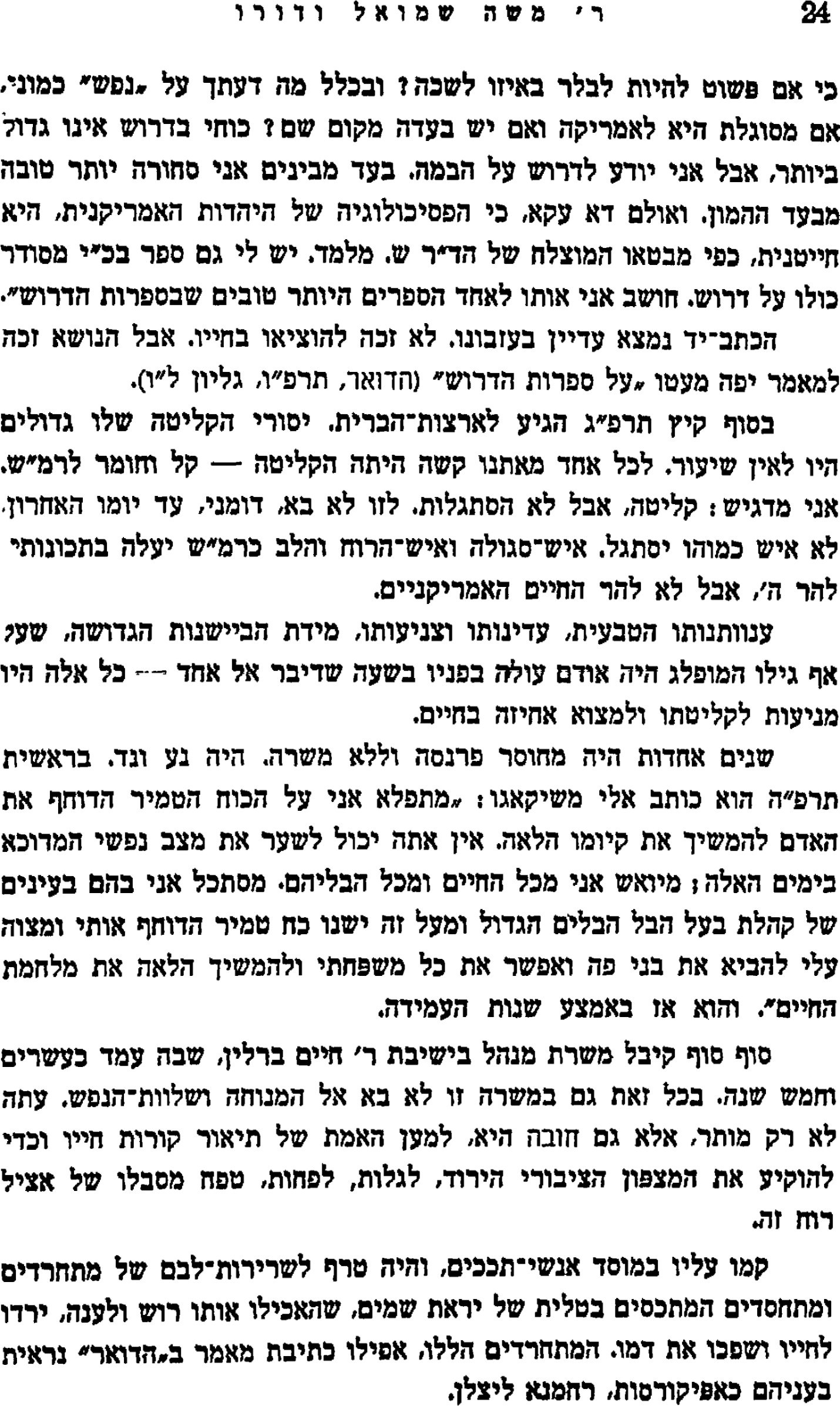
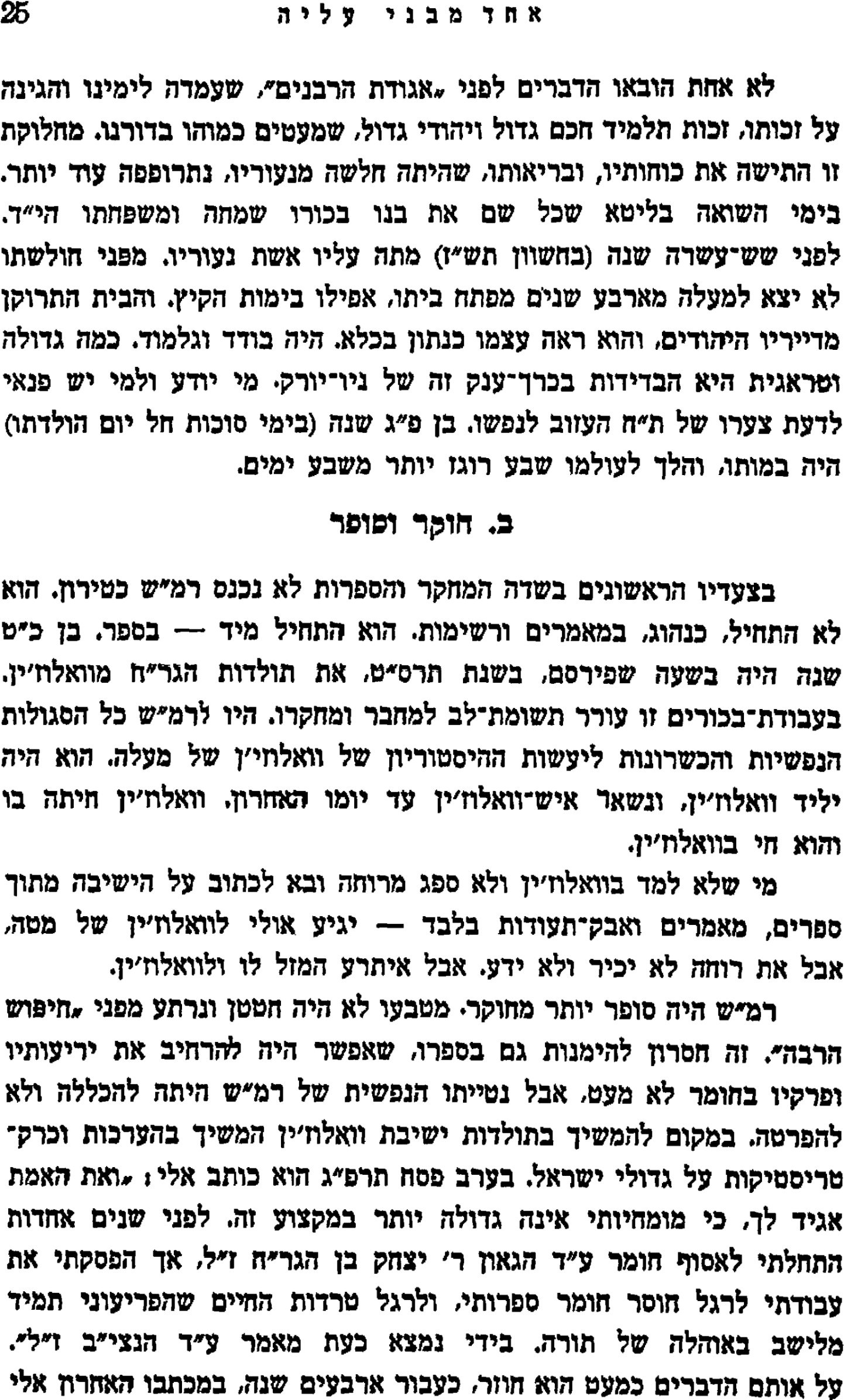
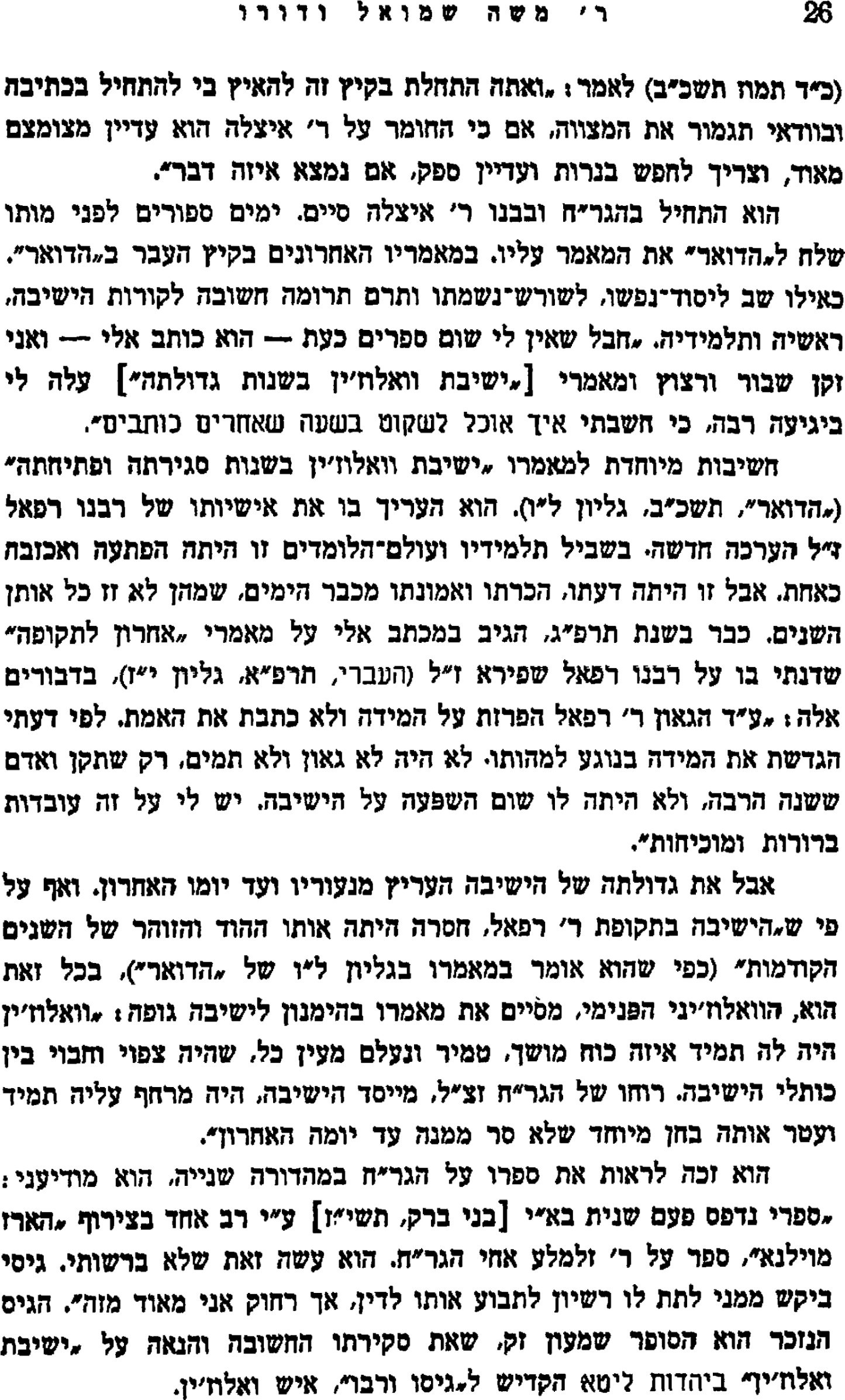
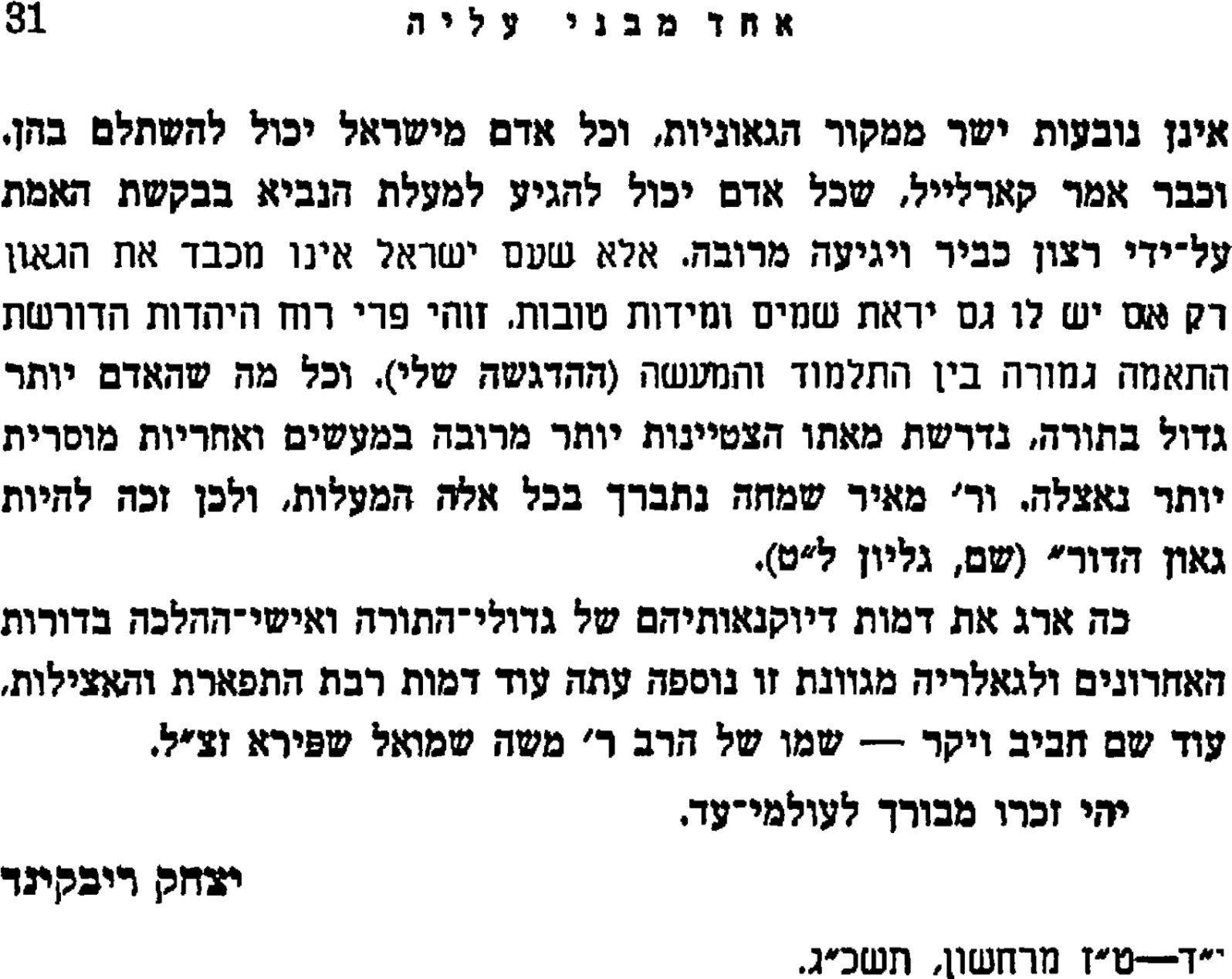
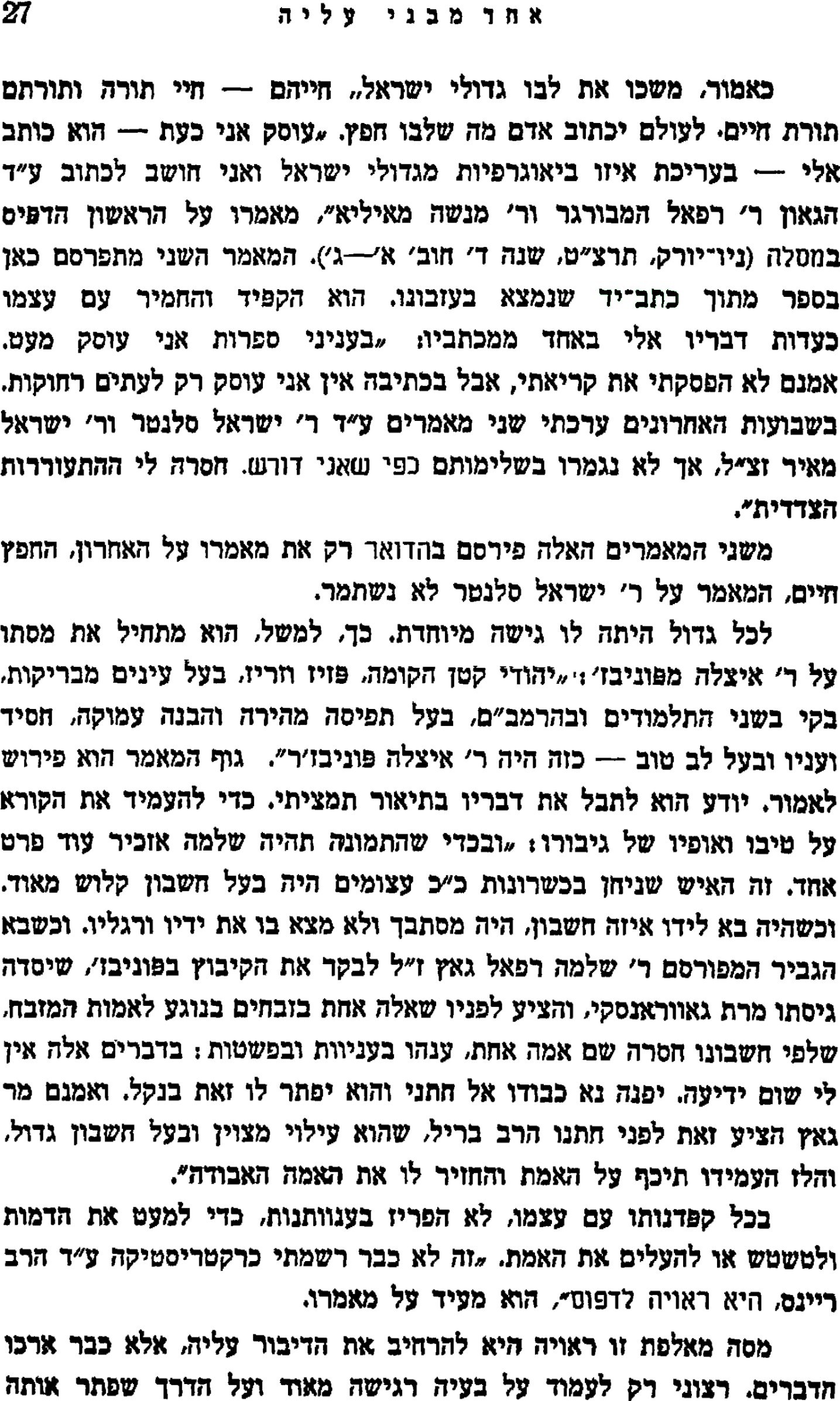
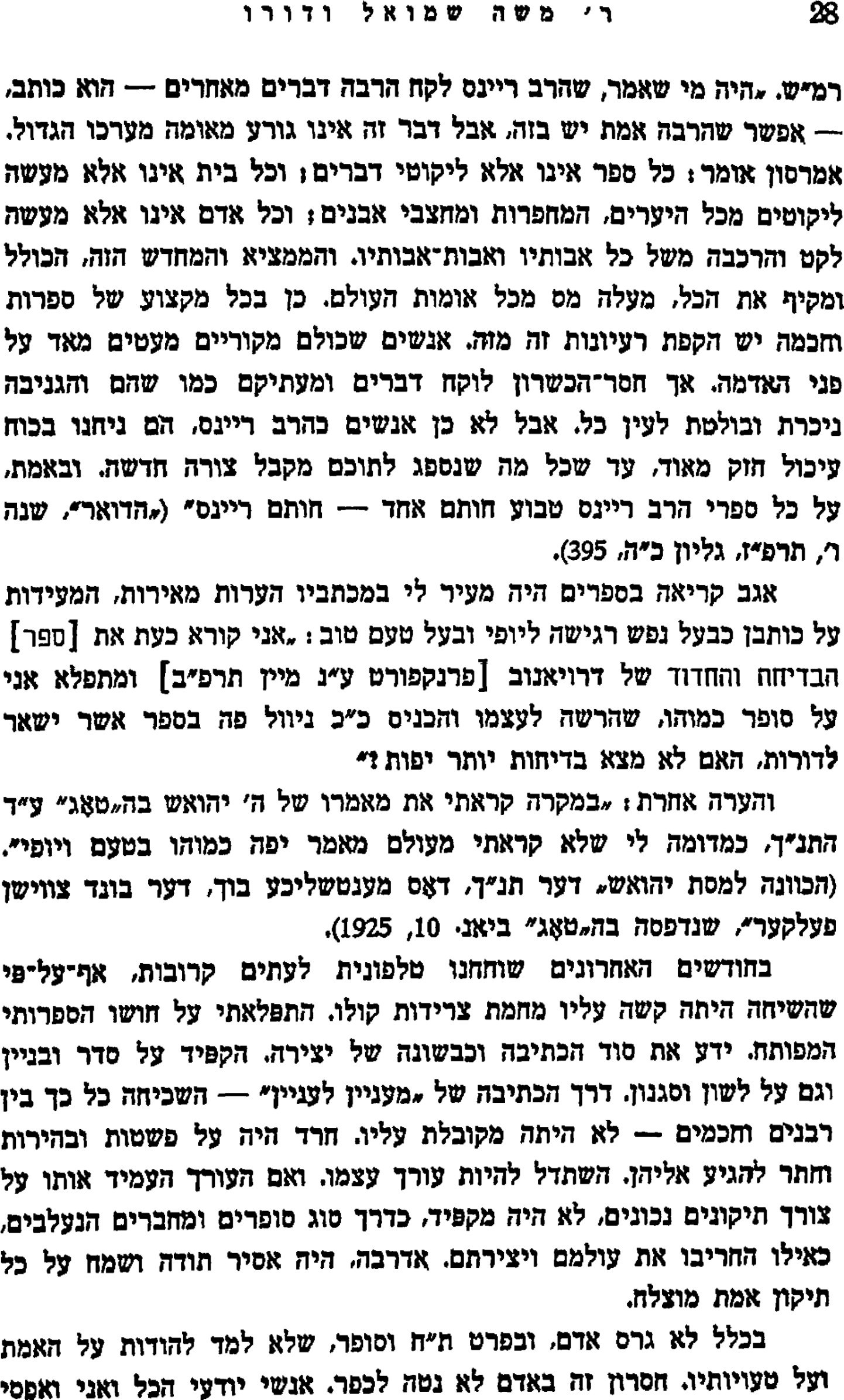
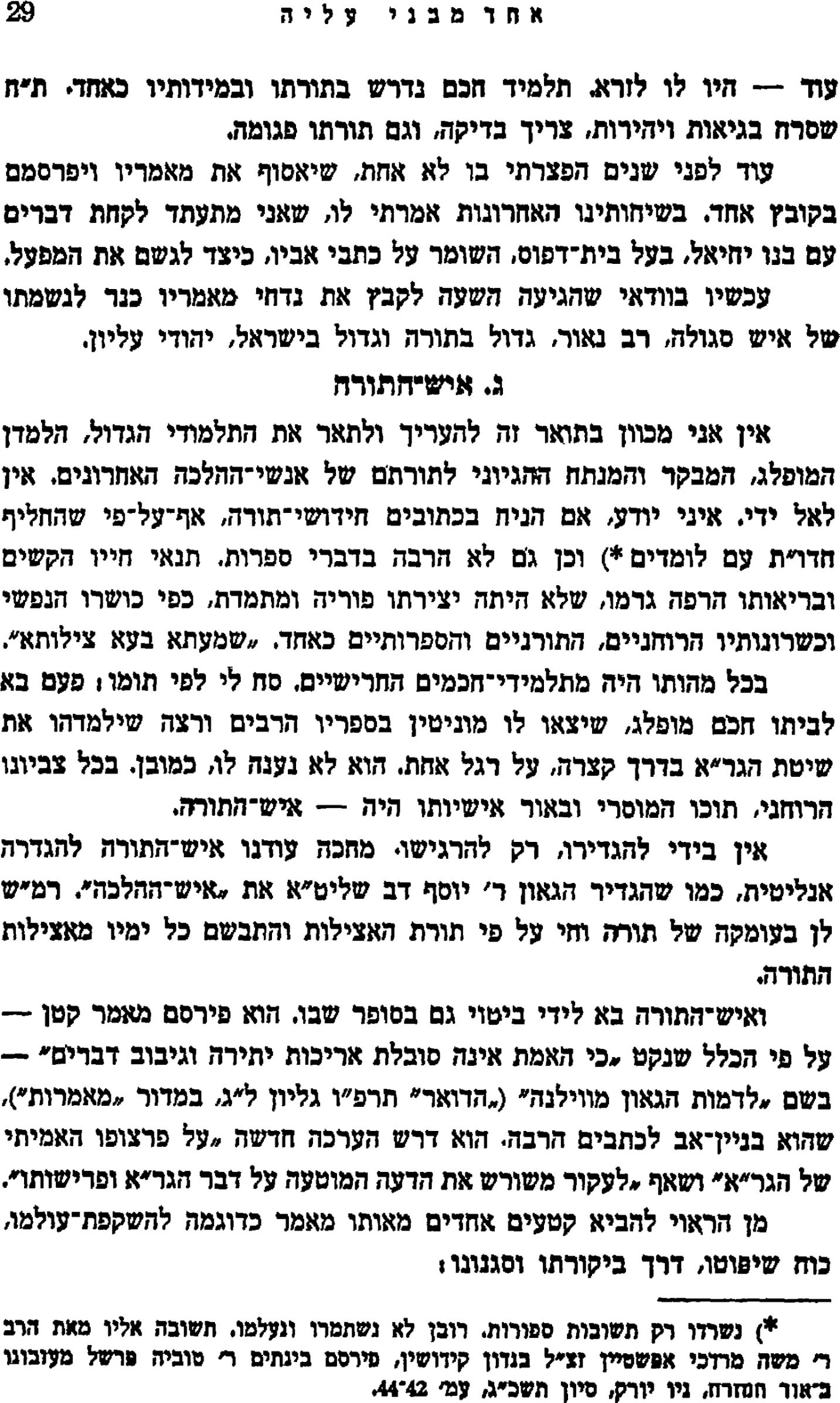
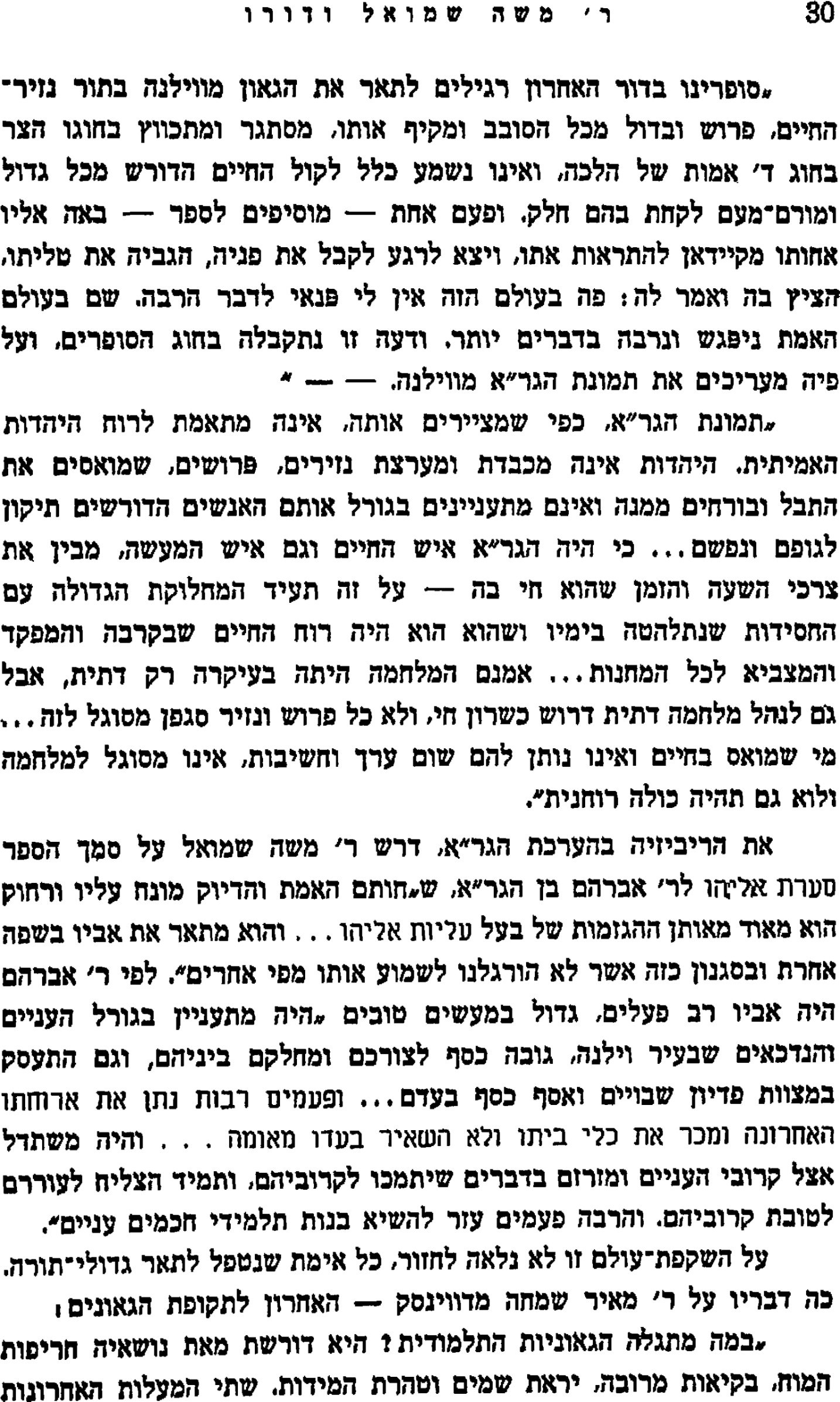
R' Moshe Shmuel V'Doro (New York, 1964), pages 23 to 31: R' Yitzchak Rivkind's memoir, Echad MiBnei Aliyah, complete. Otzar HaChochma, catalogue no. 25473
R' Moshe Shmuel V'Doro (New York, 1964), pages 23 to 31: R' Yitzchak Rivkind's memoir, Echad MiBnei Aliyah, complete. Otzar HaChochma, catalogue no. 25473 - Open full size
R' Moshe Shmuel V'Doro (New York, 1964), pages 23 to 31: R' Yitzchak Rivkind's memoir, Echad MiBnei Aliyah, complete. Otzar HaChochma, catalogue no. 25473
R' Moshe Shmuel V'Doro (New York, 1964), pages 23 to 31: R' Yitzchak Rivkind's memoir, Echad MiBnei Aliyah, complete. Otzar HaChochma, catalogue no. 25473 - Open full size
R' Moshe Shmuel V'Doro (New York, 1964), pages 23 to 31: R' Yitzchak Rivkind's memoir, Echad MiBnei Aliyah, complete. Otzar HaChochma, catalogue no. 25473
R' Moshe Shmuel V'Doro (New York, 1964), pages 23 to 31: R' Yitzchak Rivkind's memoir, Echad MiBnei Aliyah, complete. Otzar HaChochma, catalogue no. 25473 - Open full size
R' Moshe Shmuel V'Doro (New York, 1964), pages 23 to 31: R' Yitzchak Rivkind's memoir, Echad MiBnei Aliyah, complete. Otzar HaChochma, catalogue no. 25473
R' Moshe Shmuel V'Doro (New York, 1964), pages 23 to 31: R' Yitzchak Rivkind's memoir, Echad MiBnei Aliyah, complete. Otzar HaChochma, catalogue no. 25473 - Open full size
R' Moshe Shmuel V'Doro (New York, 1964), pages 23 to 31: R' Yitzchak Rivkind's memoir, Echad MiBnei Aliyah, complete. Otzar HaChochma, catalogue no. 25473
R' Moshe Shmuel V'Doro (New York, 1964), pages 23 to 31: R' Yitzchak Rivkind's memoir, Echad MiBnei Aliyah, complete. Otzar HaChochma, catalogue no. 25473 - Open full size
R' Moshe Shmuel V'Doro (New York, 1964), pages 23 to 31: R' Yitzchak Rivkind's memoir, Echad MiBnei Aliyah, complete. Otzar HaChochma, catalogue no. 25473
R' Moshe Shmuel V'Doro (New York, 1964), pages 23 to 31: R' Yitzchak Rivkind's memoir, Echad MiBnei Aliyah, complete. Otzar HaChochma, catalogue no. 25473 - Open full size
R' Moshe Shmuel V'Doro (New York, 1964), pages 23 to 31: R' Yitzchak Rivkind's memoir, Echad MiBnei Aliyah, complete. Otzar HaChochma, catalogue no. 25473
R' Moshe Shmuel V'Doro (New York, 1964), pages 23 to 31: R' Yitzchak Rivkind's memoir, Echad MiBnei Aliyah, complete. Otzar HaChochma, catalogue no. 25473 - Open full size
R' Moshe Shmuel V'Doro (New York, 1964), pages 23 to 31: R' Yitzchak Rivkind's memoir, Echad MiBnei Aliyah, complete. Otzar HaChochma, catalogue no. 25473
R' Moshe Shmuel V'Doro (New York, 1964), pages 23 to 31: R' Yitzchak Rivkind's memoir, Echad MiBnei Aliyah, complete. Otzar HaChochma, catalogue no. 25473 - Open full size
R' Moshe Shmuel V'Doro (New York, 1964), pages 23 to 31: R' Yitzchak Rivkind's memoir, Echad MiBnei Aliyah, complete. Otzar HaChochma, catalogue no. 25473
R' Moshe Shmuel V'Doro (New York, 1964), pages 23 to 31: R' Yitzchak Rivkind's memoir, Echad MiBnei Aliyah, complete. Otzar HaChochma, catalogue no. 25473 - Open full size
Statue of Liberty-Ellis Island Foundation passenger record: S.S. Lituania, 6 September 1923
Statue of Liberty-Ellis Island Foundation passenger record: S.S. Lituania, 6 September 1923 - Open full size
S.S. Lituania manifest, 1923: nearest relative Chaje Shapiro of Alsedai; going to join Brother, Nathan Dubinsky, 292 Cherry St., New York
S.S. Lituania manifest, 1923: nearest relative Chaje Shapiro of Alsedai; going to join Brother, Nathan Dubinsky, 292 Cherry St., New York - Open full size
Nathan Dubinsky's naturalization papers: born Kiev, Russia, 12 August 1876
Nathan Dubinsky's naturalization papers: born Kiev, Russia, 12 August 1876 - Open full size
Certificate of Death, Nathan Dubinsky, died 14 September 1942: father Pincus Dubinsky, mother Beckie Katz, both born Russia
Certificate of Death, Nathan Dubinsky, died 14 September 1942: father Pincus Dubinsky, mother Beckie Katz, both born Russia - Open full size
Nathan and Dora Dubinsky's shared gravestone, Mount Hebron Cemetery: Noach ben Reb Pesach
Nathan and Dora Dubinsky's shared gravestone, Mount Hebron Cemetery: Noach ben Reb Pesach - Open full size
Save your answer
SAVED-F-15

F-15 - Shimon Mordechai Dubinsky's rabbinic role in Smorgon

How should this source conflict or interpretation be stated in the family history?

Wording and source conflict

Current wording:
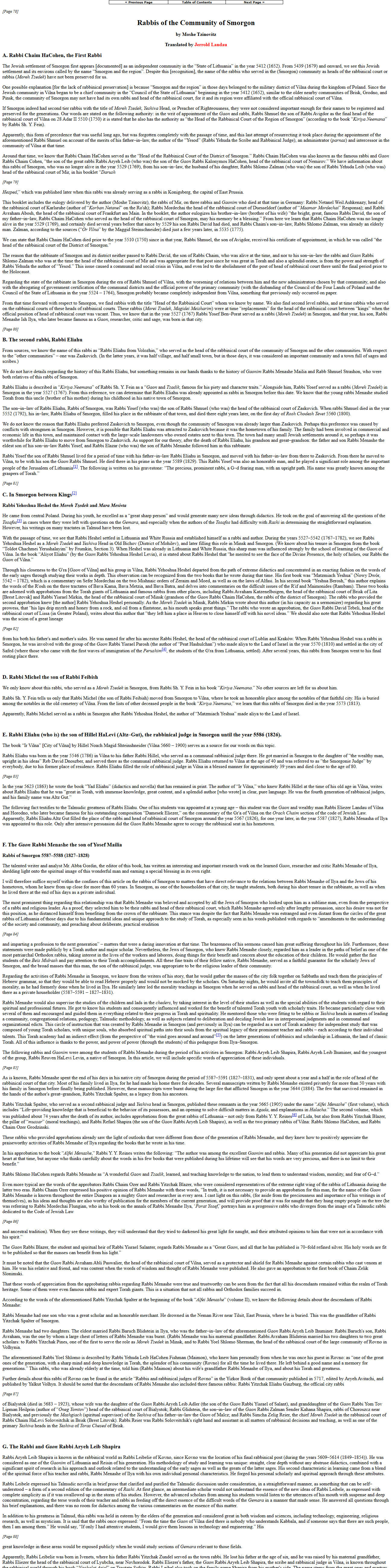
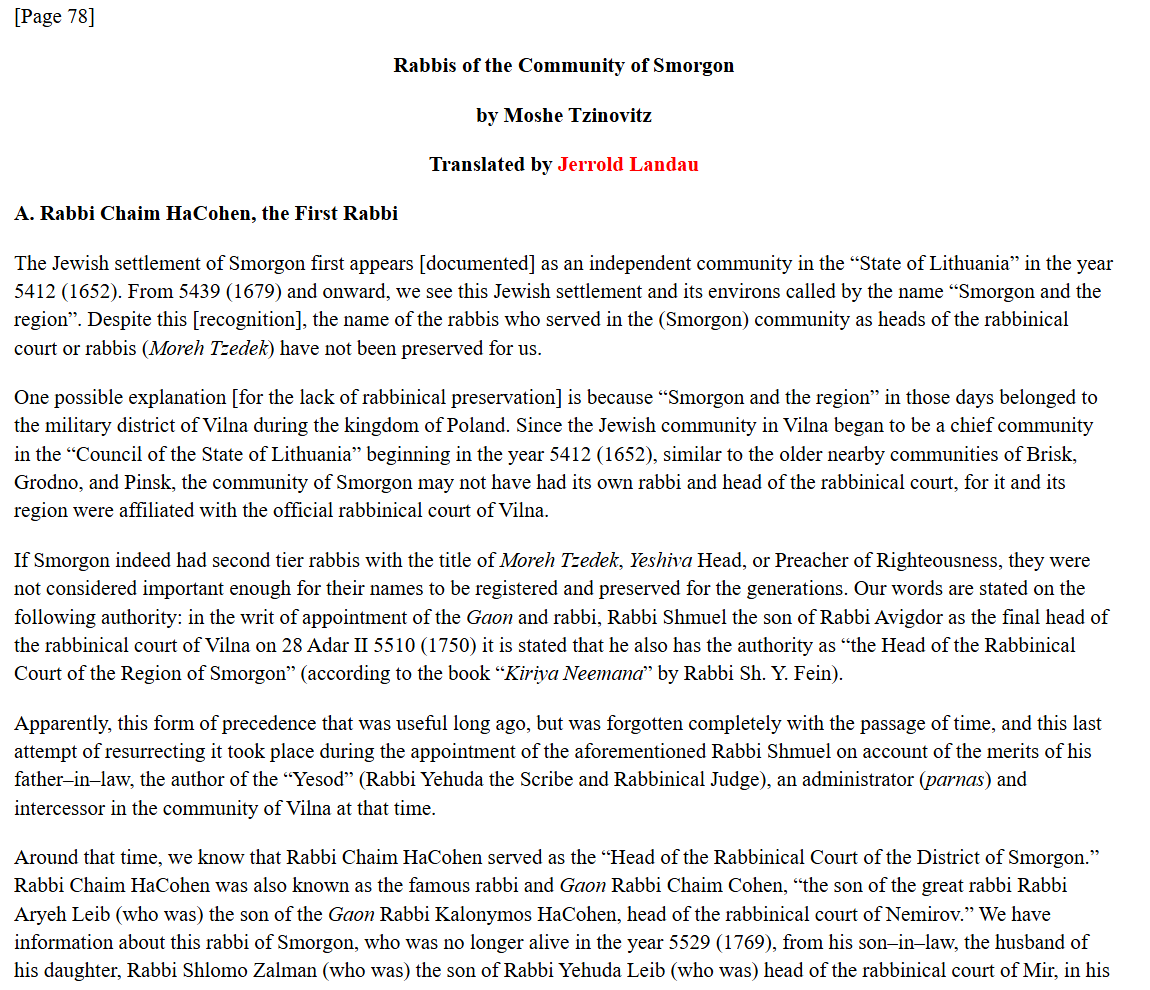
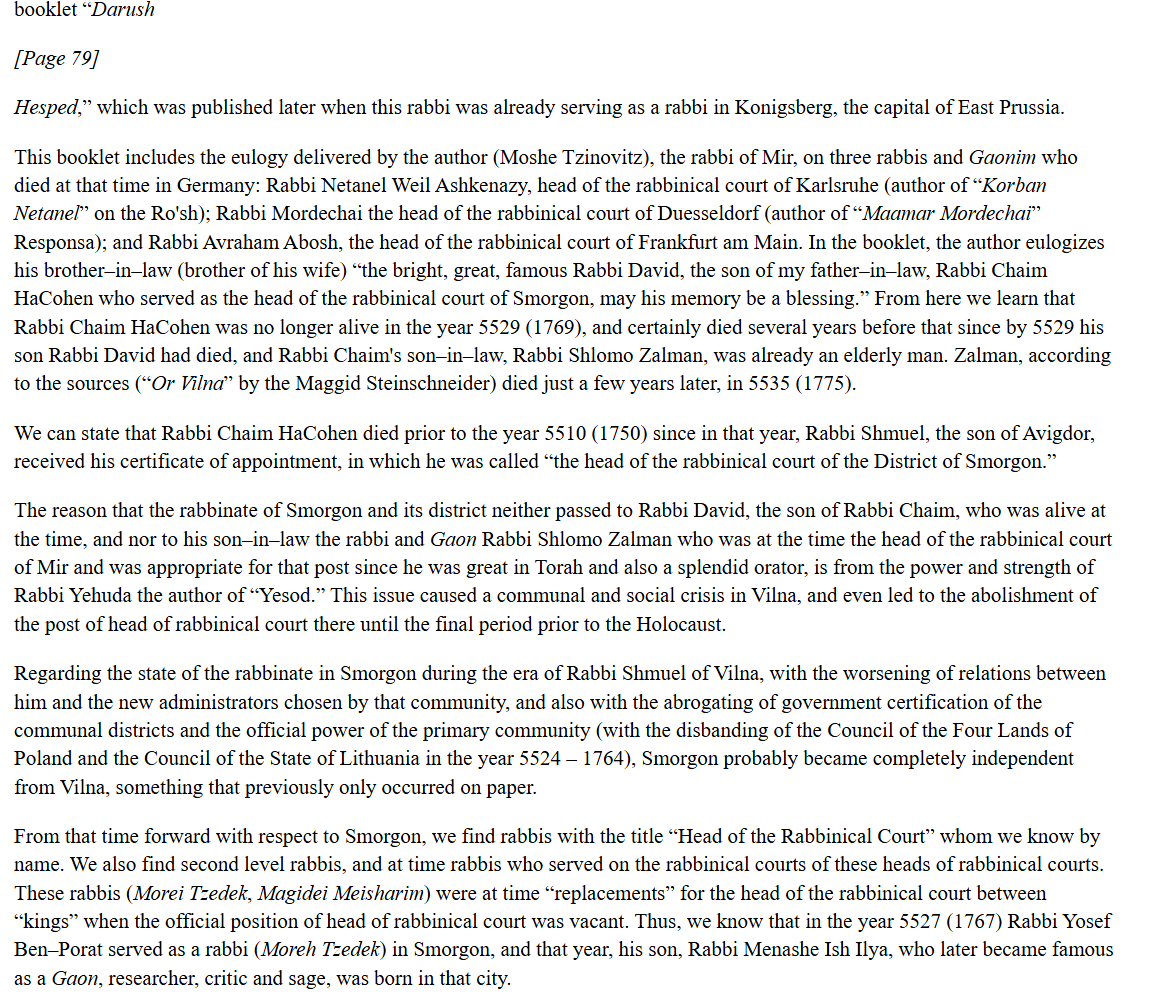
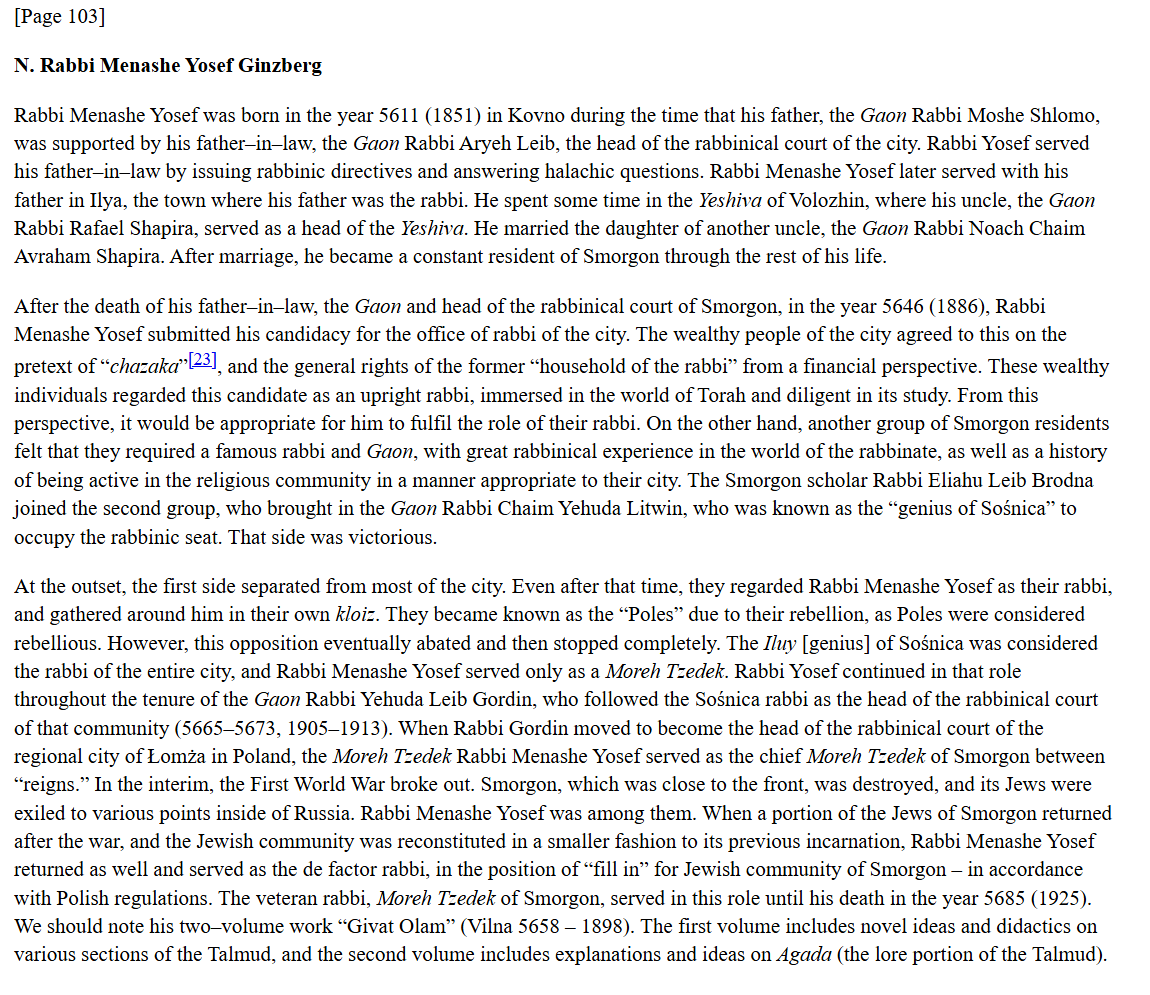
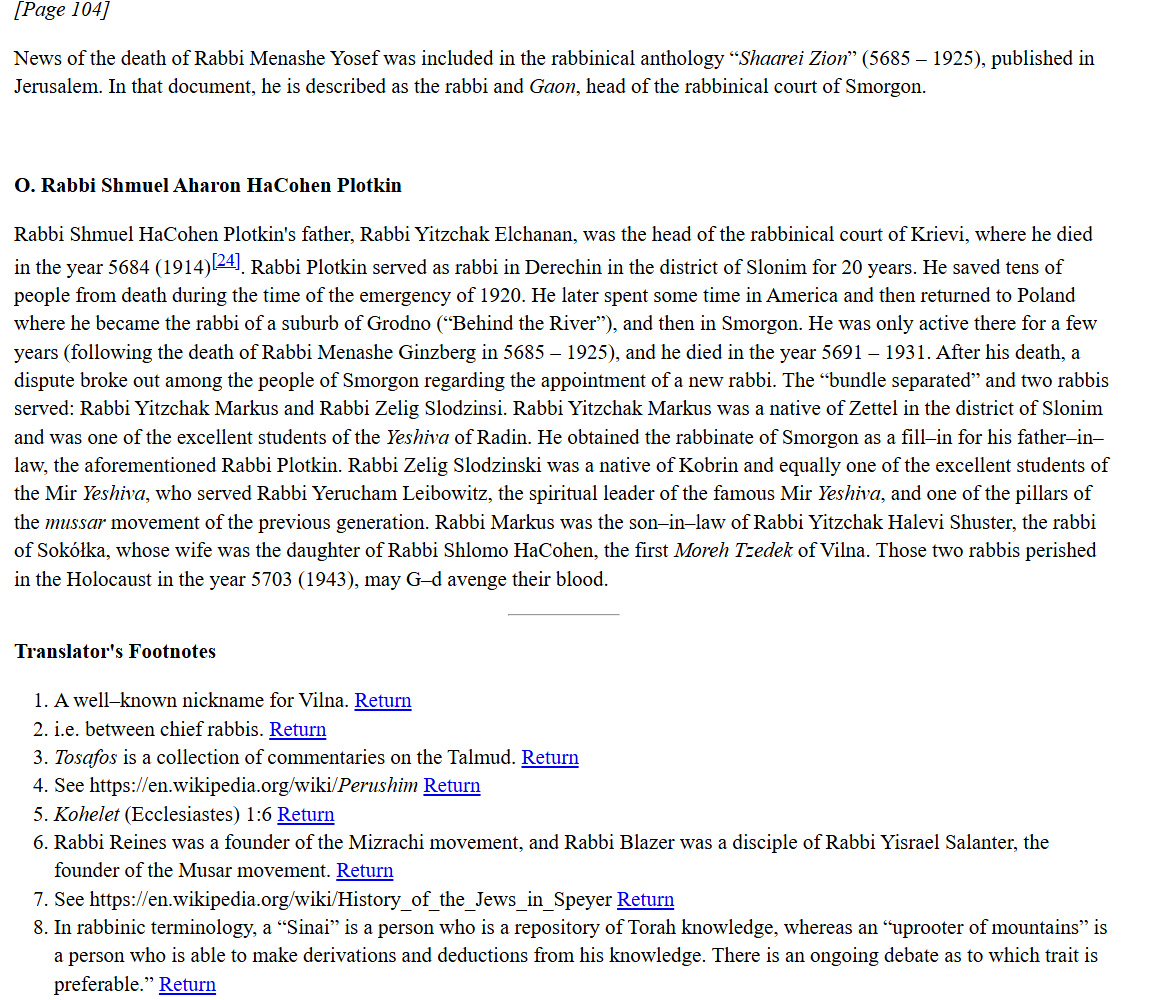
claim: "Rav of Smorgon" is disproven as stated. The Smorgon Yizkor book has a dedicated chapter listing every rav of the community from before 1750 to the last two, who perished in 1943. He is not on it. He was a resident scholar there, not the town's rav.

Proposed wording or replacement phrase:
claim: The Smorgon Yizkor book's rabbi chapter does not list him. It covers earlier rabbis and ends with Markus and Slodzinski, killed in 1943. That omission does not by itself rule out every rabbinic role. The family material describes his scholarly life in Smorgon; his precise role remains a separate question.
Why this needs a decision: Chapter contains earlier-name caveat; absence is bounded, not exhaustive proof he could not be a rav.

Sources

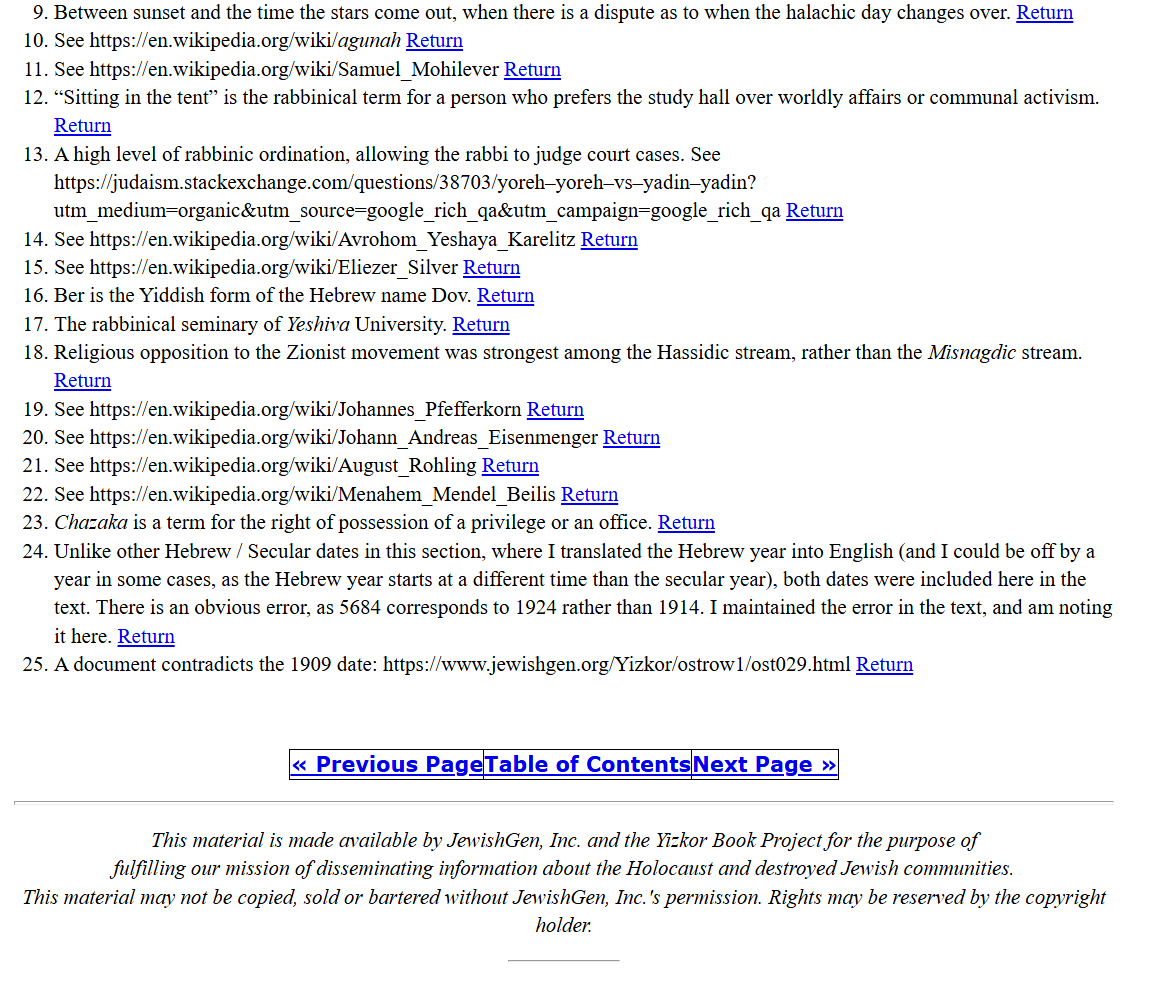
Smorgon yizkor book, JewishGen translation, the Rabbis of Smorgon chapter, pp.78 to 104: the page as a whole, its opening pages 78 to 79, its closing pages 103 to 104, the translator's footnotes and the site footer.
Smorgon yizkor book, JewishGen translation, the Rabbis of Smorgon chapter, pp.78 to 104: the page as a whole, its opening pages 78 to 79, its closing pages 103 to 104, the translator's footnotes and the site footer. - Open full size
Smorgon yizkor book, JewishGen translation, the Rabbis of Smorgon chapter, pp.78 to 104: the page as a whole, its opening pages 78 to 79, its closing pages 103 to 104, the translator's footnotes and the site footer.
Smorgon yizkor book, JewishGen translation, the Rabbis of Smorgon chapter, pp.78 to 104: the page as a whole, its opening pages 78 to 79, its closing pages 103 to 104, the translator's footnotes and the site footer. - Open full size
Smorgon yizkor book, JewishGen translation, the Rabbis of Smorgon chapter, pp.78 to 104: the page as a whole, its opening pages 78 to 79, its closing pages 103 to 104, the translator's footnotes and the site footer.
Smorgon yizkor book, JewishGen translation, the Rabbis of Smorgon chapter, pp.78 to 104: the page as a whole, its opening pages 78 to 79, its closing pages 103 to 104, the translator's footnotes and the site footer. - Open full size
Smorgon yizkor book, JewishGen translation, the Rabbis of Smorgon chapter, pp.78 to 104: the page as a whole, its opening pages 78 to 79, its closing pages 103 to 104, the translator's footnotes and the site footer.
Smorgon yizkor book, JewishGen translation, the Rabbis of Smorgon chapter, pp.78 to 104: the page as a whole, its opening pages 78 to 79, its closing pages 103 to 104, the translator's footnotes and the site footer. - Open full size
Smorgon yizkor book, JewishGen translation, the Rabbis of Smorgon chapter, pp.78 to 104: the page as a whole, its opening pages 78 to 79, its closing pages 103 to 104, the translator's footnotes and the site footer.
Smorgon yizkor book, JewishGen translation, the Rabbis of Smorgon chapter, pp.78 to 104: the page as a whole, its opening pages 78 to 79, its closing pages 103 to 104, the translator's footnotes and the site footer. - Open full size
Smorgon yizkor book, JewishGen translation, the Rabbis of Smorgon chapter, pp.78 to 104: the page as a whole, its opening pages 78 to 79, its closing pages 103 to 104, the translator's footnotes and the site footer.
Smorgon yizkor book, JewishGen translation, the Rabbis of Smorgon chapter, pp.78 to 104: the page as a whole, its opening pages 78 to 79, its closing pages 103 to 104, the translator's footnotes and the site footer. - Open full size
Smorgon yizkor book, JewishGen translation, the Rabbis of Smorgon chapter, pp.78 to 104: the page as a whole, its opening pages 78 to 79, its closing pages 103 to 104, the translator's footnotes and the site footer.
Smorgon yizkor book, JewishGen translation, the Rabbis of Smorgon chapter, pp.78 to 104: the page as a whole, its opening pages 78 to 79, its closing pages 103 to 104, the translator's footnotes and the site footer. - Open full size
Save your answer
SAVED-F-20

F-20 - Sara's father, Moshe Tzvi

How should this source conflict or interpretation be stated in the family history?

Wording and source conflict

Current wording:
claim: Sara's father was Moshe Tzvi. He is the hinge of the whole question and he appears in no printed source, in no VGD record, and nowhere in the 1909 book the brothers themselves wrote about Rav Chaim.

Proposed wording or replacement phrase:
claim: No reference to him has been found in the printed sources and VGD records checked for this review, or in the searchable text of the brothers' 1909 book about Rav Chaim. This is a bounded search result, not proof that no printed mention exists.
Why this needs a decision: Universal absence exceeds inspected corpus and OCR reliability.

Sources

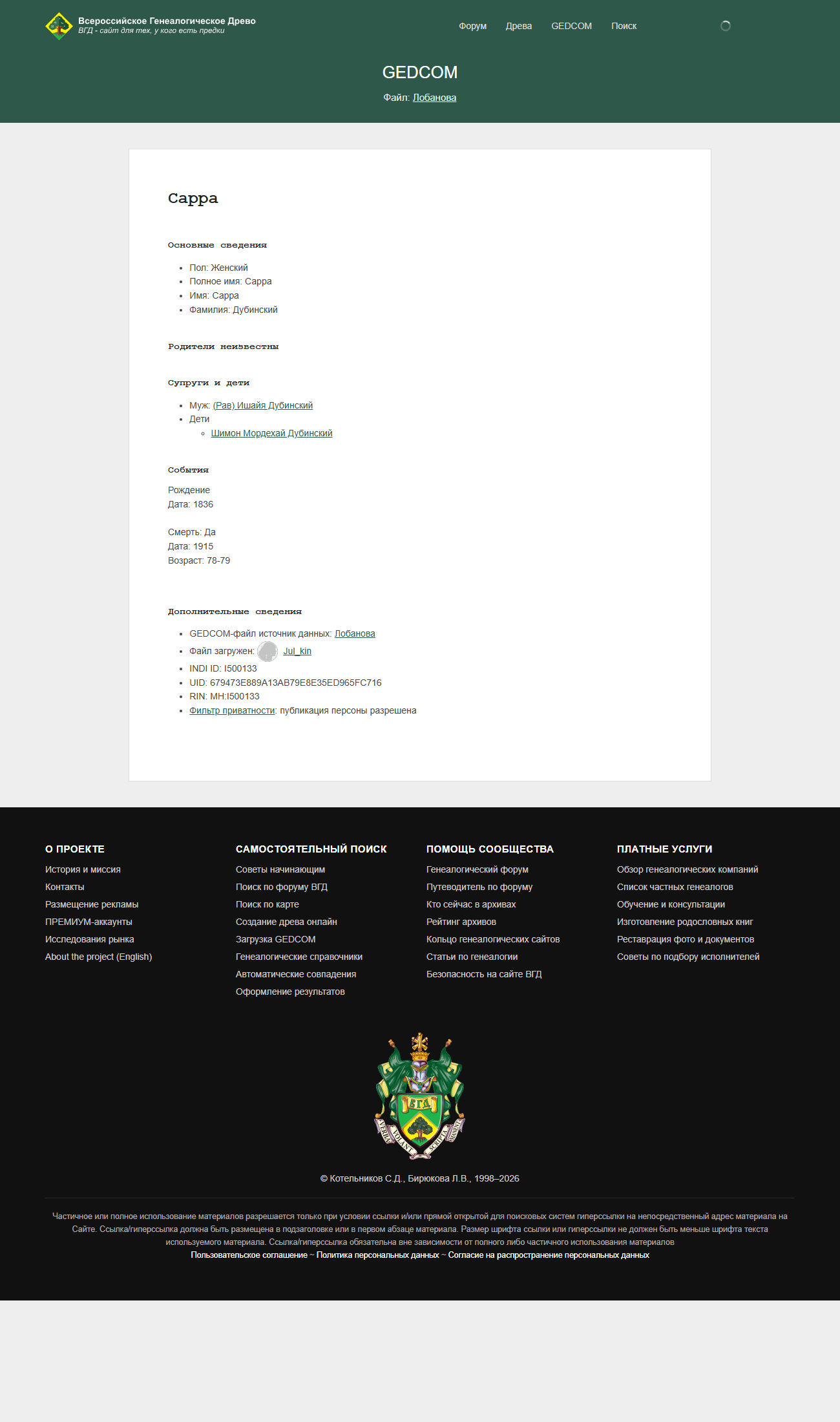
VGD record I500133, Sara
VGD GEDCOM record I500133: Sara Dubinsky, born 1836, died 1915, wife of Rav Yeshaya, mother of Shimon Mordechai. The record says her parents are unknown. - Open full size

Source links below are references; each image is a capture of the source it names. Research continues; this question does not hold up other work.

Save your answer
SAVED-F-21

F-21 - Yeshaya's father and the Itzko-Meir name

How should this source conflict or interpretation be stated in the family history?

Wording and source conflict

Current wording:
claim: Yeshaya's father was Rav Yitzchok Dubinsky, died 1903. A son born in 1893 was named Itzko-Meir, which is consistent, but the VGD record for Yeshaya says parents unknown.

Proposed wording or replacement phrase:
claim: A son born in 1893 was named Itzko-Meir, but that birth predates the stated 1903 death and does not support a posthumous naming argument;
Why this needs a decision: Avoid using pre-death birth as corroboration of posthumous namesake inference. Preserve attributed father/death claim.

Sources

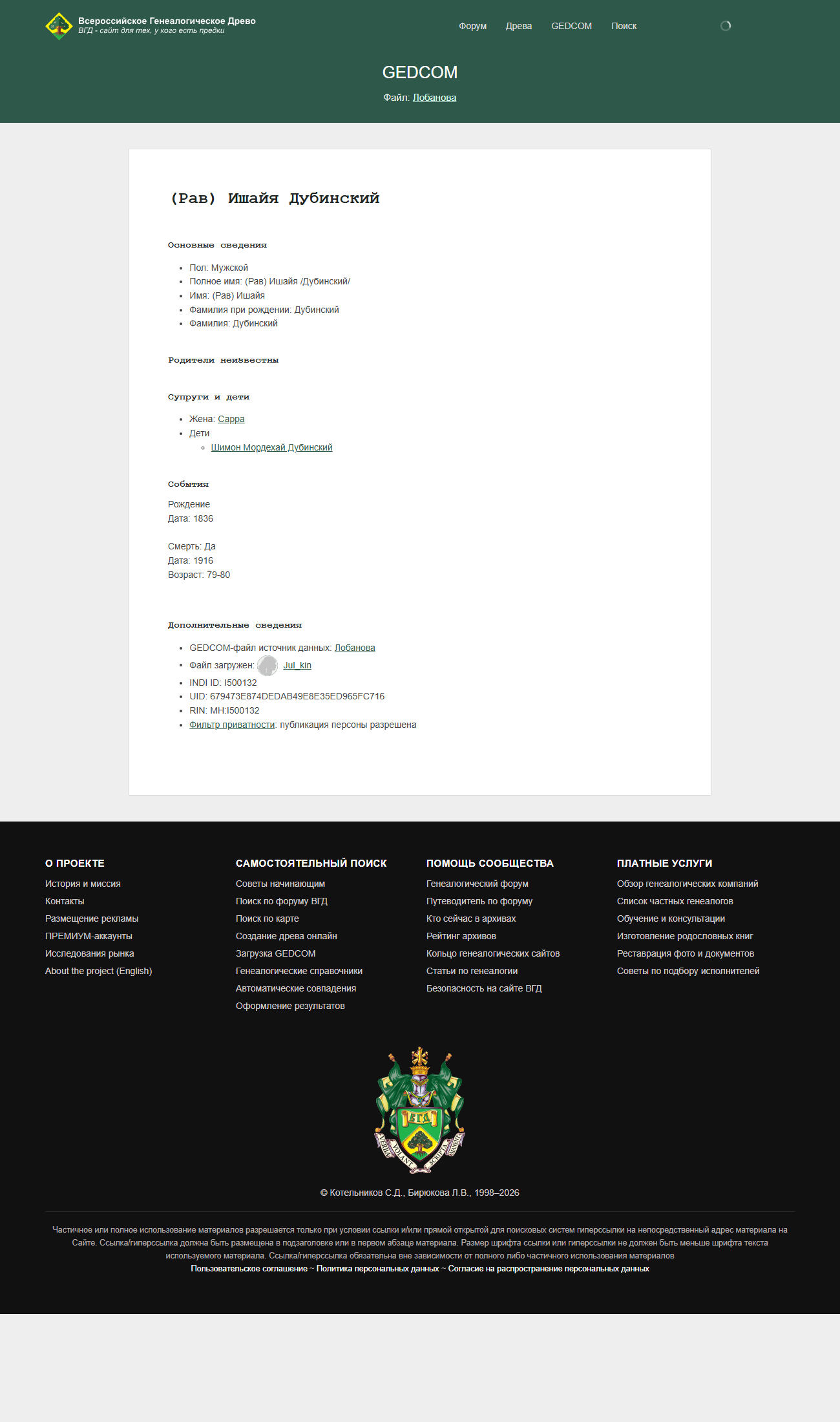
VGD record I500132, Yeshaya
VGD GEDCOM record I500132: Rav Yeshaya Dubinsky, born 1836, died 1916. The record says his parents are unknown. - Open full size
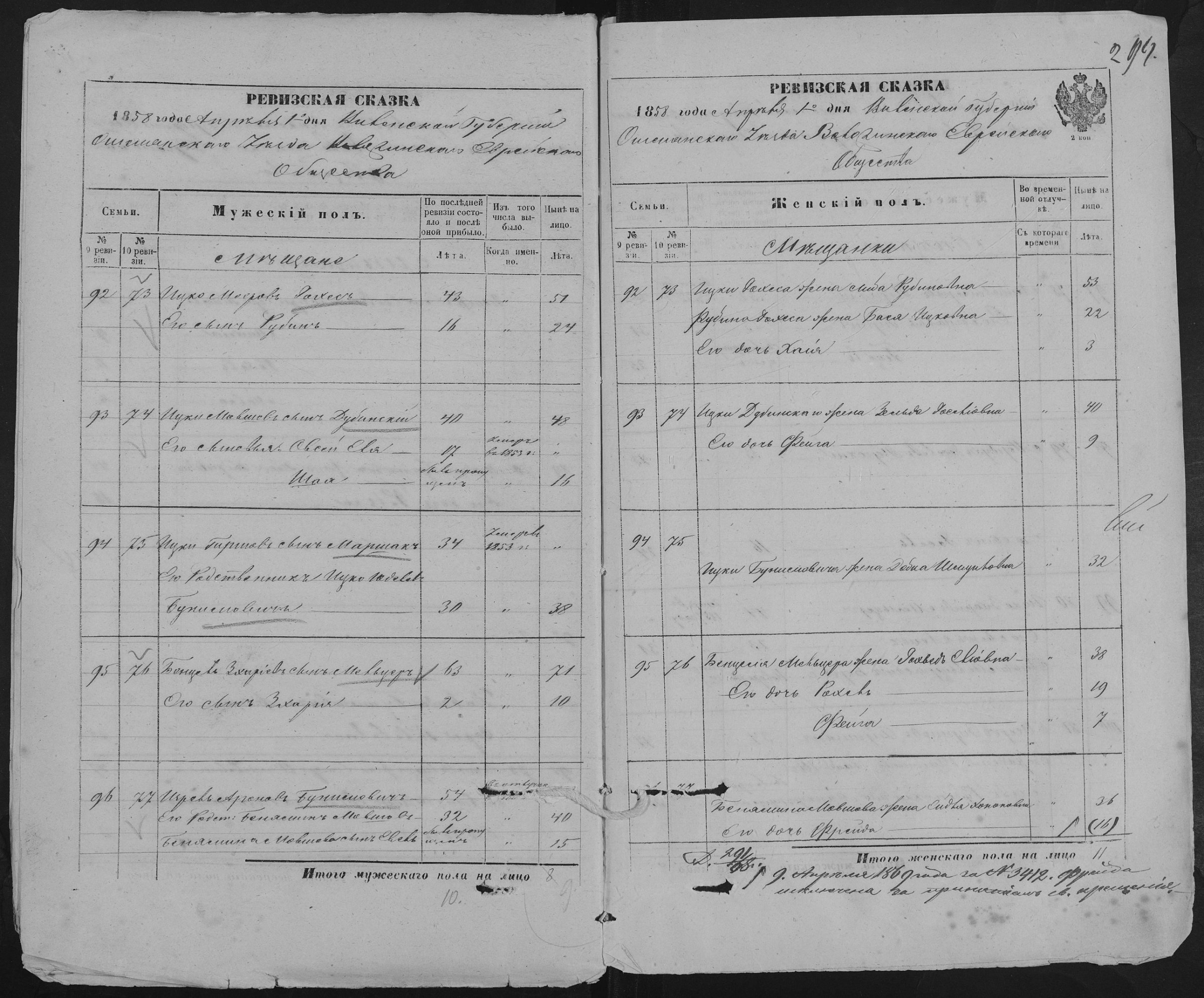
1858 Volozhin revision list, household 74
1858 revision list, Volozhin Jewish community, household 74 (LVIA 515/25/182, FamilySearch film 127163194, f.294). Itsko, son of Movsha, Dubinsky, 40 on the last revision and 48 now; under "His sons": Ovsei Elya, 17, noted as died in 1853, and Shaya, 16. The record lists Shaya as a son in Itsko's household. It does not say whether this Shaya is the Rav Yeshaya of this family. - Open full size

Source links below are references; each image is a capture of the source it names. Research continues; this question does not hold up other work.

Save your answer
SAVED-F-29

F-29 - Moshe Tzvi in the printed sources

How should this source conflict or interpretation be stated in the family history?

Wording and source conflict

Current wording:
claim: Moshe Tzvi appears nowhere. Not in the Leoni chart, not in Lipman, and not in the searchable OCR of the brothers' own 1909 book about Rav Chaim. A search inside that book for משה צבי , דובינסקי and שמוקלר returns nothing on any of the three.

Proposed wording or replacement phrase:
claim: Moshe Tzvi has not been found in the sources searched. The searches checked the Leoni chart, Lipman and the searchable OCR of the brothers' 1909 book. Searches for משה צבי , דובינסקי and שמוקלר produced no OCR hits in that attempt. Since Shmukler appears on the title page, the zero-hit result cannot establish absence from the printed book.
Why this needs a decision: OCR false negative demonstrable on title page. Keep search history separate from printed-content absence.

Sources

Toldos Rabbeinu Chaim MiVolozhin, 1909, title page
Toldos Rabbeinu Chaim MiVolozhin, 1909, title page - Open full size
Save your answer
SAVED-F-34

F-34 - Aryeh Leib Zak as a respected householder

How should this source conflict or interpretation be stated in the family history?

Wording and source conflict

Current wording:
claim: A correction to the Zak side. Rav Avraham Abba's father, R' Aryeh Leib Zak, was a בעל־בית נכבד , a respected householder of Luknik, not a rabbi . His own son says so in print.

Proposed wording or replacement phrase:
claim: Rav Avraham Abba's father, R' Aryeh Leib Zak , is described in the memoir as a בעל־בית נכבד , a respected householder of Luknik. That description does not by itself establish that he was not a rabbi.
Why this needs a decision: Literal source describes respected householder; categorical non-rabbi inference stronger than text. Attribution to ownson also needs author distinction from ShimonZak memoir.

Sources

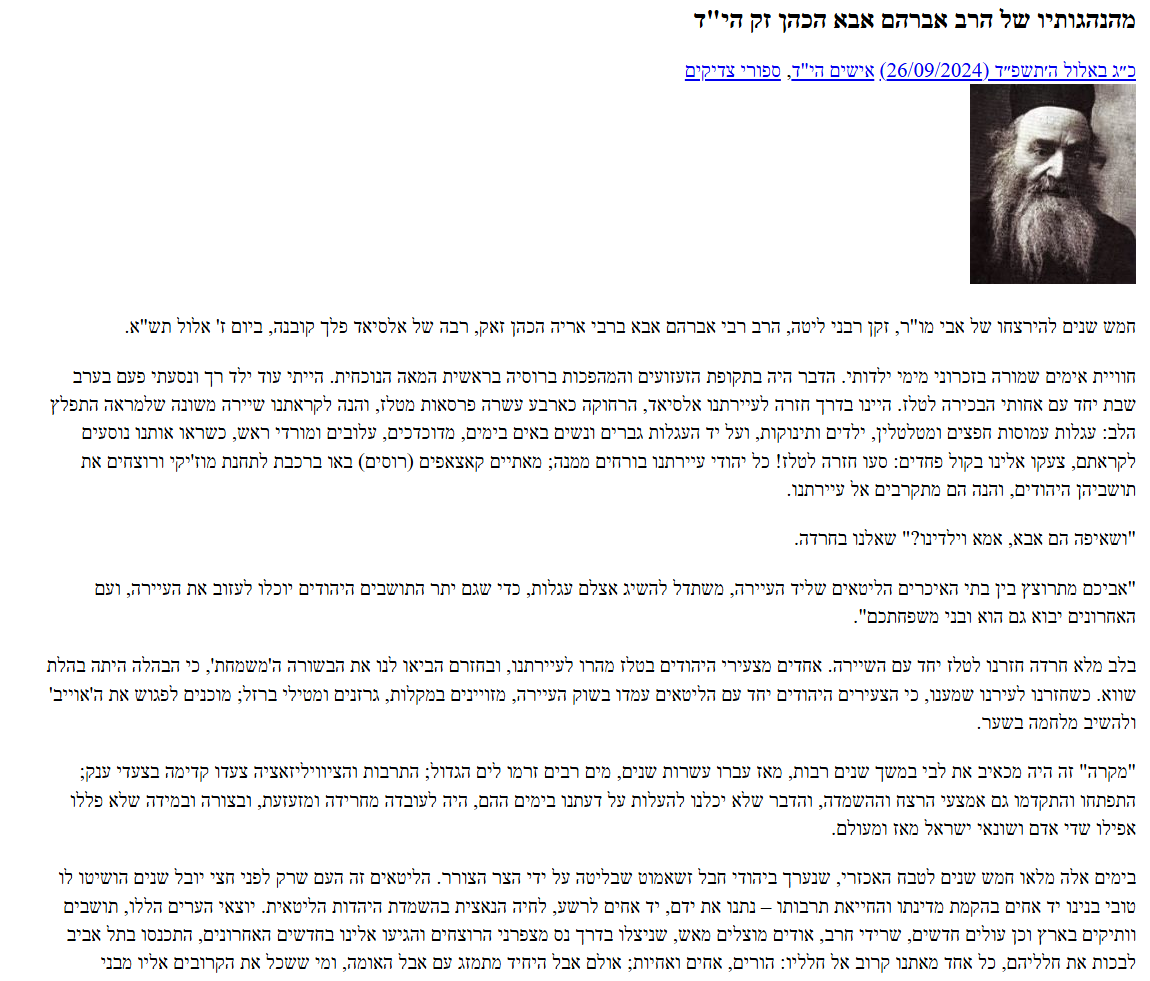
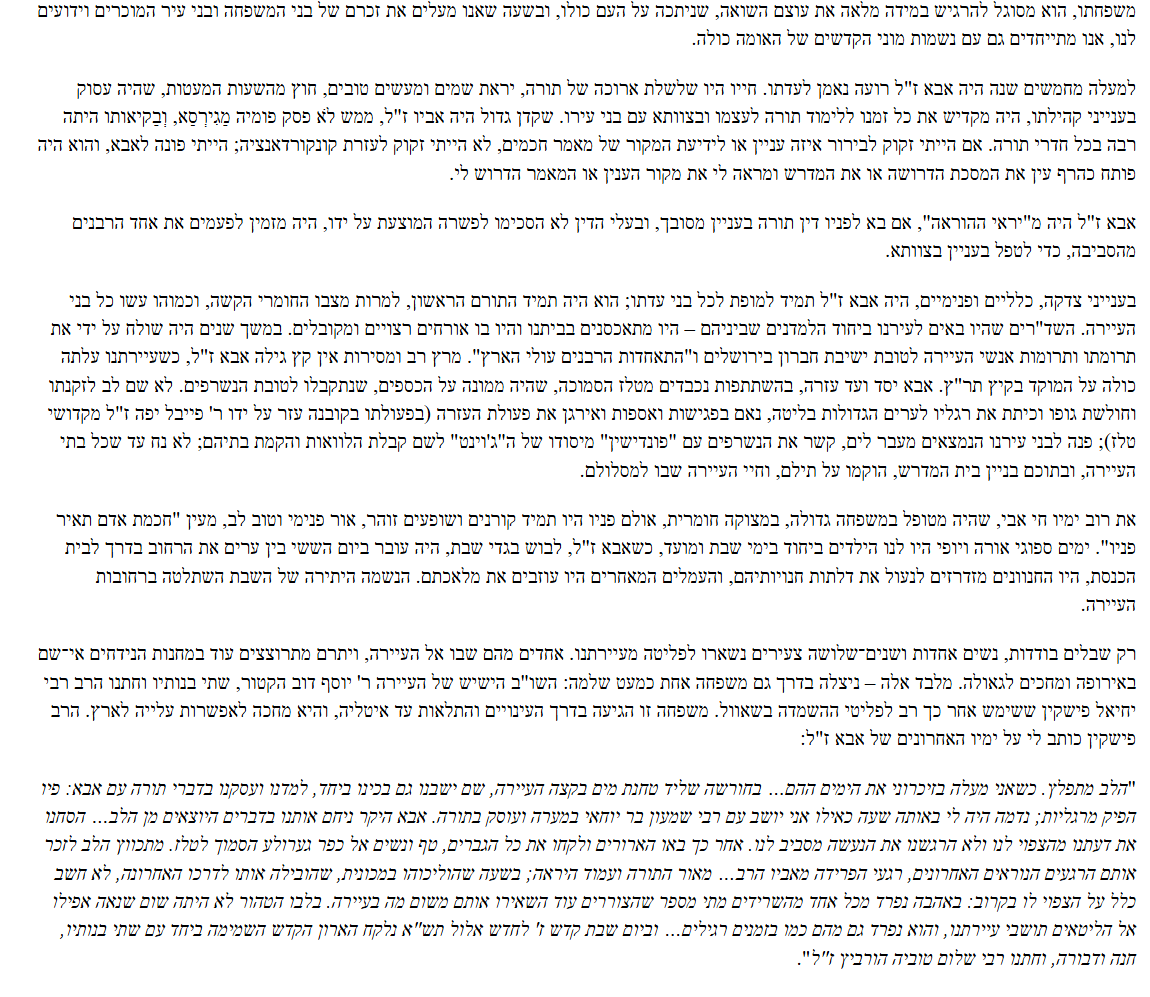
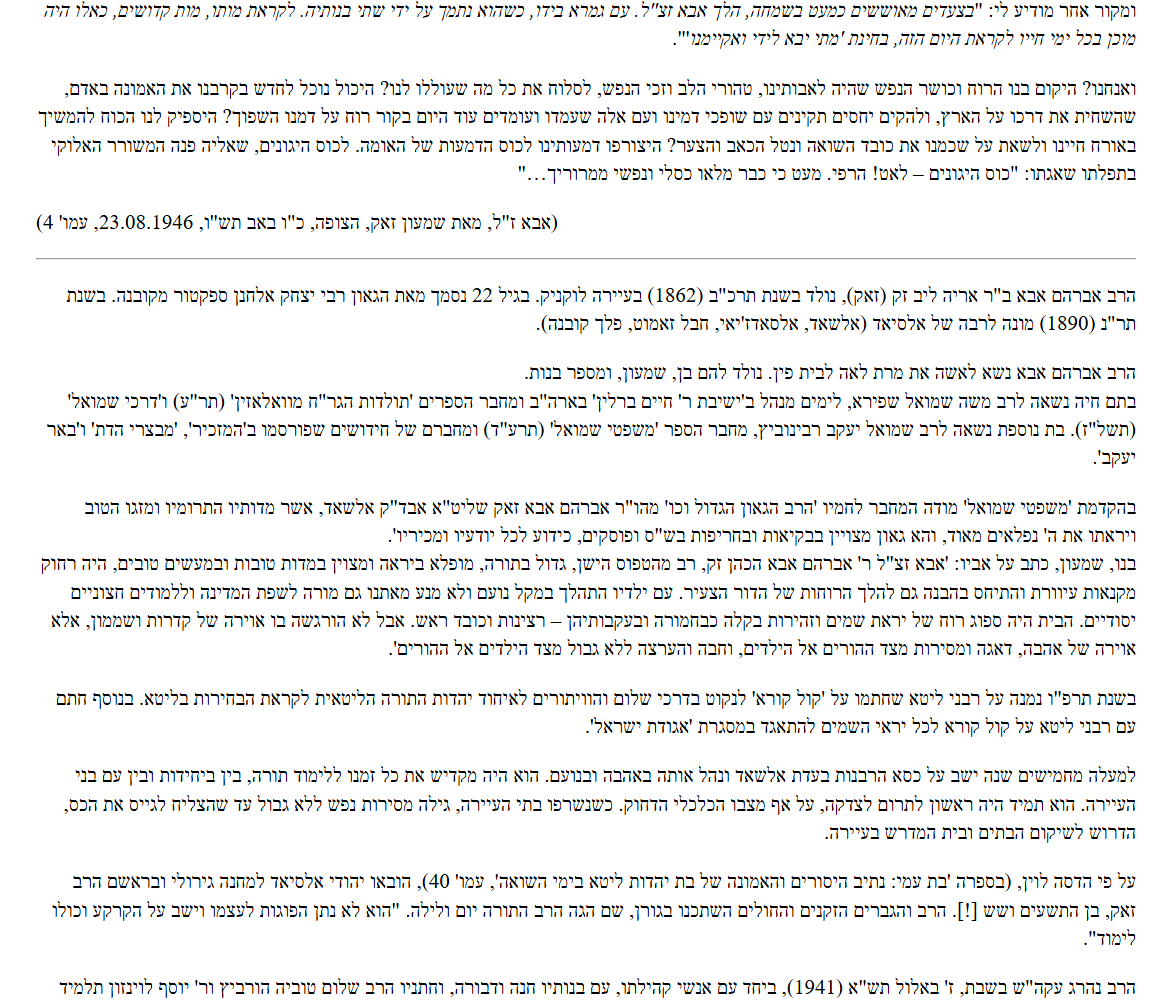
toratcha.com: the page as a whole, then Rav Shimon Zak's HaTzofe memoir of his father Rav Avraham Abba HaKohen Zak, 23 August 1946, followed by the site's biographical notes.
toratcha.com: the page as a whole, then Rav Shimon Zak's HaTzofe memoir of his father Rav Avraham Abba HaKohen Zak, 23 August 1946, followed by the site's biographical notes. - Open full size
toratcha.com: the page as a whole, then Rav Shimon Zak's HaTzofe memoir of his father Rav Avraham Abba HaKohen Zak, 23 August 1946, followed by the site's biographical notes.
toratcha.com: the page as a whole, then Rav Shimon Zak's HaTzofe memoir of his father Rav Avraham Abba HaKohen Zak, 23 August 1946, followed by the site's biographical notes. - Open full size
toratcha.com: the page as a whole, then Rav Shimon Zak's HaTzofe memoir of his father Rav Avraham Abba HaKohen Zak, 23 August 1946, followed by the site's biographical notes.
toratcha.com: the page as a whole, then Rav Shimon Zak's HaTzofe memoir of his father Rav Avraham Abba HaKohen Zak, 23 August 1946, followed by the site's biographical notes. - Open full size
toratcha.com: the page as a whole, then Rav Shimon Zak's HaTzofe memoir of his father Rav Avraham Abba HaKohen Zak, 23 August 1946, followed by the site's biographical notes.
toratcha.com: the page as a whole, then Rav Shimon Zak's HaTzofe memoir of his father Rav Avraham Abba HaKohen Zak, 23 August 1946, followed by the site's biographical notes. - Open full size
toratcha.com: the page as a whole, then Rav Shimon Zak's HaTzofe memoir of his father Rav Avraham Abba HaKohen Zak, 23 August 1946, followed by the site's biographical notes.
toratcha.com: the page as a whole, then Rav Shimon Zak's HaTzofe memoir of his father Rav Avraham Abba HaKohen Zak, 23 August 1946, followed by the site's biographical notes. - Open full size
Save your answer
SAVED-F-67

F-67 - Isaac's 1927 family arrival and possible derivative citizenship

How should this source conflict or interpretation be stated in the family history?

Wording and source conflict

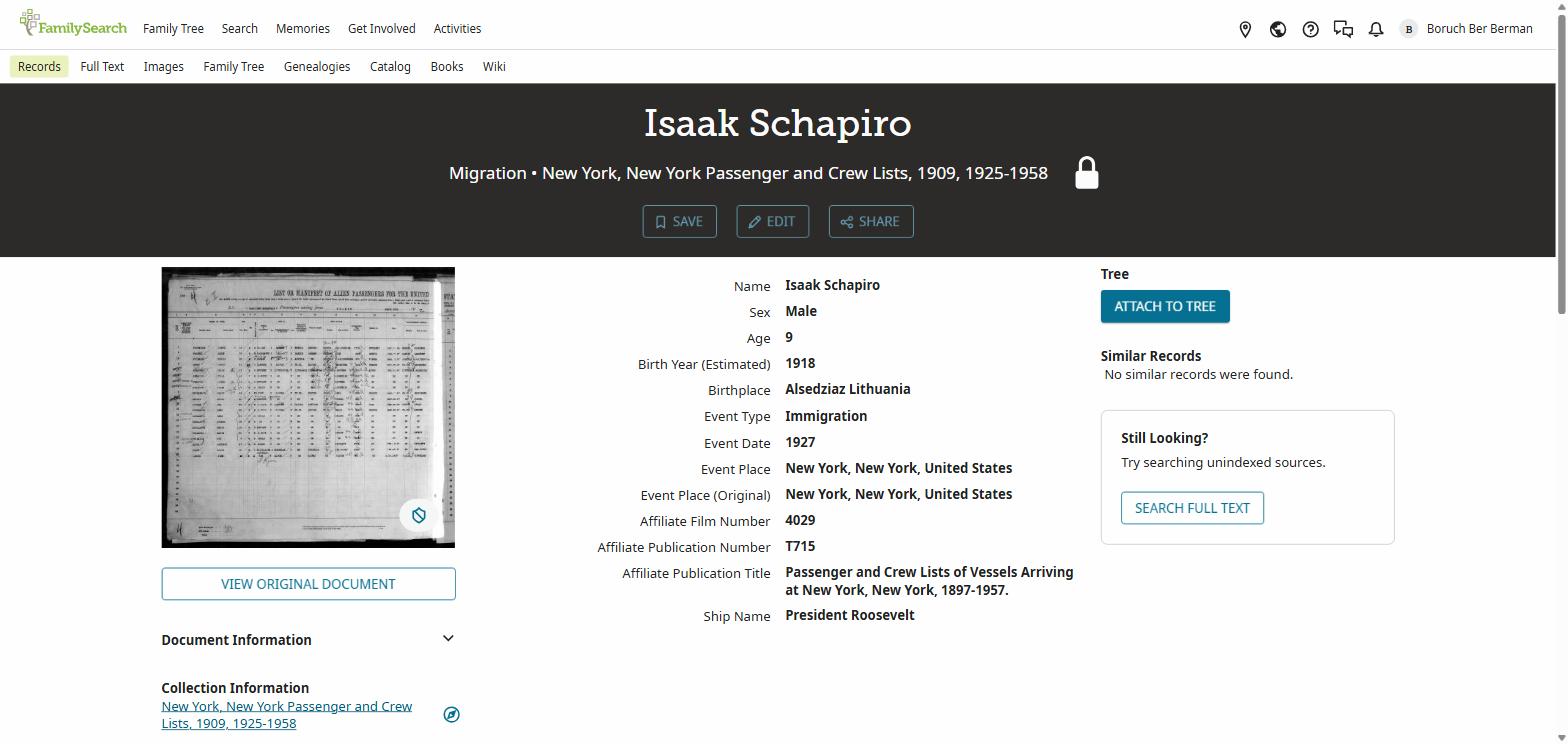
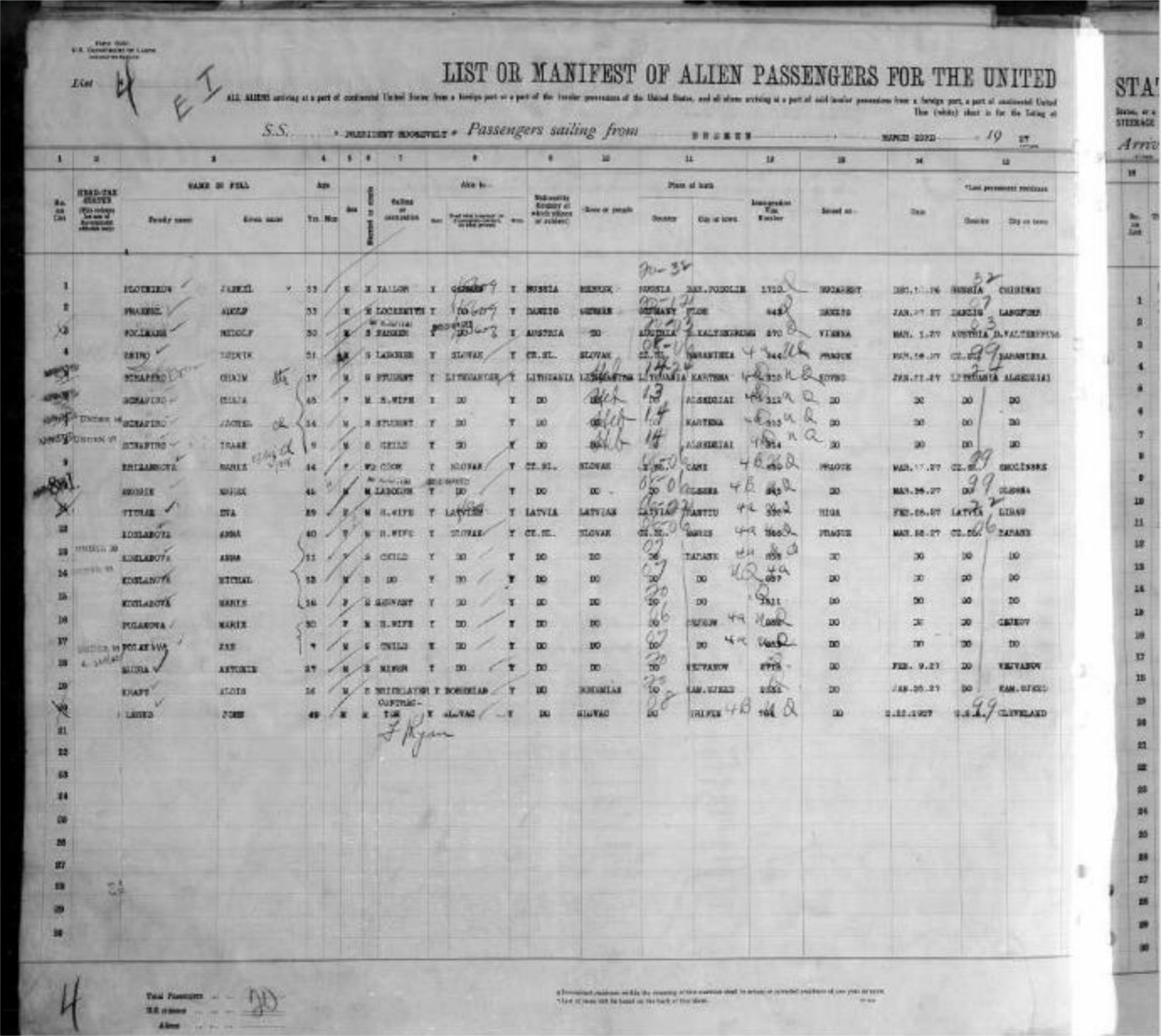
Current wording:
claim: Isaac's own arrival record, found at last, and the whole family travels together. A ship manifest, checked directly off the scan, records Chaja Schapiro, 45, wife , and three sons, all born Alsedziai, Lithuania , arriving together on the S/S President Roosevelt in the window 1 to 3 April 1927 : Chaim, 17, student; Jacheel, 14; and Isaak, 9, child . Isaak's age of 9 matches his known birth date, 15 August 1917, F-59: he would turn 10 that August; this is the youngest son's own immigration record, the specific document a search for his own naturalization paperwork had not been able to find. Jacheel, 14, matches Yechiel's own 10 June 1912 birth date exactly, F-56, confirming he too is on this same sailing. Chaim, 17, is very likely Hyman , since Hyman is the standard English form of Chaim; his age here implies a birth year of about 1909 to 1910, one more independent record agreeing with his father's 1936 petition, F-65, and with his own 1940 draft card and 1933 declaration; see F-58, where the birth-year question is now settled at 10 October 1909. Why no separate naturalization petition for Isaac/Irving may exist: he was a minor, 9 years old, entering with his mother in 1927, and was still under 21 in March 1936 when his father naturalized, F-65; children under 21 residing with a parent at the time of that parent's naturalization became United States citizens automatically under the law of the period, with no petition of their own required. If that is what happened here, it would explain why this file's search for his own petition kept coming up empty: there may genuinely be no such document to find.
Proposed wording or replacement phrase:
claim: the period's derivative-citizenship law included more than the child's age and a parent's naturalization. A 1936 State Department explanation quotes the 1934 requirement of five years' permanent residence in the United States. Whether Irving met all applicable conditions still needs to be checked; if he did, a separate petition may not have been required.
Why this needs a decision: Contemporary1936legalexplanation includes residency condition; father naturalization plus age alone insufficient. Source https://history.state.gov/historicaldocuments/frus1936v02/d11

Sources

FamilySearch record page: Isaak Schapiro, 9, born Alsedziai, S/S President Roosevelt, New York 1927
FamilySearch record page: Isaak Schapiro, 9, born Alsedziai, S/S President Roosevelt, New York 1927 - Open full size
S/S President Roosevelt manifest, arrived New York 1 April 1927, page 1: the Schapiro family, lines 5 to 8
S/S President Roosevelt manifest, arrived New York 1 April 1927, page 1: the Schapiro family, lines 5 to 8 - Open full size
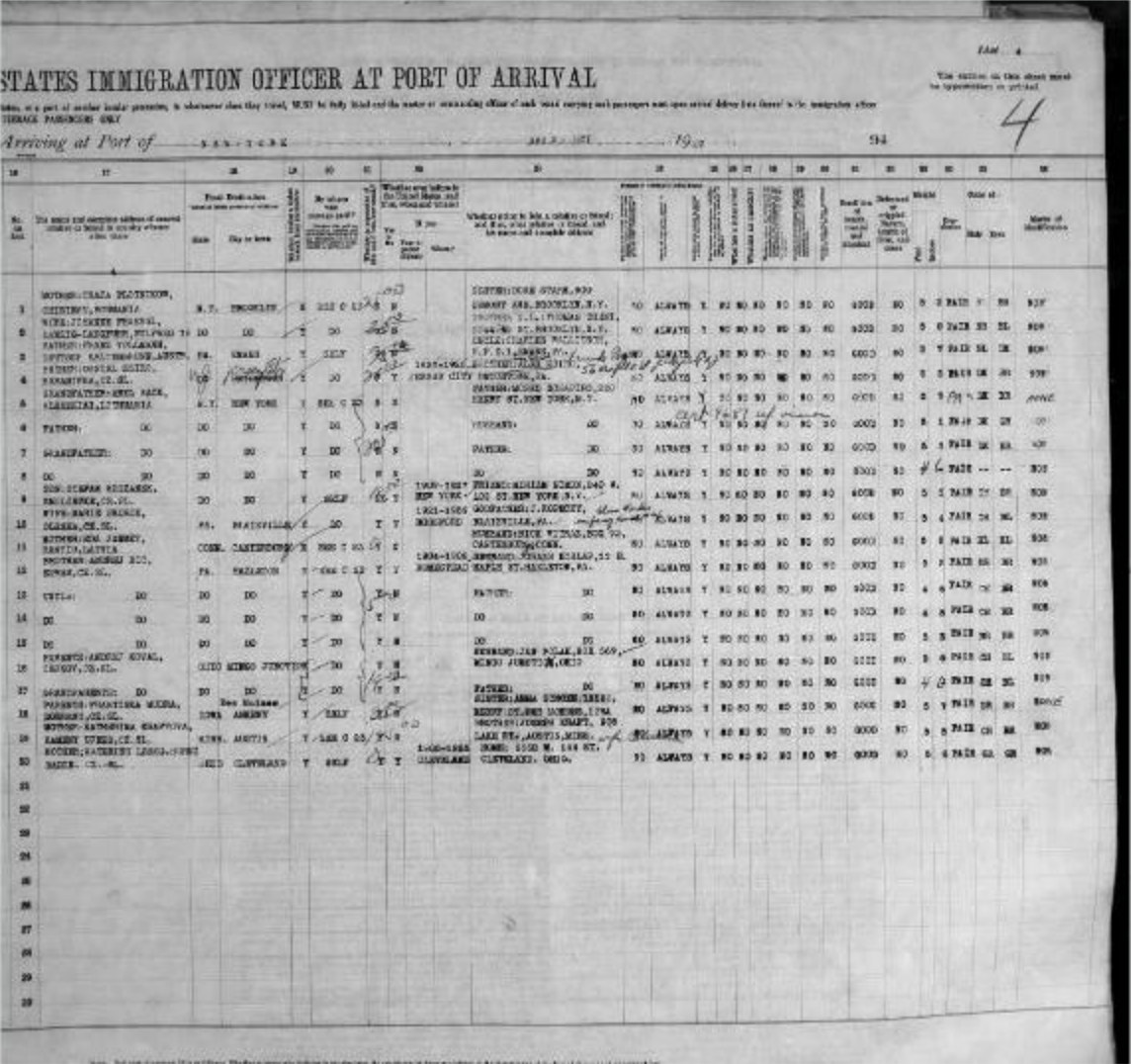
S/S President Roosevelt manifest, 1927, page 2: relative being joined in the United States
S/S President Roosevelt manifest, 1927, page 2: relative being joined in the United States - Open full size
Save your answer
SAVED-Q-25

Q-25 - One monument, or several separate graves?

How should this source conflict or interpretation be stated in the family history?

Wording and source conflict

Current wording:
claim: Mitzvat Emet has seven catalogue rows for this family in one cemetery. The best reading is that several of them are faces of one monument, not separate plots.

Proposed wording or replacement phrase:
claim: Mitzvat Emet has seven catalogue rows associated with this family in one cemetery. Two rows, burial329268 and burial352860, use the same photograph of the stone naming Lev Rubin and Dubinsky. The other photographs include separate stones. The catalogue alone does not show whether those stones share a plot.
Why this needs a decision: Same photograph proves duplicate catalogue representation, not seven faces of a monument or plot layout.

Sources

Kharkiv: the stone of Rav Shimon Mordechai Dubinsky (Mitzvat Emet burial 352860)
Kharkiv: the stone of Rav Shimon Mordechai Dubinsky (Mitzvat Emet burial 352860) - Open full size
Save your answer
SAVED-Q-31

Q-31 - Was Moshe Shmuel's mother a Shmukler of Ivye?

How should this source conflict or interpretation be stated in the family history?

Wording and source conflict

Current wording:
fore: It is the only reading that explains the surname. Moshe Shmuel was registered in the Ivye community in his own marriage record of 1903, F-78, six years before he published as Shmukler, so Shmuklerhood was his legal identity and not a pen name, Q-05. Assumed registrations in the Russian empire were normally taken in a real relative's community, and the commonest such relative is a mother's family. The Ivye Shmuklers are that family: a documented Girsh, a documented Movsha son of Girsh, and a documented daughter Sora. Nothing else on this file has ever produced a Moshe and a Tzvi standing in the right relation to each other.

fore: It is the only reading that explains the surname. Moshe Shmuel was registered in the Ivye community in his own marriage record of 1903, F-78, six years before he published as Shmukler, so Shmuklerhood was his legal identity and not a pen name, Q-05. Assumed registrations in the Russian empire were normally taken in a real relative's community, and the commonest such relative is a mother's family. The Ivye Shmuklers are that family: a documented Girsh, a documented Movsha son of Girsh, and a documented daughter Sora. Nothing else on this file has ever produced a Moshe and a Tzvi standing in the right relation to each other.

against: The ages do not match. This Sora is 5 in December 1850 , so born about 1845, while the family and the VGD tree both give Sara 1836 to 1915, F-19. Nine years is too much to wave away, although 1845 fits motherhood of sons born 1870 and 1879 more comfortably than 1836 does. No document ties this Sora to Yeshaya Dubinsky or to Volozhin , and none is likely to: no Volozhin register survives, F-73. Sora is the commonest woman's name in these lists and Shmukler is a large Ivye family, 272 translated rows. And the marriage record makes the groom the son of a Josel , which fits neither a Dubinsky father named Yeshaya nor this Movsha Iuda; if the registration was borrowed, the borrowed patronymic proves nothing either way.

Proposed wording or replacement phrase:
fore: This is one possible explanation of the surname, not an established family link.
Why this needs a decision: No document ties candidateSora to Yeshaya; borrowed identity admits alternatives.

fore: The Ivye Shmuklers are a candidate family:
Why this needs a decision: Candidate must not become identified maternal family from shared names alone.

against: The inventory checked in F-73 does not establish that no relevant Volozhin register survives.
Why this needs a decision: Absence from a bounded inventory is not archive-exhaustive absence.

Sources

Supporting marriage record: the groom’s recorded surname and patronymic. This is not an image of the Ivye Sora household.
Supporting VGD record for Sara’s dates. This does not identify the Ivye Sora as Sara.

The supporting images below do not settle the Ivye family link. Original Ivye household images are still needed.

Save your answer
SAVED-Q-36

Q-36 - Is a Sapira/Shapira family documented in Volozhin itself the source of the surname?

How should this source conflict or interpretation be stated in the family history?

Wording and source conflict

Current wording:
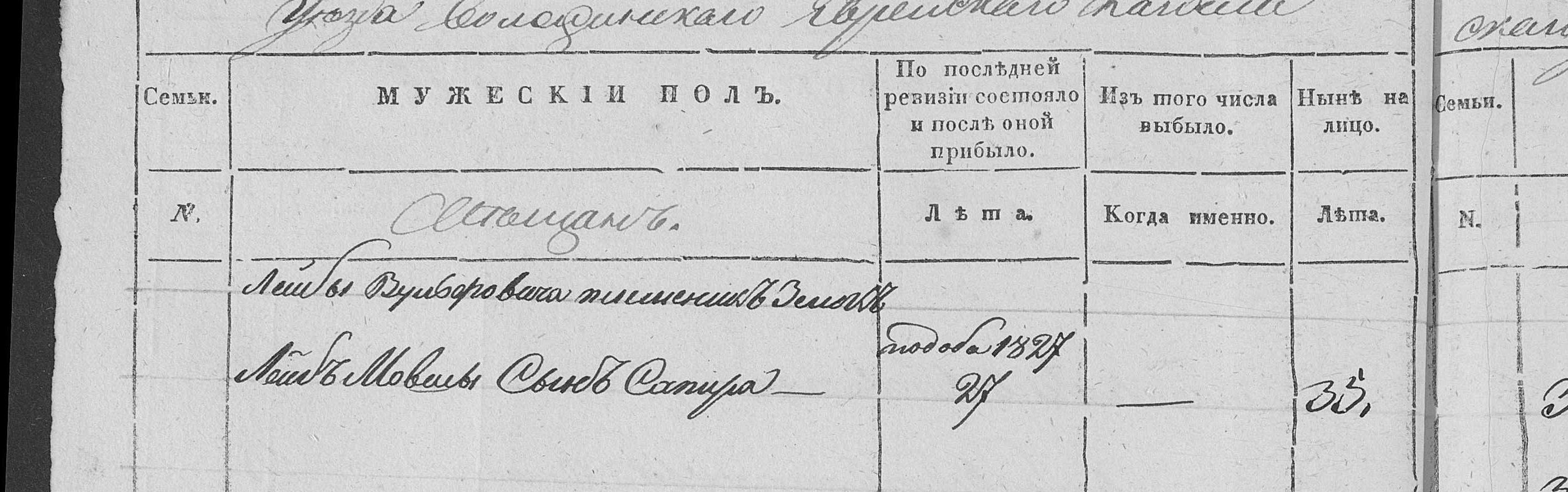
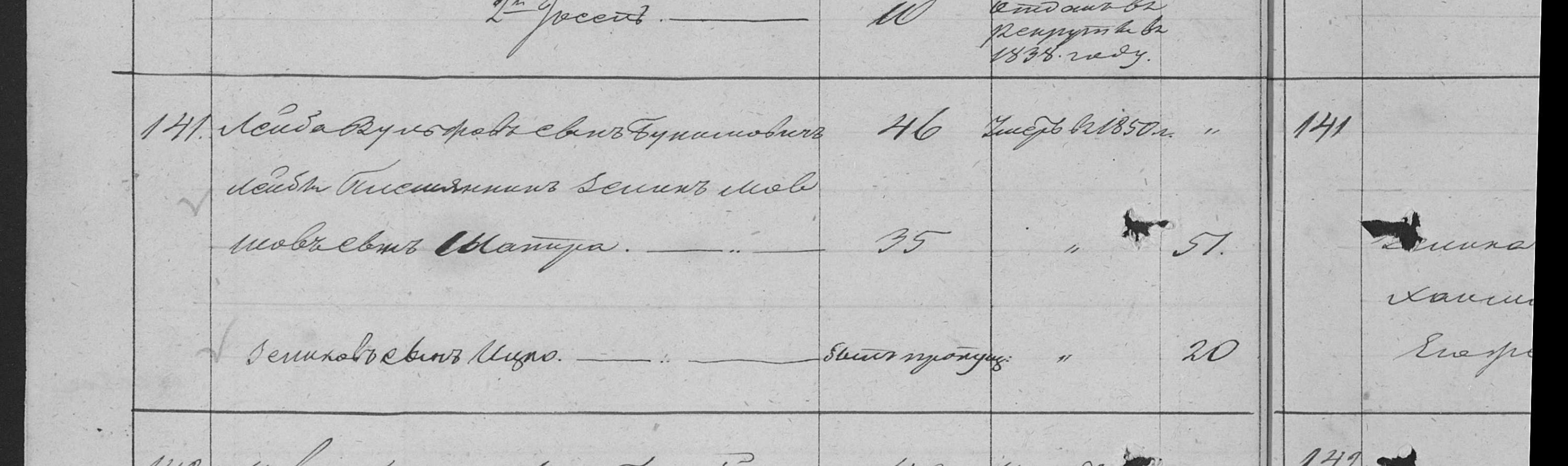
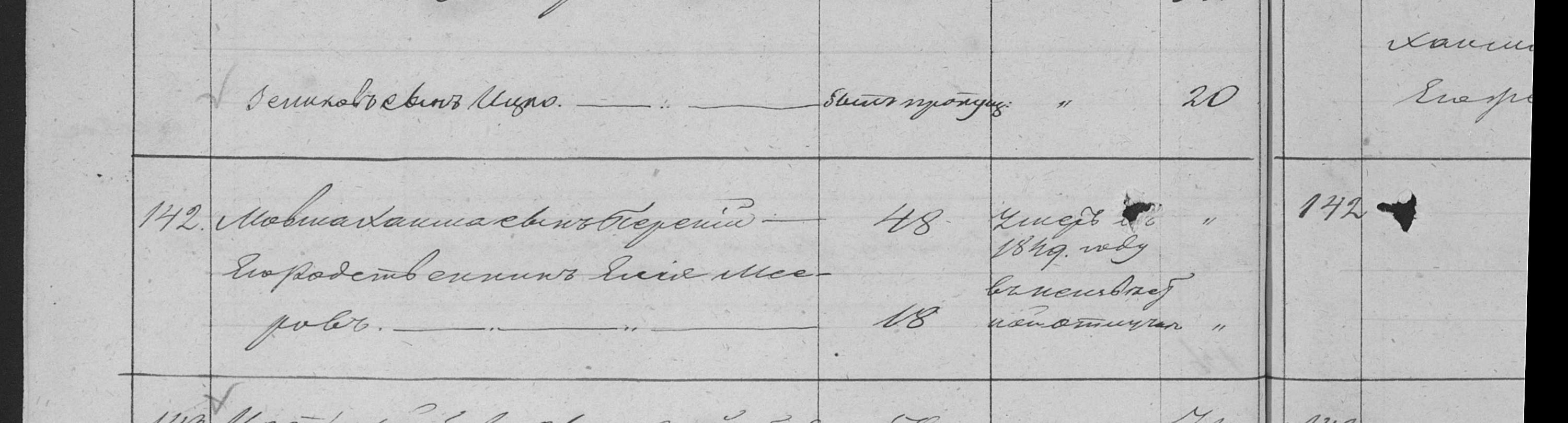
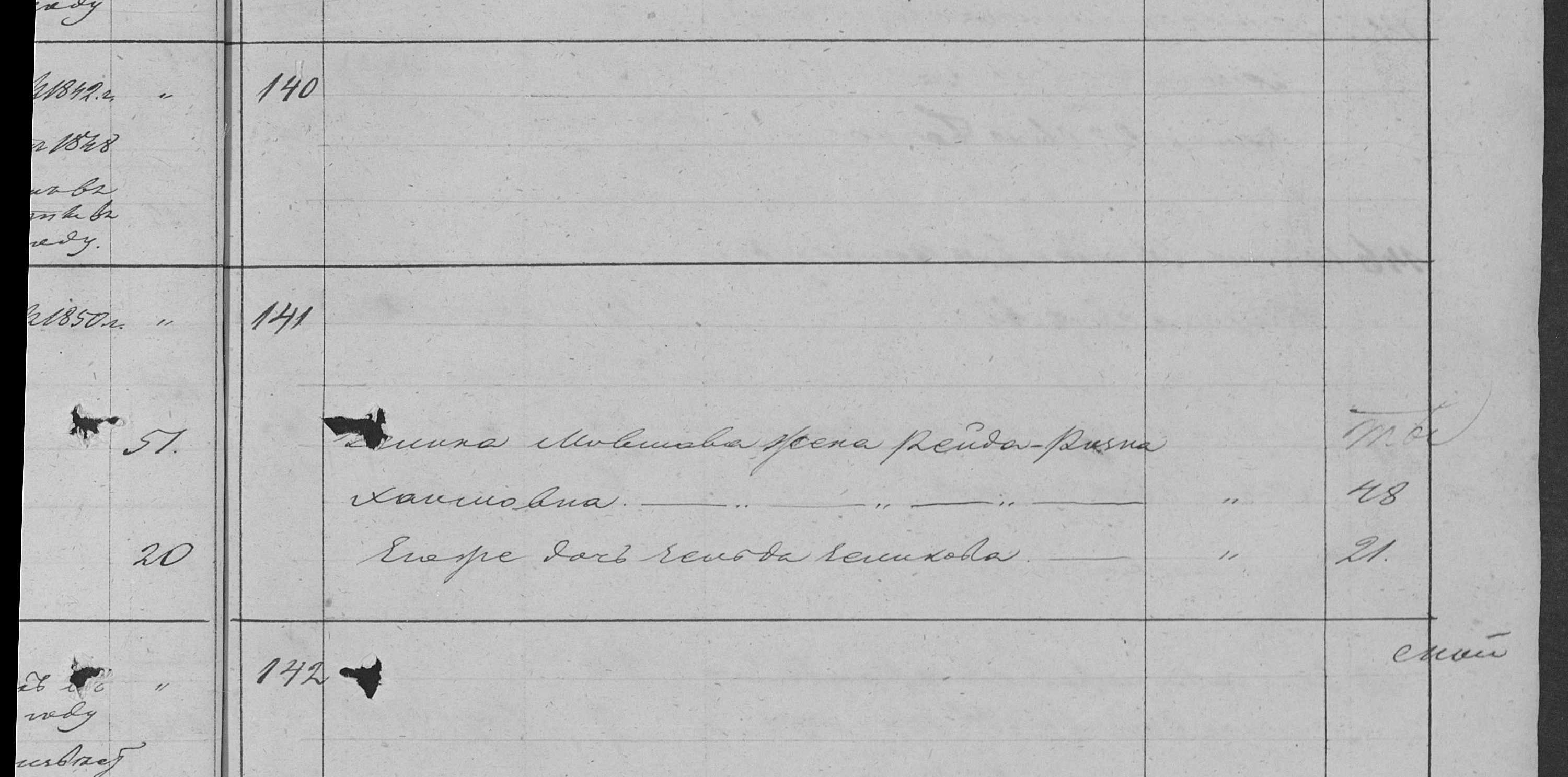
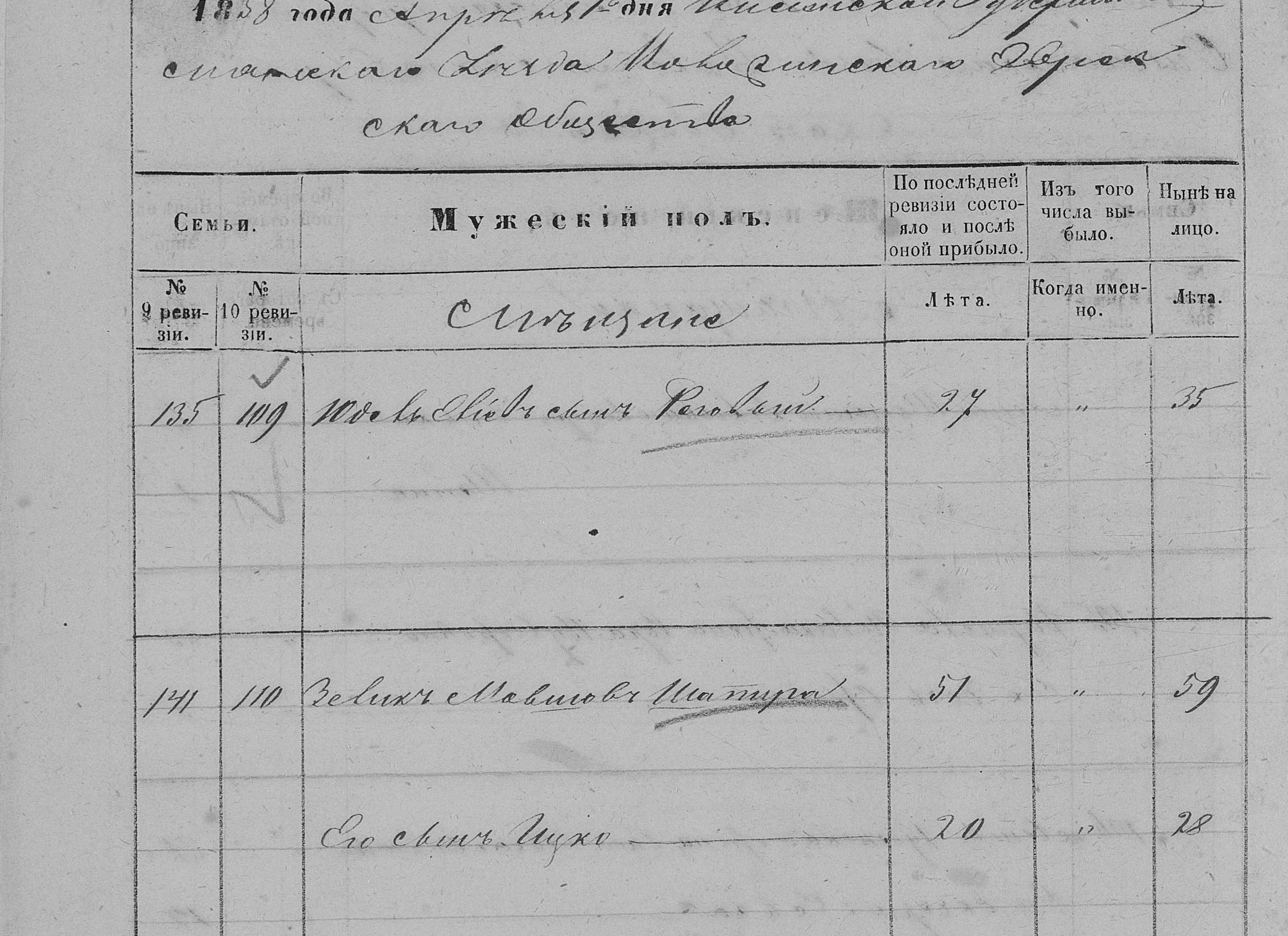
claim: A family collaborator's film-by-film sweep of the Volozhin revision lists covering 1811 through 1874 turns up a Sapira/Shapira household where this file had never looked: Zelik Leib, son of Movsha Sapira , first recorded as a household head in 1827, appears in 1834 as the nephew, by marriage, of Leib Vulf Bunim (wife Rokha, daughters Khvoska and Zelda Basya), and the same man is recorded again in the 1850 and 1858 lists, household 141/110. The 1850 household's two pages, since re-read at native resolution, settle a naming wrinkle rather than raising a new one: the clerk wrote him as the diminutive Zelik three times (male page, twice, including his son Itsko 's own patronymic) and once, on the female page, by the formal Zelman , in his wife's genitive line — Zelik is the ordinary Yiddish diminutive of Zelman, one man, not two. That same female-page line also settles his wife's name as Reida-Rizka, daughter of Chaim, 48 , where earlier passes over this file had read her variously as Rochel or as "Freida-Raya." A second household, Rafal Leyba Shapira , appears in Volozhin in 1858 and again in 1873; whether he is Zelik's own relative or an unconnected, coincidentally-named neighbor is not established. No other Shapira or Sapira household has turned up in Volozhin in any revision list read so far.

fore: This is the only Shapira-surnamed family documented living in Volozhin itself, in the right town and the right general era, found despite a full sweep of the available revision lists. A Bunim woman marrying into the Sapira family a generation before Zelik ties the surname into Volozhin meshchane society by the early 1800s, well before Yeshaya Dubinsky's own generation.

Proposed wording or replacement phrase:
claim: appears in 1834 as the nephew of Leib Vulf Bunim
Why this needs a decision: Original nephew term does not itself establish affinity rather than blood; keep possibility separate.

fore: The nephew relationship places Zelik in the Bunim household. It does not identify which parent supplied that relationship, or establish a Bunim woman's marriage into the Sapira family.
Why this needs a decision: Proposed marriage/blood path not stated by original relationship term.

Sources

1834 Volozhin revision list, household 110: Zelik Leib son of Movsha Sapira, nephew of the household head
1834 Volozhin revision list, household 110: Zelik Leib son of Movsha Sapira, nephew of the household head - Open full size
1850 Volozhin revision list, household 141, male page: Zelik Movshov son Shapira, nephew, 35→age 51; his son Zelikov (Itsko), age 20
1850 Volozhin revision list, household 141, male page: Zelik Movshov son Shapira, nephew, 35→age 51; his son Zelikov (Itsko), age 20 - Open full size
1850 Volozhin revision list, household 141, male page: Zelik Movshov son Shapira, nephew, 35→age 51; his son Zelikov (Itsko), age 20
1850 Volozhin revision list, household 141, male page: Zelik Movshov son Shapira, nephew, 35→age 51; his son Zelikov (Itsko), age 20 - Open full size
1850 Volozhin revision list, household 141, female page: Zelman Movshov's wife Reida-Rizka Khaimovna, 48, and their daughter, Zelikovna, 21
1850 Volozhin revision list, household 141, female page: Zelman Movshov's wife Reida-Rizka Khaimovna, 48, and their daughter, Zelikovna, 21 - Open full size
1858 Volozhin revision list, folio 303: the Shapira household, previous-revision number 141 and current number 110
1858 Volozhin revision list, folio 303: the Shapira household, previous-revision number 141 and current number 110 - Open full size
Save your answer
SAVED-MARRIAGE-DATE

Moses and Chaje: marriage-date conflict

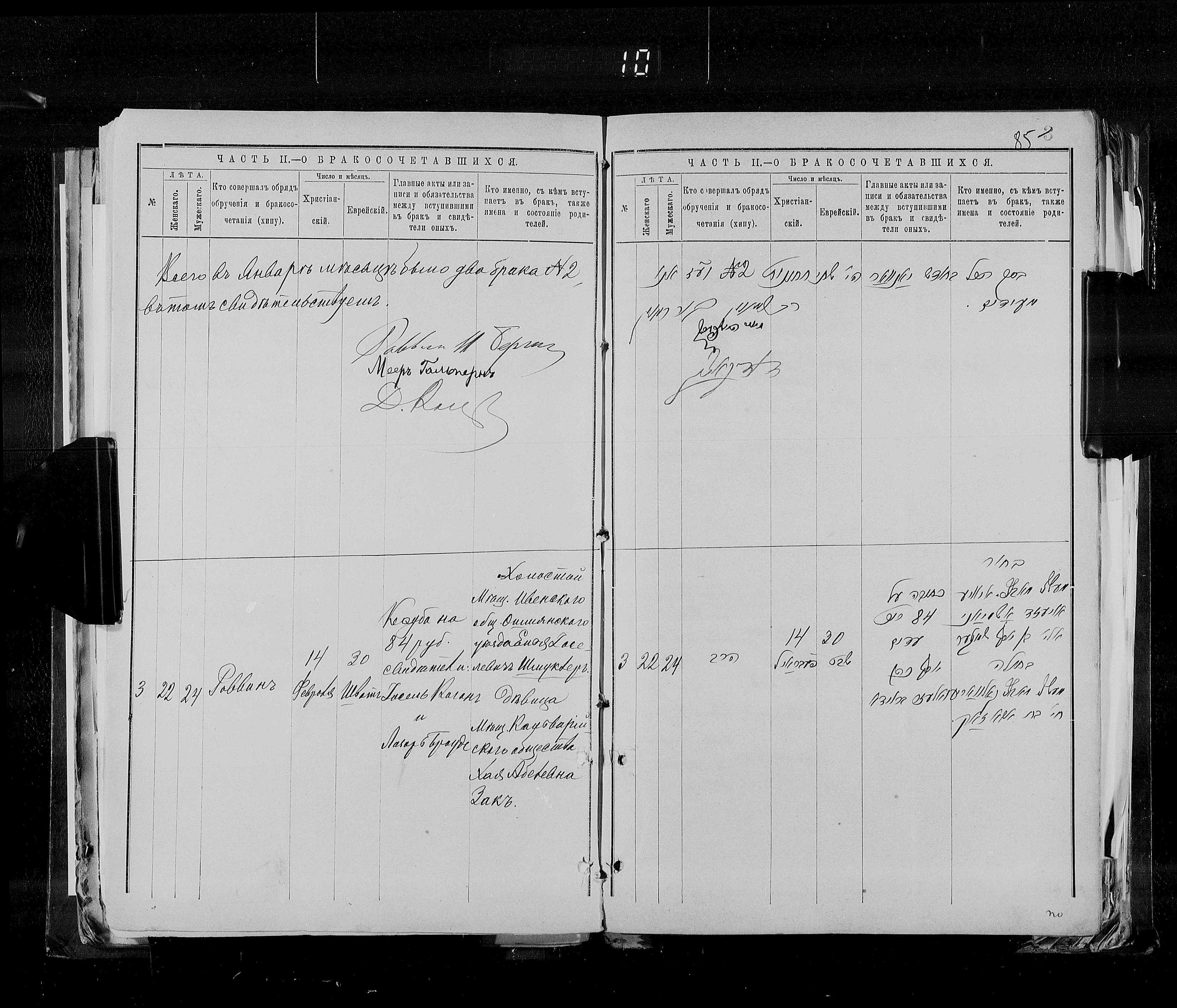
How should the difference between the 1903 marriage register and the 1936 petition be described?

Wording and source conflict

The petition says April 4, 1903. The register reading is February 14, 1903 Old Style / 30 Shevat 5663. Keep the two sources distinct; this question does not authorize replacing one source date with the other.

Sources

Original source: open full size
Original source: open full size - Open full size
Original source: open full size
Original source: open full size - Open full size
Save your answer
SAVED-1927-FAMILY-MANIFEST

Family manifest: line numbers and birthplace

How should the family manifest place-name reading be stated?

Wording and source conflict

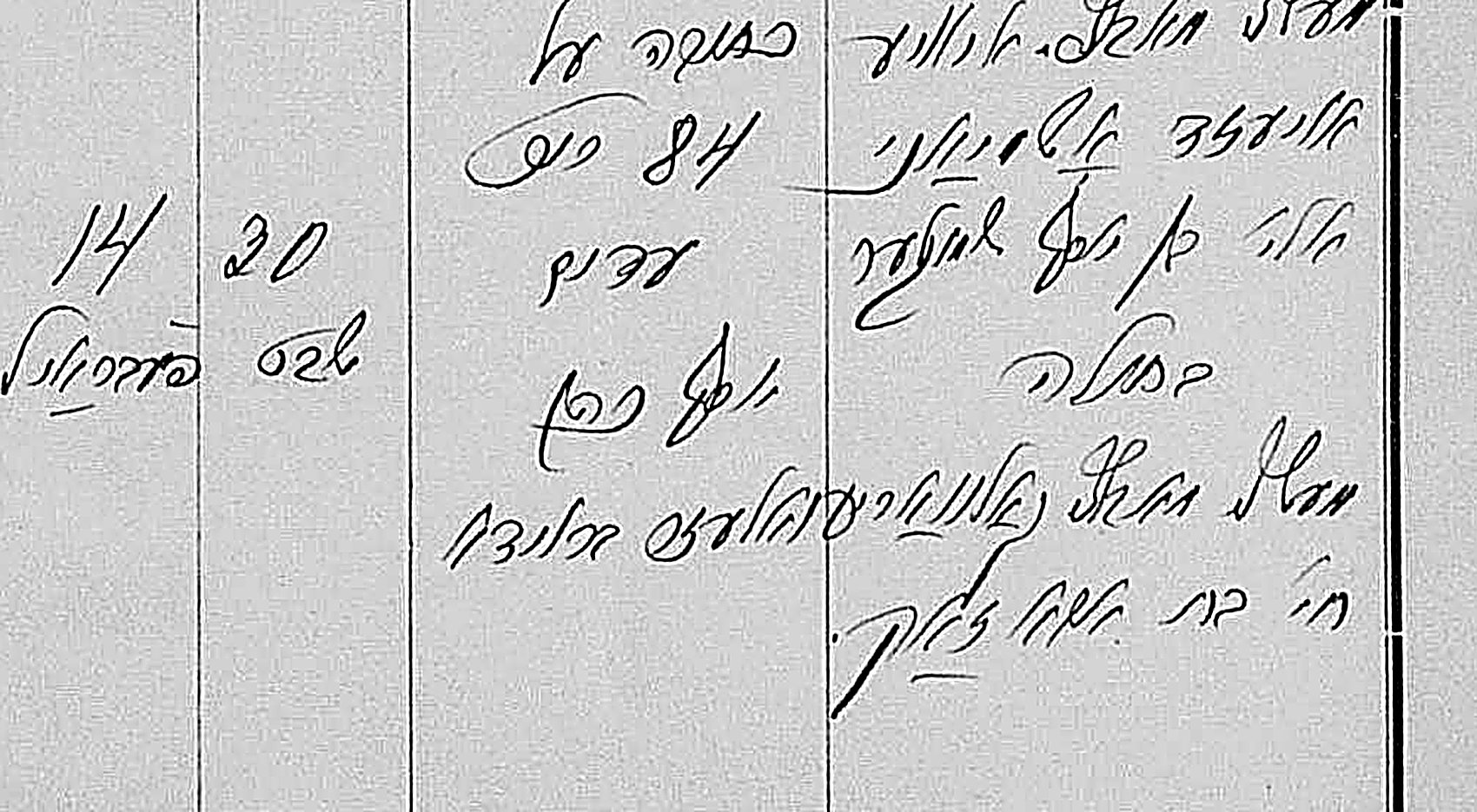
The inspected manifest places the family on lines 5-8. The disputed birthplaces for Chaim and Jachel were read as Kartena, while current family wording differs. Please give your reading from the original.

Sources

Original source: open full size
Original source: open full size - Open full size
Save your answer
SAVED-NATHAN-CONTACT

Nathan Dubinsky: the passenger-list contact and the New York candidate

Do the records establish that the Nathan and Dora Dubinsky candidate is the Nathan named as brother on Moses Shapiro’s passenger list, or should that identity and relationship remain open?

The permanent research page gives 97 Cherry Street and says “He was not a blood brother.” The original passenger list names “Brother, Nathan Dubinsky, 292 Cherry St., New York, N.Y.” The New York candidate’s death certificate names parents Pincus Dubinsky and Beckie Katz. Those parents distinguish that candidate from a documented son of Yeshaya, but do not alone identify him as the passenger-list contact. Current reader pages leave the match and relationship open. The earlier settled wording is retained for review, not silently removed.

Original records

Original manifest page 2, line 3: Brother, Nathan Dubinsky, 292 Cherry Street
Original manifest page 2, line 3: Brother, Nathan Dubinsky, 292 Cherry Street - Open full size
New York candidate’s naturalization papers
New York candidate’s naturalization papers - Open full size
New York candidate’s death certificate
New York candidate’s death certificate - Open full size
Save your answer
Saved family question

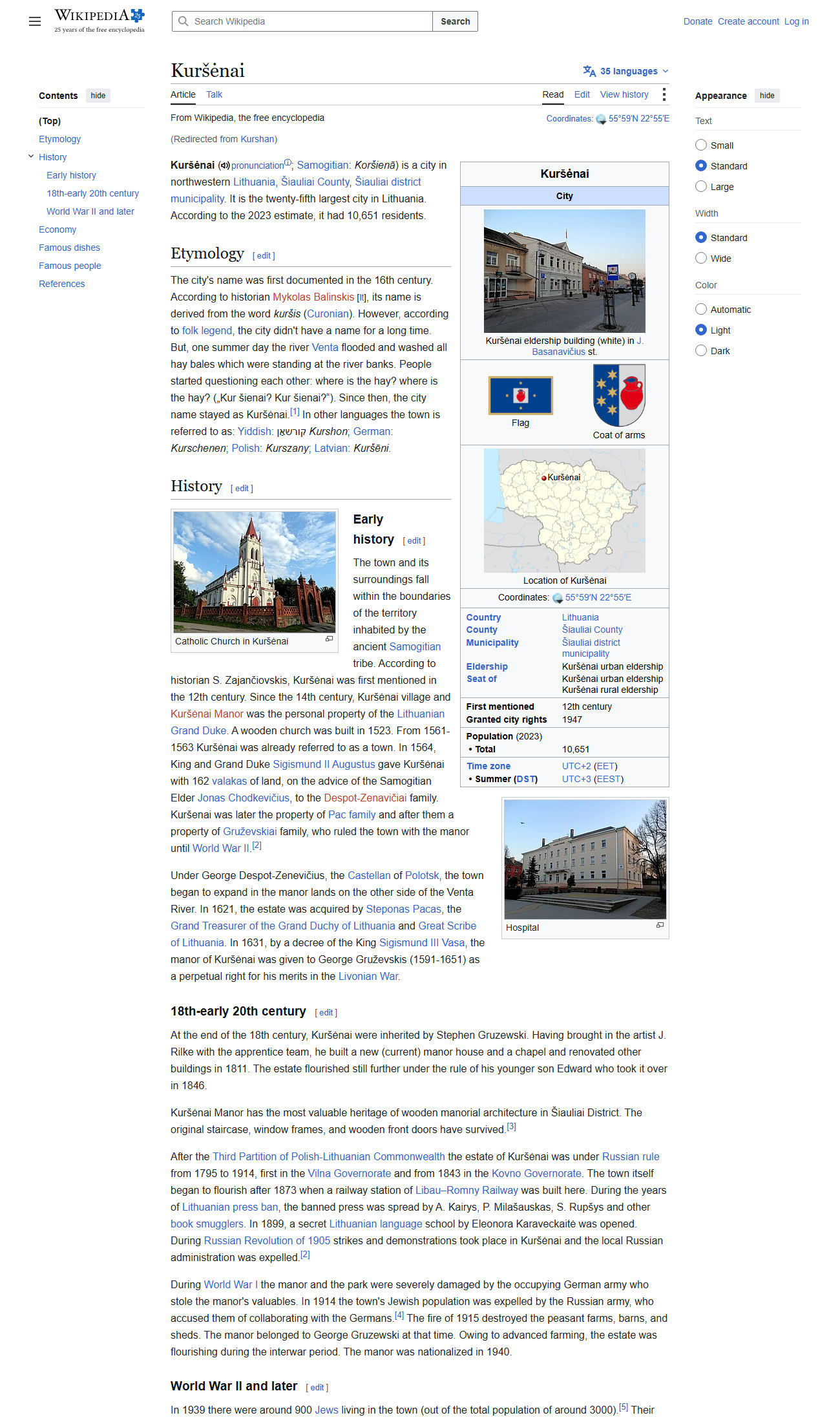
Kurtzan/Kurtzen and the Kuršėnai hypothesis

What place do the recorded Kurtzan/Kurtzen spellings refer to?

The earlier portal proposed Kuršėnai (Kurshan) as a phonetic candidate for Kurtzan/Kurtzen in the family’s later American papers. It explicitly called this a guess, not a finding. The place remains unidentified in the book. The 1927 manifest’s Kantzan/Kartena reading is a separate handwriting question and does not establish that either spelling means Kuršėnai.

Retained reference-page screenshot for Kurshan; not proof of the family’s birthplace
Save your answer
Saved family question

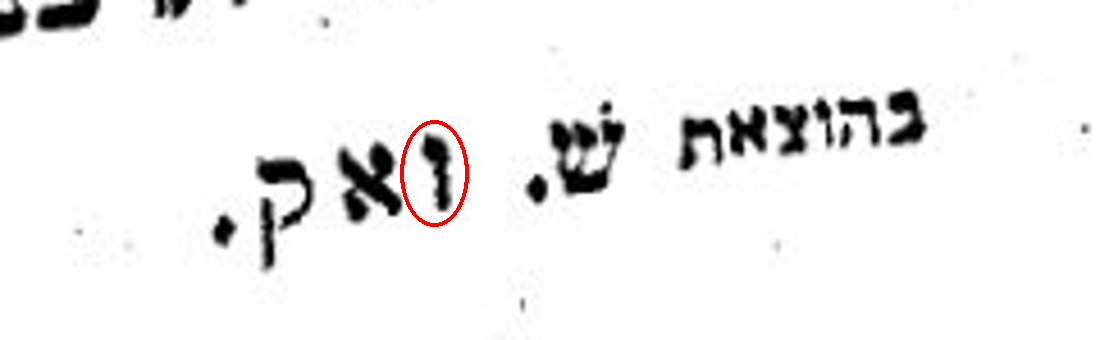
Publisher surname on the 1909 title page

Can you read the circled first letter in the publisher’s surname: ז or ו?

The line is read as either בהוצאת ש. זאק. or בהוצאת ש. ואק. The circled letter is unclear in the retained scan. A larger same-page letter comparison does not settle it. Resolving this spelling would not identify the publisher’s full name or prove that he was Moshe Shmuel’s brother-in-law. Those are separate questions.

Full publisher line, with only the uncertain first surname letter circled
Original 1909 title page, retained HebrewBooks/YIVO scan

1909 edition, HebrewBooks catalog and original scan

Save your answer